

If you’re new here, welcome.
Welcome back to GVP. Every week we meet one Indian founder, verify the traction, and write the story so you can make faster investment decisions. We added 32 new subscribers last week — now at 657 investors reading weekly. If someone forwarded this to you, subscribe here.
There’s some happy news:
Last week, we featured “Tight The Nut” - B2B quick commerce for workshops. They got an investor meeting from one of our investor subscribers.
Dear fellow investors,
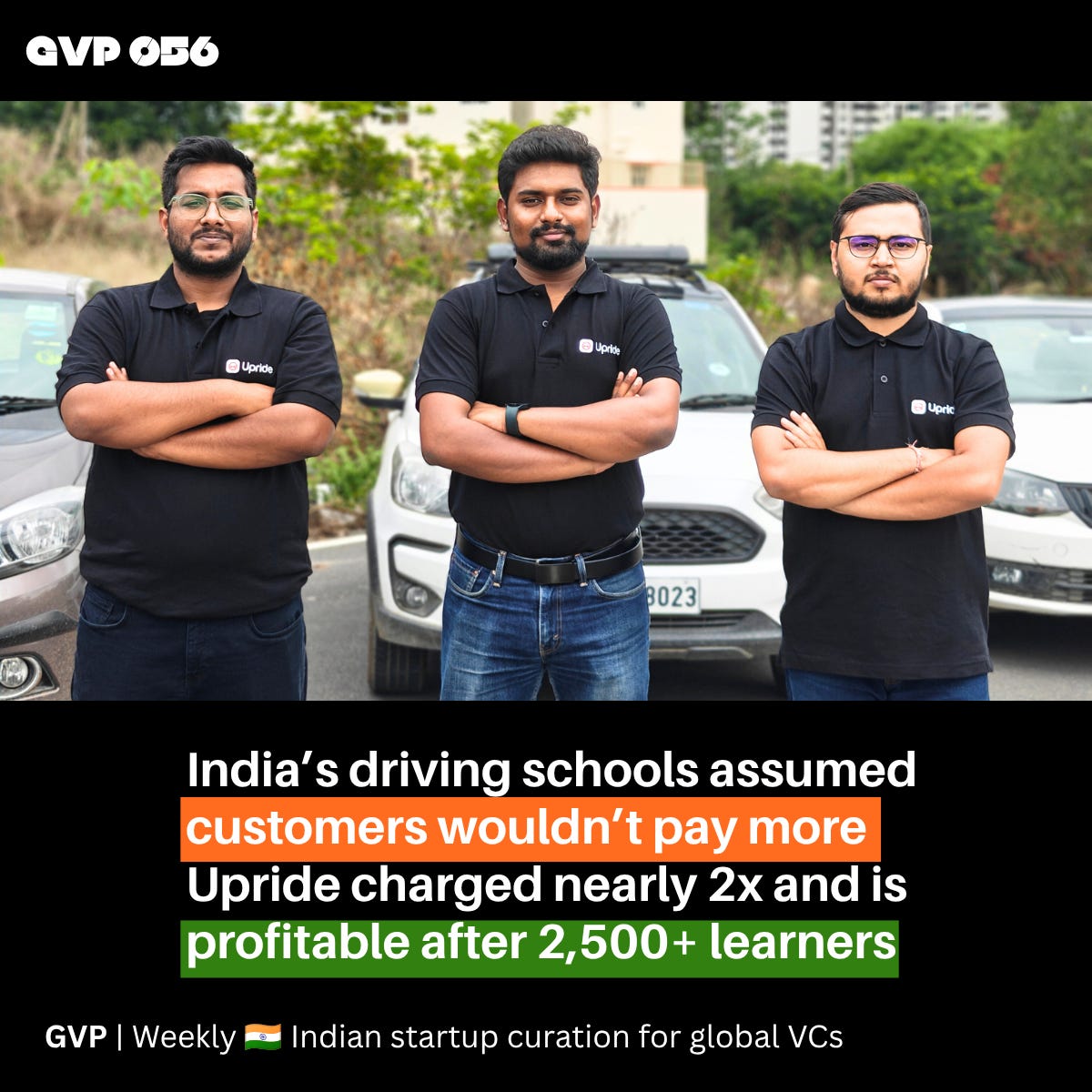
Before Utkarsh Verma built Upride, he was the customer it exists for.
At 21, studying computer science at RV College in Bangalore, he found a driving school on Google, called it several times, and got no answer.
The owners were too busy to pick up. He travelled three kilometres to a physical shop, sat with the owner, and asked which car he would train on, whether he would learn parking or highway driving, and what the schedule was.
The owner could not answer any of it. The only conversation available was price.
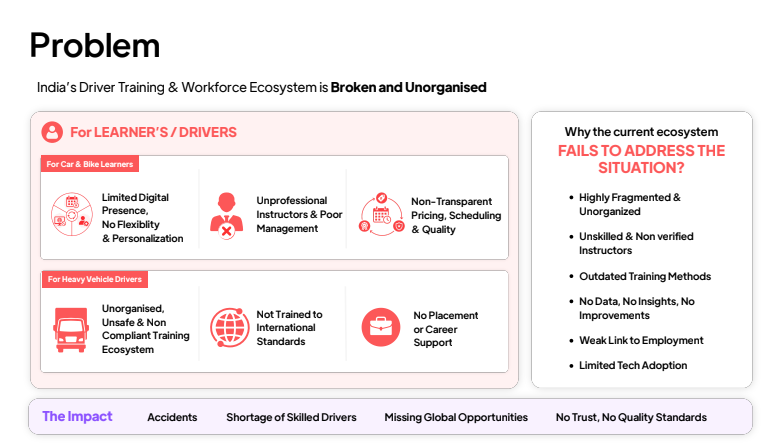
He was quoted $100 (₹8,800) for ten sessions. He paid $150. The extra $50 had a name. Gurudakshina, the offering a student traditionally gives a teacher after learning, collected here as a charge disclosed after the fact.
Ten sessions meant to run across two weeks stretched to two months. The license, normally a 45-day process, took six months. In the end, he could not drive a car.
India loses about 180,000 people a year to road accidents, and the transport ministry attributes a large share of them to untrained drivers.
The World Bank puts the country short of 2.2 million skilled drivers. The training layer that should fix this runs out of unmarked shops owned by men who left school around eighth standard.
Nobody had tested whether Indians would pay more
Every incumbent competes on price, because price is the only variable they can describe.
Utkarsh started Upride by becoming an instructor. He fitted a camera into his own car and drove out to teach whoever booked on the website. In month one, he taught 10 to 12 learners. In month two, he hired one instructor, and it went to 20.
The videos are still on the company’s Instagram if you scroll back far enough.
What he found in that passenger seat was the thesis. A customer paying around $200 converts in a 30-minute call, with no haggling, in a market where converting an Indian consumer at that price point usually takes weeks.
Anyone with a car can become a supplier
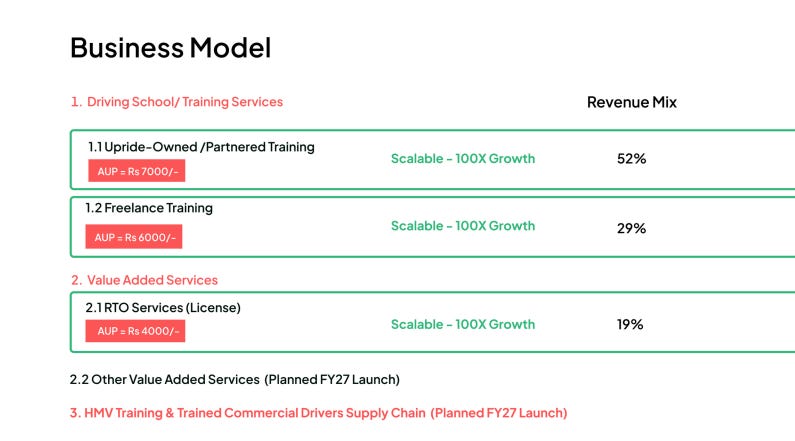
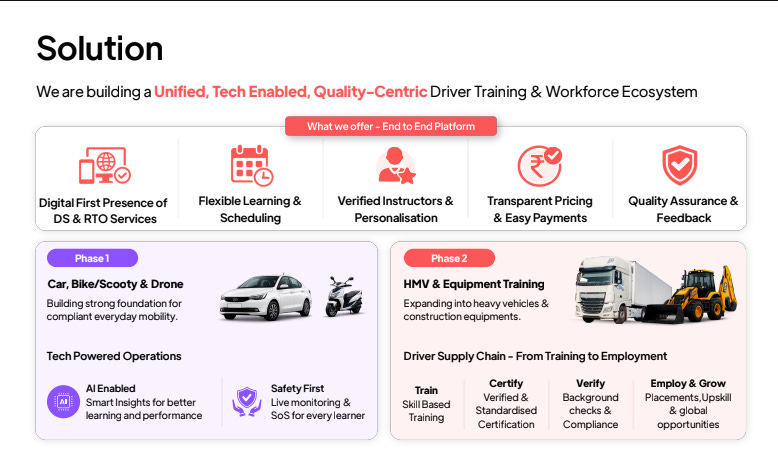
Upride sells through three lines. Training delivered by its own operations and partner driving schools, training delivered by certified freelance instructors, and RTO services covering the license itself.
The freelance line is the scaling mechanism. You own a car or a scooter, you get certified through Upride Partners, take bookings through the platform and start earning. Upride adds capacity without buying a vehicle.
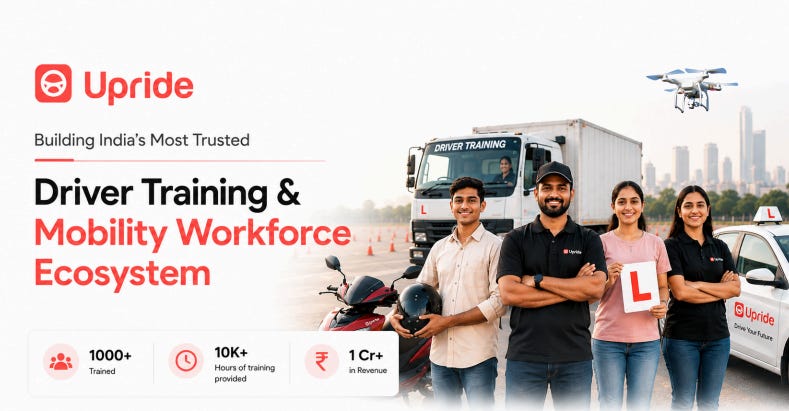
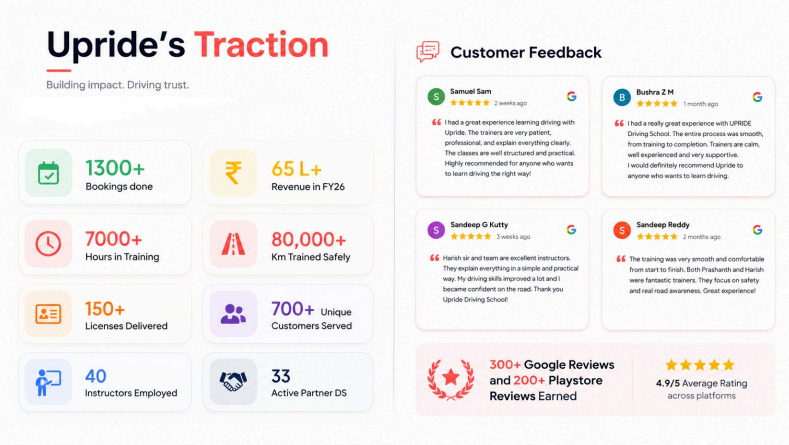
That is why the company owns no cars and no bikes after 18 months. It runs 80 instructors and 33 partner driving schools, trains around 270 people a month, and has delivered close to 750+ licenses.
Here is where an investor should slow down. Upride reports profitability every month, at an average ticket near $100, on a single angel round of $15,000. Utkarsh’s framing is that if no investor ever funds them, they survive, because nobody else is in the market and they can wait.
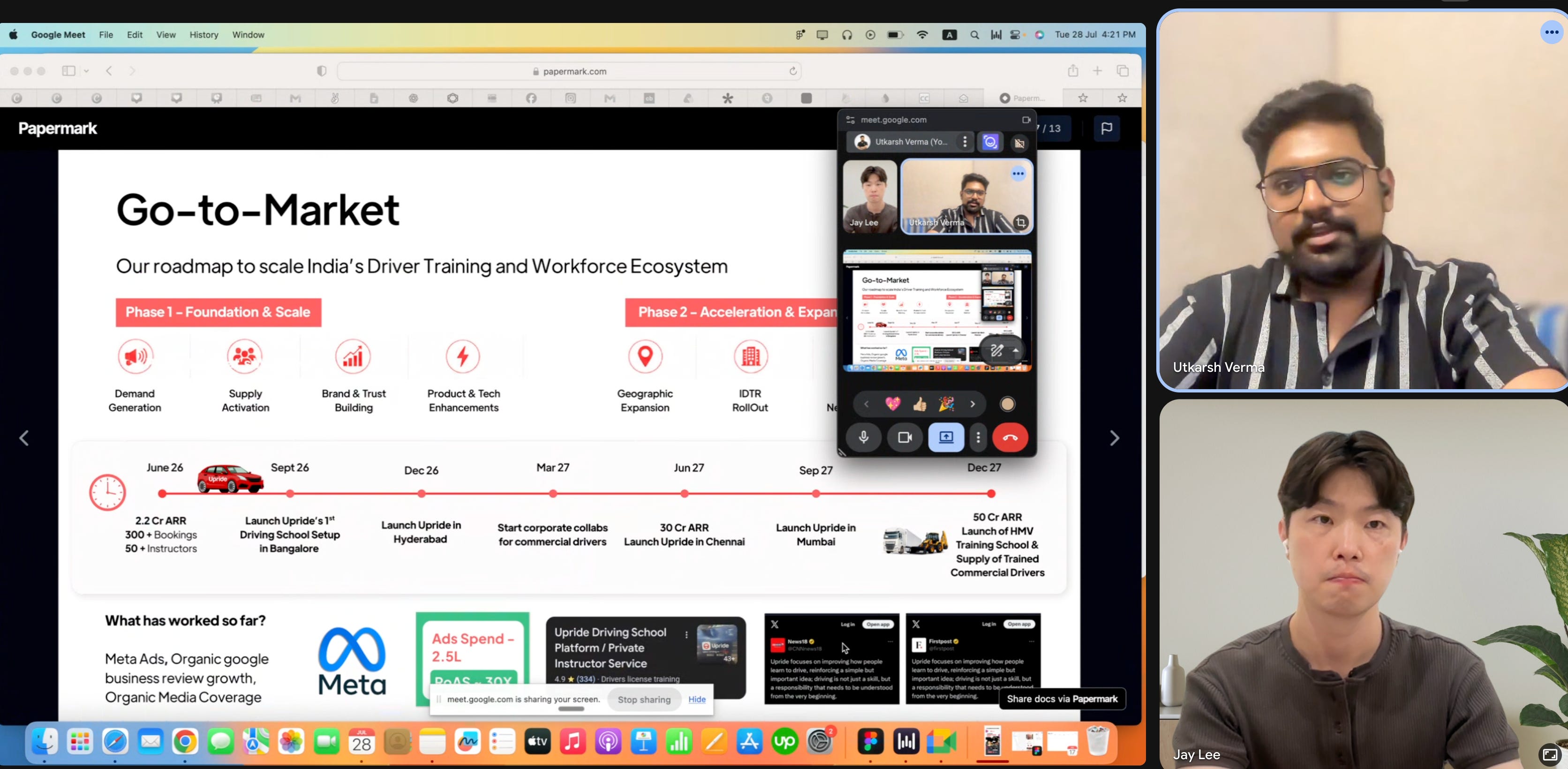
The company sits at roughly $250,000 (₹2.2 Cr) ARR and is raising $230,000 (₹2 Cr) to move across Bangalore and beyond.
A new rule is about to close the small operators
Accreditation norms from the transport ministry require a driving training centre to hold a test track of roughly two acres. In a major Indian city that land costs $560,000 to $1.1 million (₹5 to 10 crore).
Legacy operators cannot finance it, and some are attempting cooperative structures to survive the requirement.
The operators under that pressure are the ones Upride has spent 18 months onboarding.
Trucks are the reason he started with scooters
India trains heavy vehicle drivers through what Utkarsh calls the guru-chela system. An existing driver teaches four or five people in his family or friend circle. No syllabus, no standard, no certification, and no commercial layer of any kind.
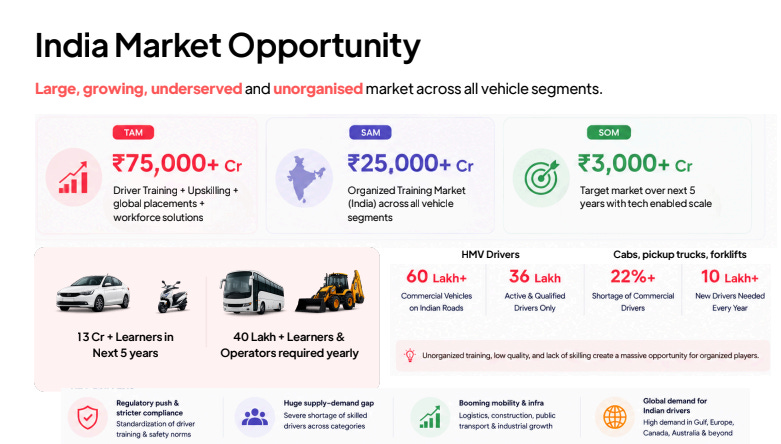
The result is 6 million trucks on Indian roads against 3.6 million active drivers. The truck-to-driver ratio has fallen from 75:100 to 55:100 in a few years, leaving a quarter of the fleet idle while quick commerce and warehousing keep adding demand for heavy vehicle and forklift operators.
The same shortage exists abroad. The IRU counts 2.9 million unfilled truck driver positions across 18 markets, with around 502,000 in Europe. Utkarsh named the Gulf, Canada, the US, Russia and Ukraine as sources of inbound demand for trained Indian drivers.
Upride’s asset-light model breaks at this point. Nobody teaches a truck on a freelancer’s own truck, and heavy vehicle training needs a track, equipment, and certification infrastructure.
The route through it is public money. The transport ministry has committed $506 million (₹4,500 crore) to set up 1,600 driver training institutes, and the scheme guidelines allow private partners to handle establishment, curriculum, and day-to-day management of an IDTR. Government carries the capital cost, and an operator like Upride runs it.
That is what sits at the end of the company’s roadmap in late 2027, alongside the supply of trained commercial drivers into logistics. Upride has not won an institute, signed a fleet operator, or placed a driver.
Meet the team
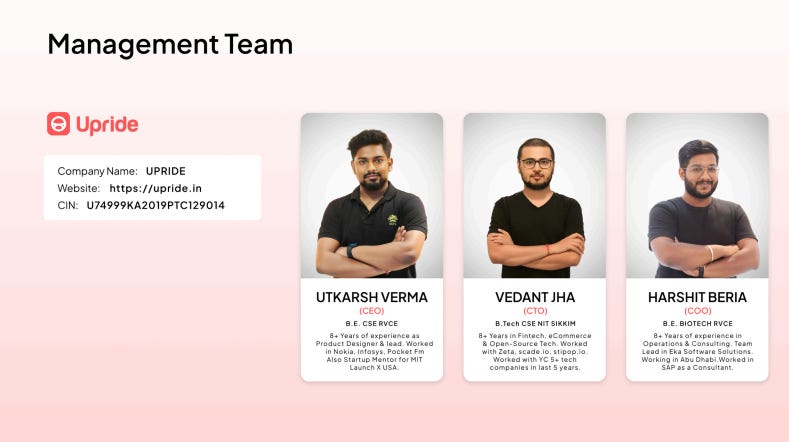
Utkarsh Verma, CEO. Computer science at RV College, Bangalore. Freelanced through Upwork after COVID and started building in 2023. Upride is his first company, and he had never held a job before it.
Vedant Jha, CTO. School friend of Utkarsh. Fintech and open-source background across Zeta, scade.io and stipop.io.
Harshit Beria, COO. College batchmate. Operations and consulting, previously at SAP and Eka Software Solutions.
Our take
Monthly profitability is the strongest signal in the business. An Indian consumer startup that makes money on every unit after a $15,000 angel round has solved something structural about the category. The next test is whether that holds under paid acquisition in a second city.
The supply relationships are harder to copy than the product. Any competent team builds a booking app. Onboarding 33 independent driving schools onto shared SOPs took 18 months of ground work, and the accreditation squeeze makes those relationships more valuable each quarter.
Nobody learns to drive twice, so every dollar of acquisition cost has to be recovered on one transaction. This is why the reported 30x return on Meta spend matters and also why it needs verification. It is the founder’s own attribution in a category with almost no competing advertisers.
Utkarsh argues the answer is adjacency: that learning to drive is the first paid moment in a person’s automotive life and the cheapest point to earn trust before the dash cam or the used car. Ornikar proved a version of this in France, moving from driving education into insurance and finding that 80% of early insurance buyers had never been students. They bought on brand alone. Ornikar has raised $175 million against that thesis. Upride has not started it.
The commercial driver business carries the valuation and has no revenue behind it. The right investor brings fleet operators, logistics platforms, and overseas recruitment channels rather than capital, because those relationships decide whether that line becomes a business or stays a slide.
Upride is attempting something harder than digitising driving schools.
It is trying to own the first paid moment in a person’s automotive life, then convert that operating knowledge into the training layer for a commercial driver market that has never had one.
If it can prove the second transaction exists, this stops being a driving school platform.
Want an intro to the founders? Just reply to this email.
P.S. One last thing…
GVP has 657 investor subscribers — including partners at Accel, principals at family offices in Singapore and Dubai, and angels across the US, Australia, and Europe.
If you forward this newsletter to 3 investors who subscribe, we’ll make a warm intro for you to any family office or VC in our network you’d like to meet.
See you next week
If you want me to make a warm intro with this startup founder, feel free to reply to this email!
Email: jaylee@globalventureplay.com