

Dear fellow investors,
In March 2023, Khan Academy launched Khanmigo — an AI tutor running on GPT-4, the best model available at the time. The Gates Foundation funded it. Reed Hastings, who built Netflix, sat on the board. 180 million learners were already on the platform.
If an AI tutor was ever going to work, it was this one.
Three years later, Khan Academy published the usage data.
15%. Only 15% of students with access used Khanmigo regularly. In April 2026, Sal Khan said that for most students it had been “a non-event”.
The model wasn’t wrong. Children simply didn’t open it.
Khanmigo sat in the corner of the screen and waited to be asked. In 2026, Khan Academy rebuilt it to appear on its own, without being invited, because students were not seeking out its help.
That fix tells you what the real problem is.
A child who doesn’t understand fractions does not ask for help. He goes quiet. He copies from the boy beside him. The students who need the most help are the least likely to ask for it. Every teacher knows this. Most software is built as if it weren’t true.
So the opening in AI education is not a smarter model; anyone can rent one. The opening is reaching the child who will never raise his hand.
India has 24.72 crore school students and 1.03 crore teachers. One teacher for every 24 children — and that is the flattering national average
India’s private tutoring market reached USD 4.4 billion in 2025, and it exists almost entirely because the school day cannot do what those numbers make impossible.
Sold her first edtech startup to Byju’s. What’s she’s building next?
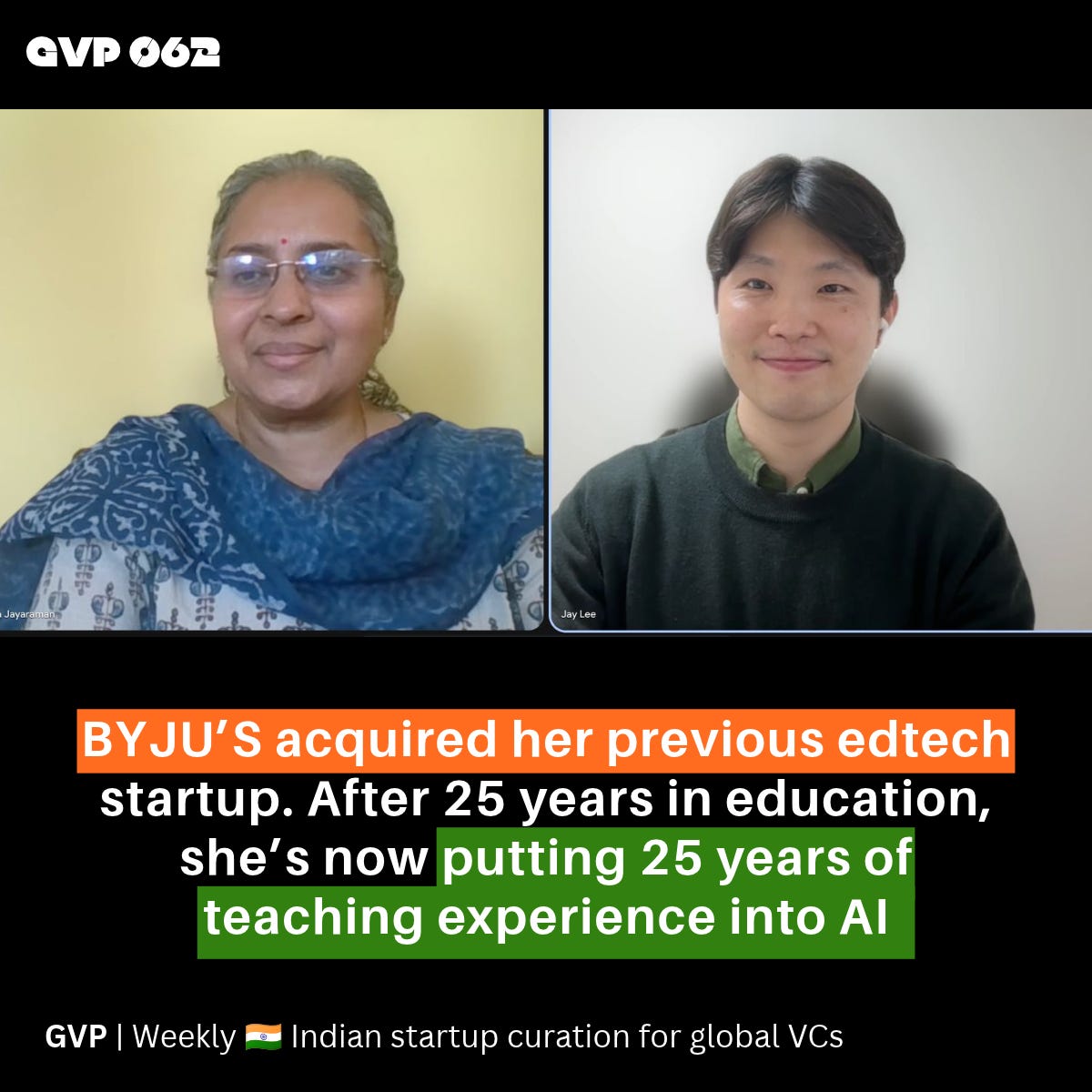
Vidya Jayaraman left her chemical engineering career in 1999 to teach Mathematics, Physics and Chemistry for grades 8 to 12 and for competitive exams.
In 2012 she founded Math Adventures. Byju’s acquired it in July 2018, and she stayed on four years as Vice President of Content Development.
In the recent years, she has observed that:
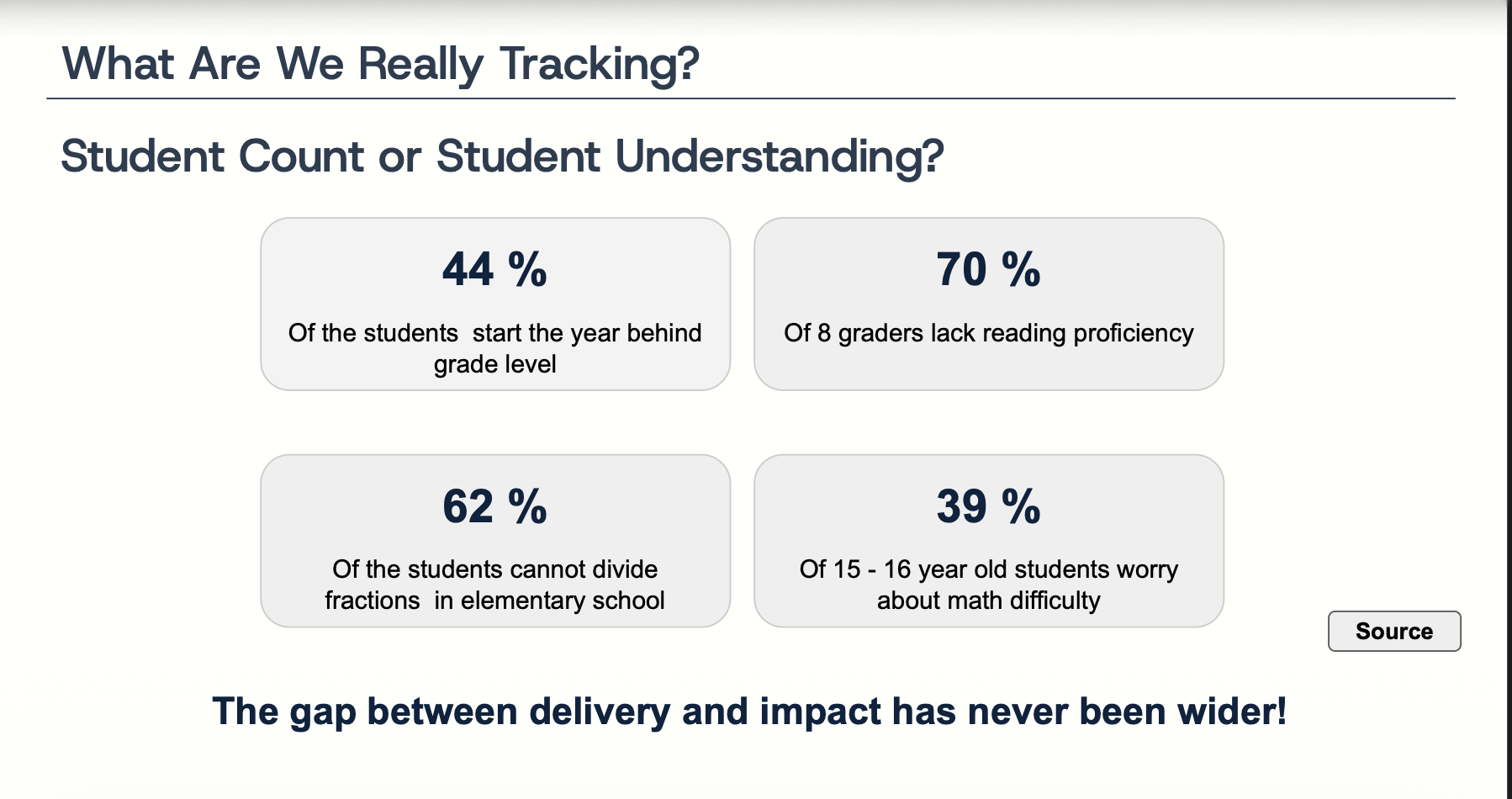
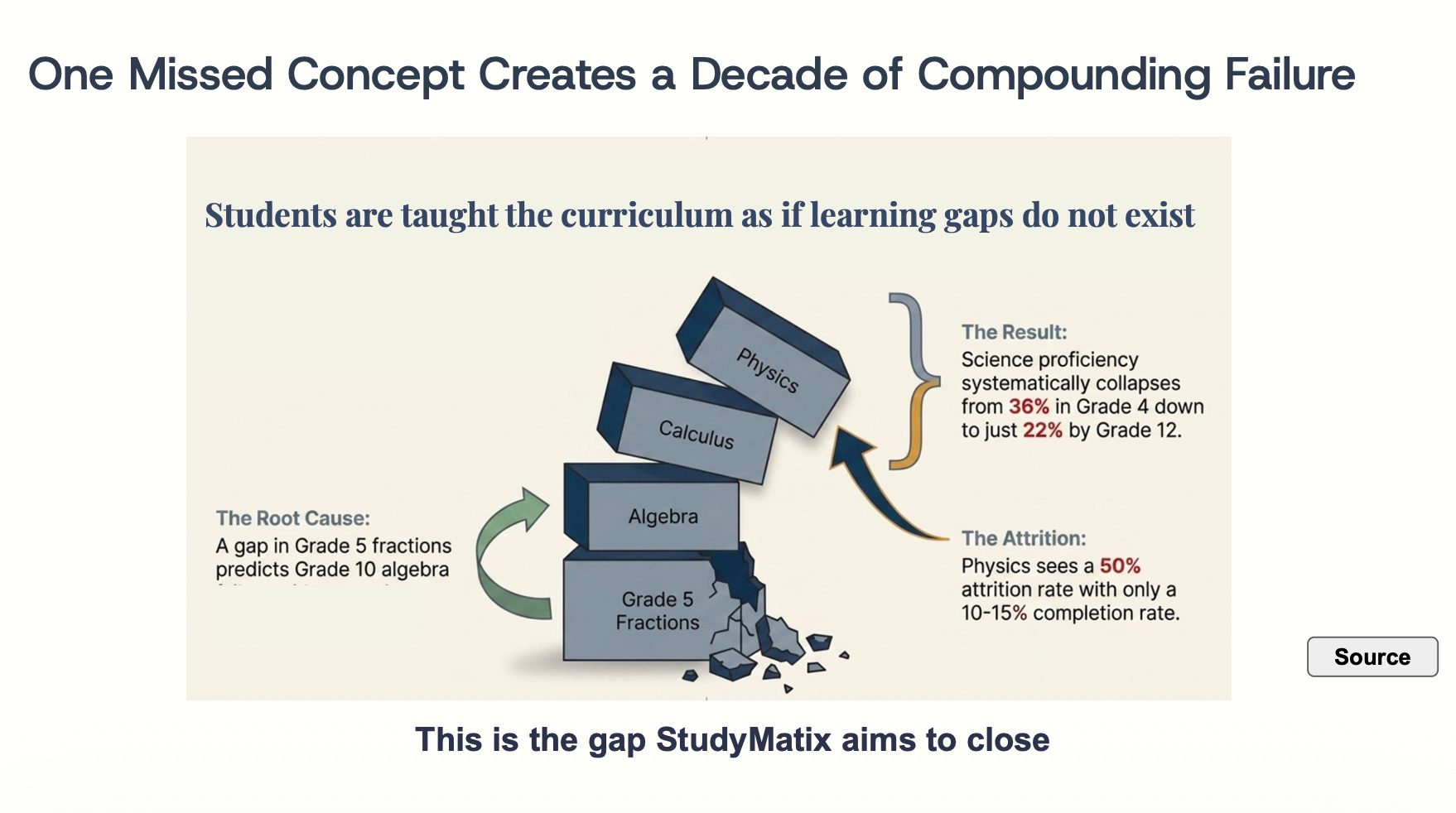
Schools track attendance and marks, but nobody tracks what a child has actually understood. So gaps accumulate in silence. A child who missed fractions in class 5 meets algebra in class 8 and is told he’s weak at maths. He isn’t. He has a three-year-old learning gap nobody went looking for.
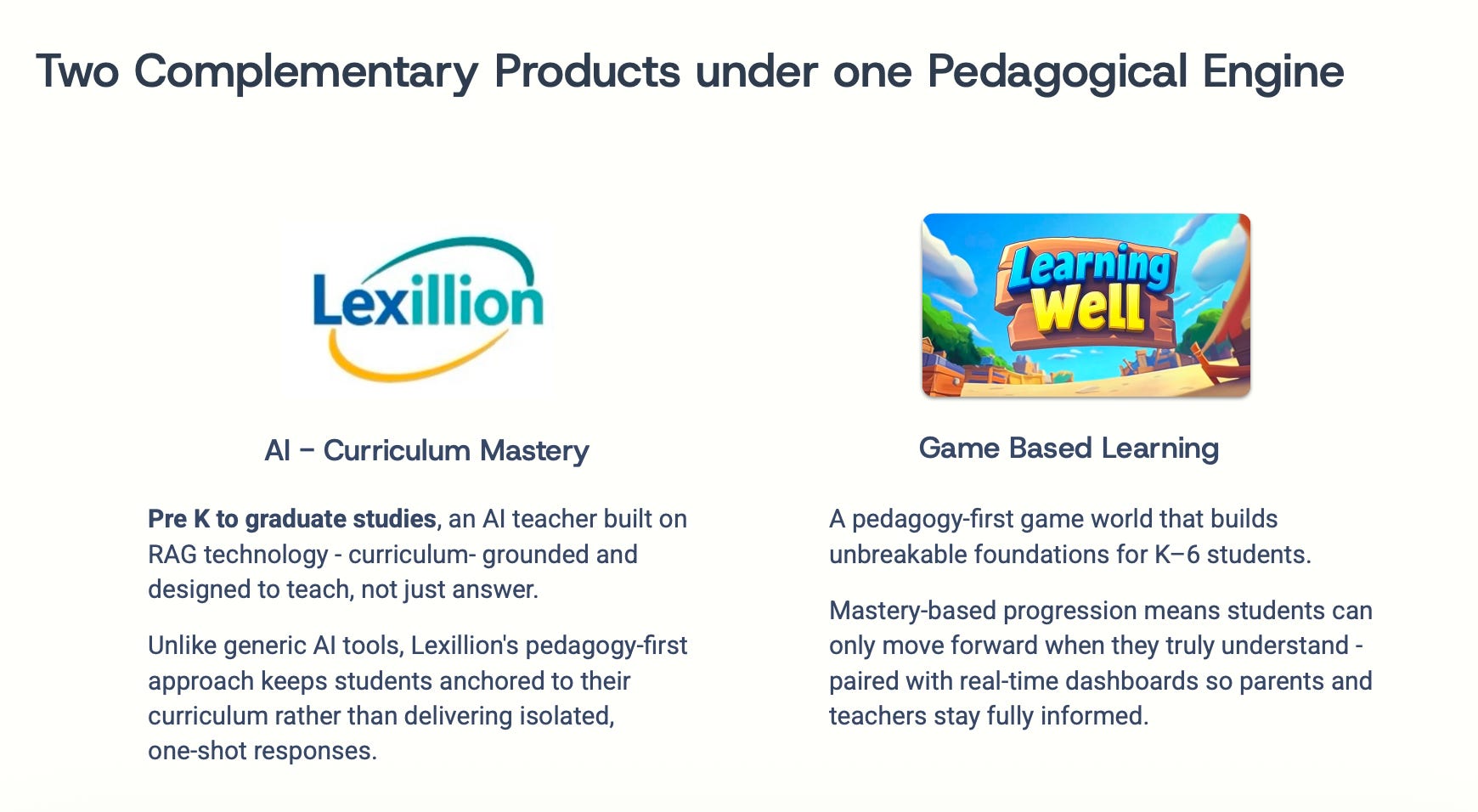
Her company today is StudyMatix.They’ve two complementary products to solve this issue:
Lexillion builds a profile of each student as they use it. It tracks their curriculum, language, learning preferences and pace, alongside previous interactions, strengths, topics they have mastered and recurring mistakes.
It also draws on what StudyMatix calls Global Intelligence. This looks across learning patterns on the platform to identify common difficulties and teaching approaches that help students progress.
The company says these two sources shape how Lexillion teaches: how much detail to give, which questions and examples to use, when to slow down, and which language to explain in. The responses adapt while following consistent teaching principles.
That is the potential moat StudyMatix is building: a richer understanding of each learner, combined with teaching insights drawn from the wider platform. It bets that these accumulated histories and insights make personalisation more useful as the platform is used.
Meet the team:
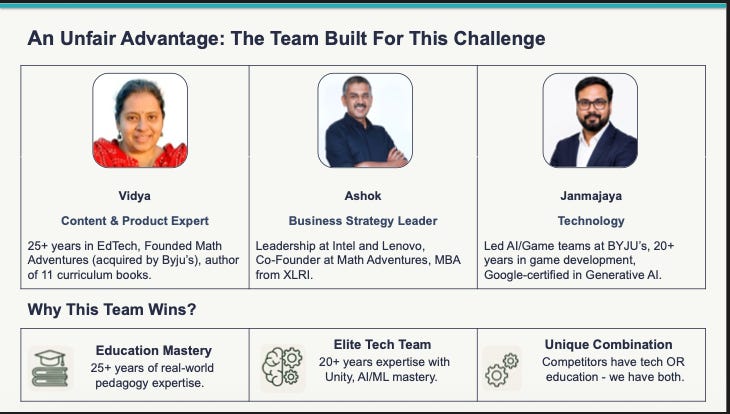
Vidya Jayaraman — product and pedagogy. NIT-Karnataka engineer, 27 years in education, author of 11 curriculum books. She has written for CBSE, ICSE, IB, IGCSE and state boards — which is why Lexillion isn’t built around any single syllabus.
Ashok Nair — Advisor for business and distribution. NIT-Karnataka and XLRI, close to 30 years at Intel and Lenovo India in sales, marketing and operations. He has spent a career moving hardware through Indian channel partners—the same experience Vidya’s HP and publisher deals rely on. He was also part of Math Adventures.
Janmajaya Mohanty — technology. Twenty years in game development. Led AI and game teams at BYJU’S, building products that use computer vision.
Lexillion and Learning Well! were built by the same team of eight people, all of whom have been with Vidya since day one.
Vidya worked with the mathematics teachers at PM Shree KPS Govt Higher Primary School, Ramagondanahalli, to deliver game-based learning in maths.
Their Current Traction:
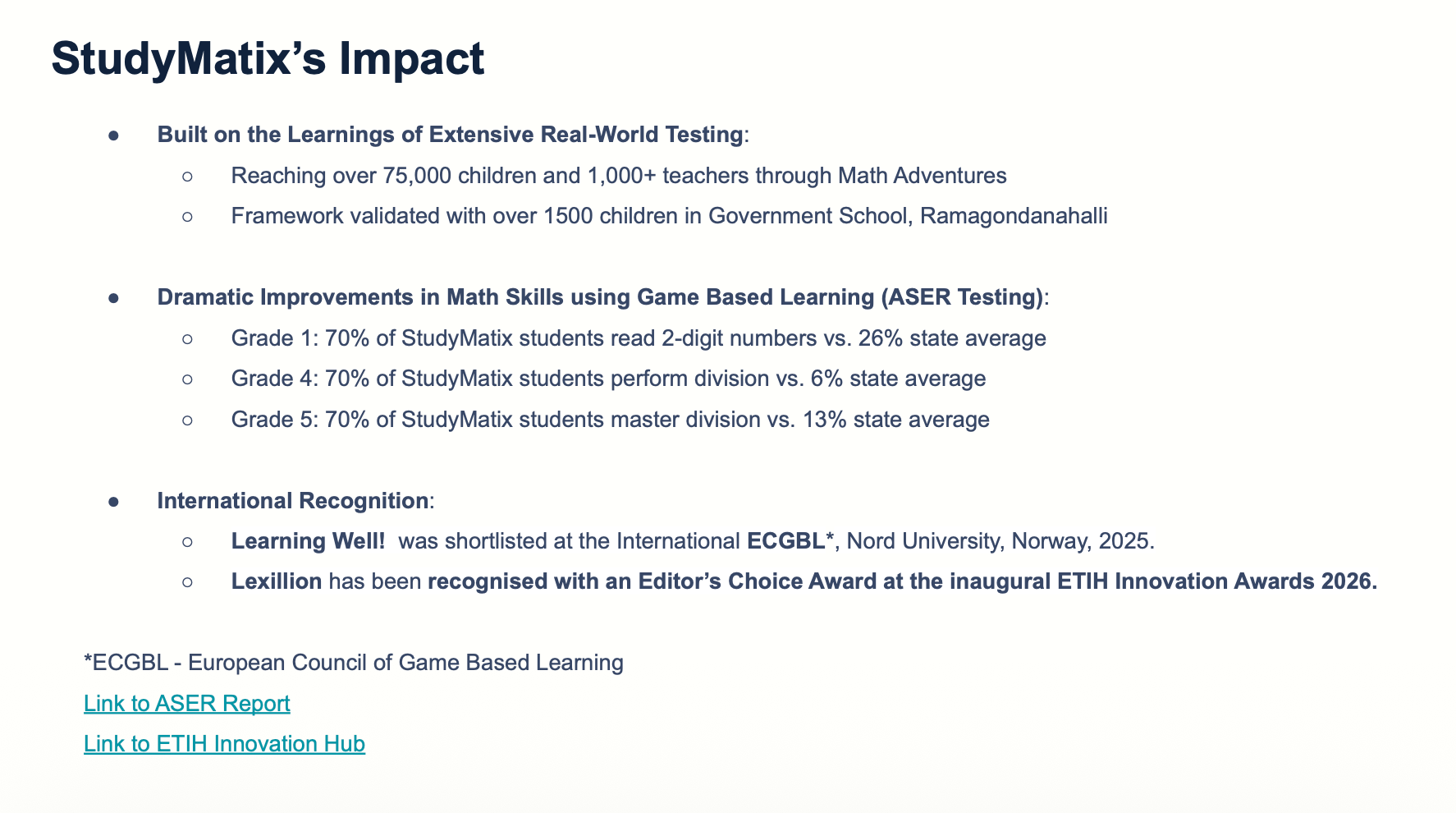
The strongest evidence doesn’t come from the company. It comes from ASER, the third-party assessment the school commissioned.
In Grade 4 at PM Shree KPS Govt Higher Primary School, Ramagondanahalli, 70% of her students could do division. The state average is 6%.
In Grade 5, 70% had mastered it, against a state average of 13%.
Then the slower proof.
In 2024, the school sent its first batch of 19 students to the Class 10 board exam, and all 19 passed. The top scorer got 95-96% in mathematics.
8 went on to private schools to study mathematics, physics and chemistry in classes 11 and 12, continuing with Vidya’s guidance and helping validate Lexillion’s efficacy as it was being built.
Four of those girls are now at Christ College, reading computer science, mathematics and data science. One boy is at Azim Premji University on a full ₹5 lakh annual scholarship. All of them came from families that could not have paid for any of it.
Commercially, it is early but real. Orient BlackSwan, the textbook publisher, holds four enterprise licences and has paid roughly $11,300 to date.
What comes next?
The next twelve months are about distribution, and almost none of it requires StudyMatix to buy a user.
Orange Publications has printed QR codes into 2 lakh textbooks for this academic year. The child scans the book he already owns.
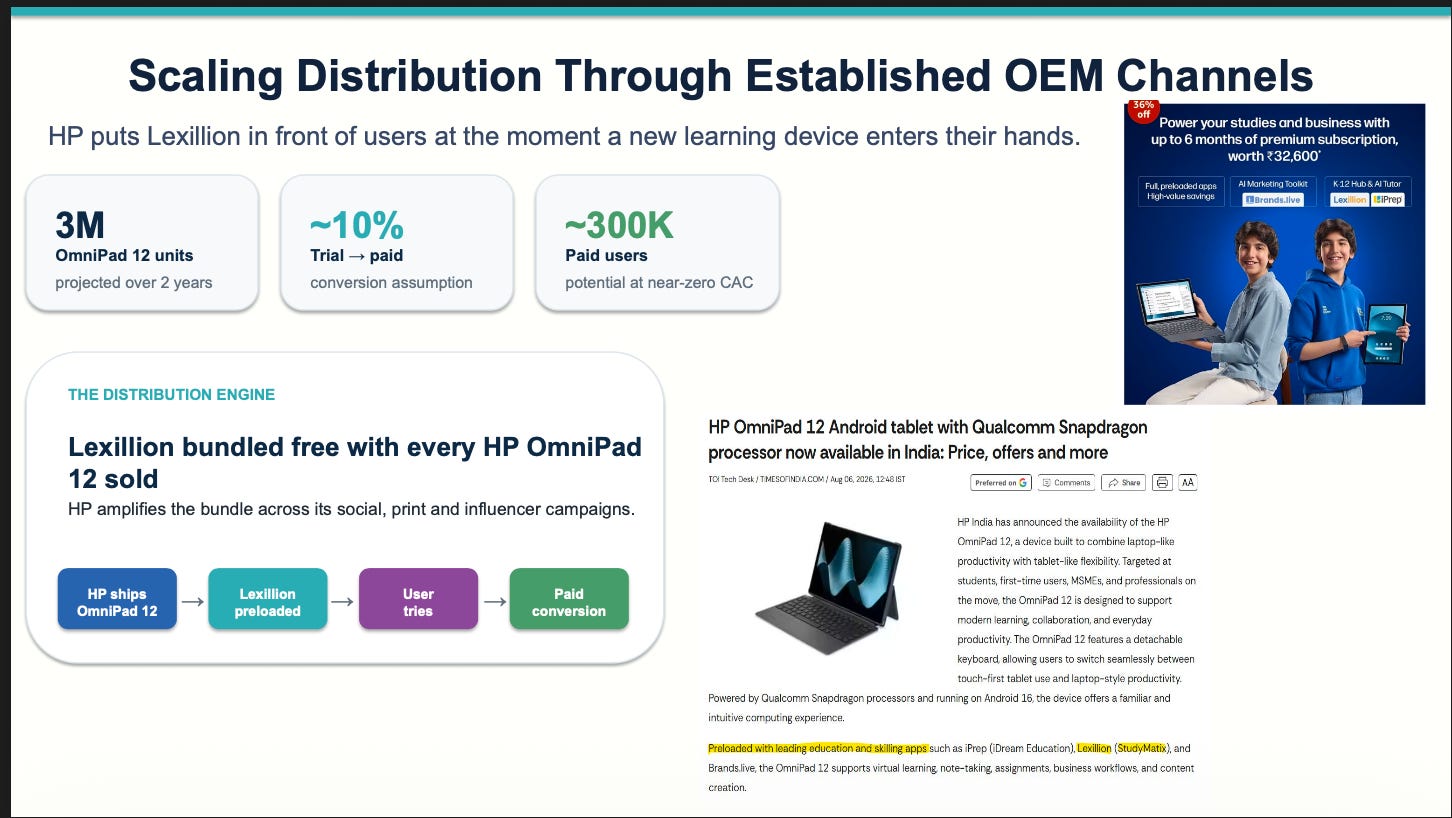
In August 2026, HP launched the OmniPad 12 in India with Lexillion preloaded. HP pays for the free starter credits. Talks are underway to move Lexillion from a preloaded app into HP’s own sales catalogue, where HP’s field teams demo it — 11 venues today, 18 planned by March 2027.
The UAE is the first market outside India, entered through a single master distributor rather than an office.
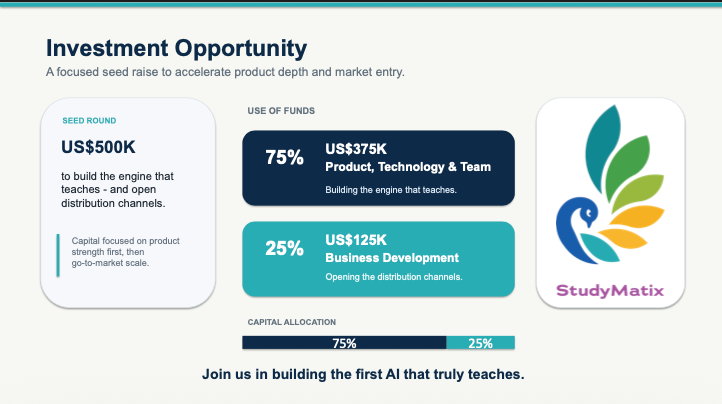
She is raising US$500,000. Three-quarters goes to product, technology and team. The rest opens the channels.
GVP Take
We featured StudyMatix because the evidence runs the right way round.
Most AI education pitches start with a model and go looking for a classroom. This one started in a classroom — one government school, eight years, unpaid — and went looking for a model. The ASER results are the only third-party learning outcomes we have seen in an AI tutoring deck this year.
What we cannot yet tell you is whether it holds at scale. A thousand users is not three hundred thousand, and the HP channel is a projection, not a result.
So this is early.
It is also a $500,000 round, which is a small cheque for a founder who has already built an edtech product, sold it to Byju’s, and then spent four years inside the largest failure this sector has produced. She is not guessing about what breaks.
If you have been waiting for an AI tutor built by someone who has actually taught, this is the one worth a call.
Vidya is open to introductions. Reply to this email, and we’ll set it up.
Want an intro to the founders? Just reply to this email.
P.S. One last thing…
GVP has 719 investor subscribers — including partners at Accel, principals at family offices in Singapore and Dubai, and angels across the US, Australia, and Europe.
If you forward this newsletter to 3 investors who subscribe, we’ll make a warm intro for you to any family office or VC in our network you’d like to meet.
If you want me to make a warm intro with this startup founder, feel free to reply to this email!
Email: jaylee@globalventureplay.com
See you next week