

If you’re new here, Welcome.
Welcome back to GVP. Every week we meet one Indian founder, verify the traction, and write the story so you can make faster investment decisions. We added 32 new subscribers last week — now at 650 investors reading weekly. If someone forwarded this to you, subscribe here.
The most valuable voice-AI company in India may not build an AI model
My dear fellow investors,
When most investors hear “voice AI,” they think about the model.
How natural does it sound?
How many languages can it speak?
How accurately can it understand a customer?
Those are important questions. But they may not be the most important ones.
For banks, hospitals and government agencies in India, the first question is often much simpler:
Where does the customer’s voice go?
If the answer is “to somebody else’s server”, the conversation may end there.
That is the problem Orvnix, a four-person company in Kolkata, is trying to solve.
It is not building another foundation model.
It is building the infrastructure that turns existing speech and language models into phone agents that can operate inside the customer’s own environment.
That sounds like a technical distinction.It may become a valuable one.

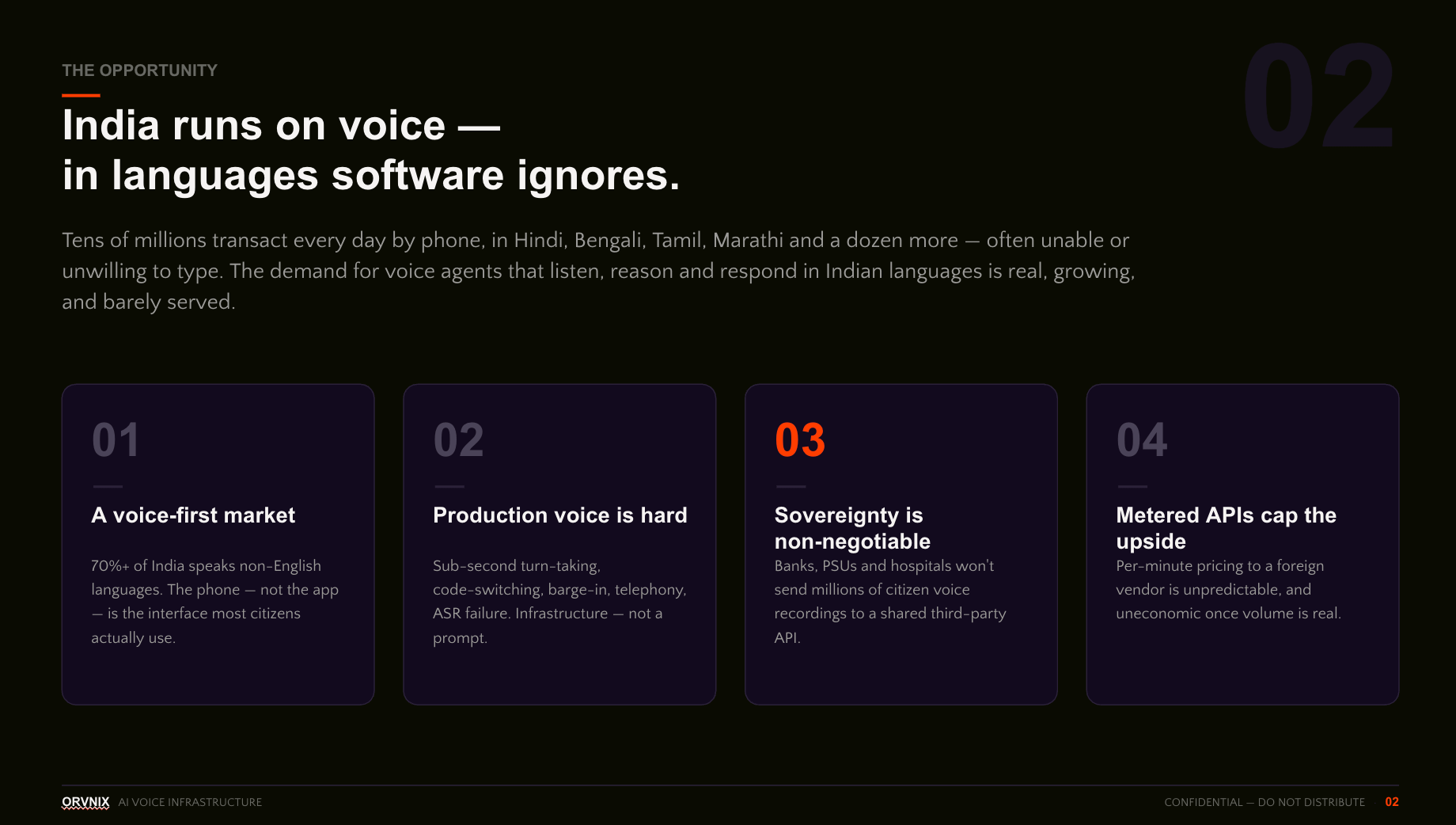
India has built digital systems millions of Indians still struggle to use
India is rightly celebrated for its digital infrastructure.
UPI changed how the country pays. Aadhaar gave more than a billion people a digital identity. Cheap mobile data brought hundreds of millions of people online.
But access and ability are not the same thing.
A large part of the country still struggles to navigate digital products independently—especially when those products require reading, typing or operating in English.
So they do what people have always done.
When people cannot complete something online, they usually do not stop needing the service.
They call the bank. They call the hospital. They call customer support and explain the problem in the language they are most comfortable using.
That is why multilingual voice AI matters in India.
But these are not ordinary conversations. They can include bank details, medical information, identity records and payment data.
And most voice-AI products process that information on infrastructure the customer does not control.
Most voice AI runs on rented technology
Most voice-AI startups pay outside providers every time a call is processed.
That helps them launch quickly. But costs rise with usage, and customer data may pass through systems they do not control.
This is an excellent model for getting a product to market quickly.
It is less attractive when the customer is a bank, hospital or public institution handling millions of sensitive conversations.
The institution loses control of where the audio travels. The startup loses control of its cost. And both remain dependent on companies that can change their pricing, policies or availability.
Orvnix is taking the opposite route.
It can install the system inside the bank’s own infrastructure.
Think of it as the difference between paying for a taxi every day and owning the car: more expensive upfront, but cheaper and easier to control once usage becomes large.
The audio stays inside the customer’s environment. The prompts, workflows and escalation rules remain under the customer’s control.
This matters for banks, hospitals and government agencies handling sensitive conversations.
The unglamorous work may be the moat
A voice agent has to handle interruptions, silence, weak phone lines, language switching and transfers to human agents.
Orvnix says it has already built much of this layer. During our call, Kuntal Roy demonstrated the platform in Bengali, although one part of the demo failed.
The company has also tested a metro-rail agent across 18 failure conditions.
The product is still pre-production.
The team
Orvnix is a four-person company led by founder, a software engineer with prior product-company experience and an AI background going back to college.
A co-founder, part of the leadership team, while another team member leads technology. The company is now looking to add marketing talent.
Traction and economics
Orvnix is still pre-revenue and has no signed pilots.
But the product has been built and tested. The team has created a metro-rail calling agent, connected the system to customer databases, and tested how it responds when real calls do not go as planned.
The economics are straightforward.
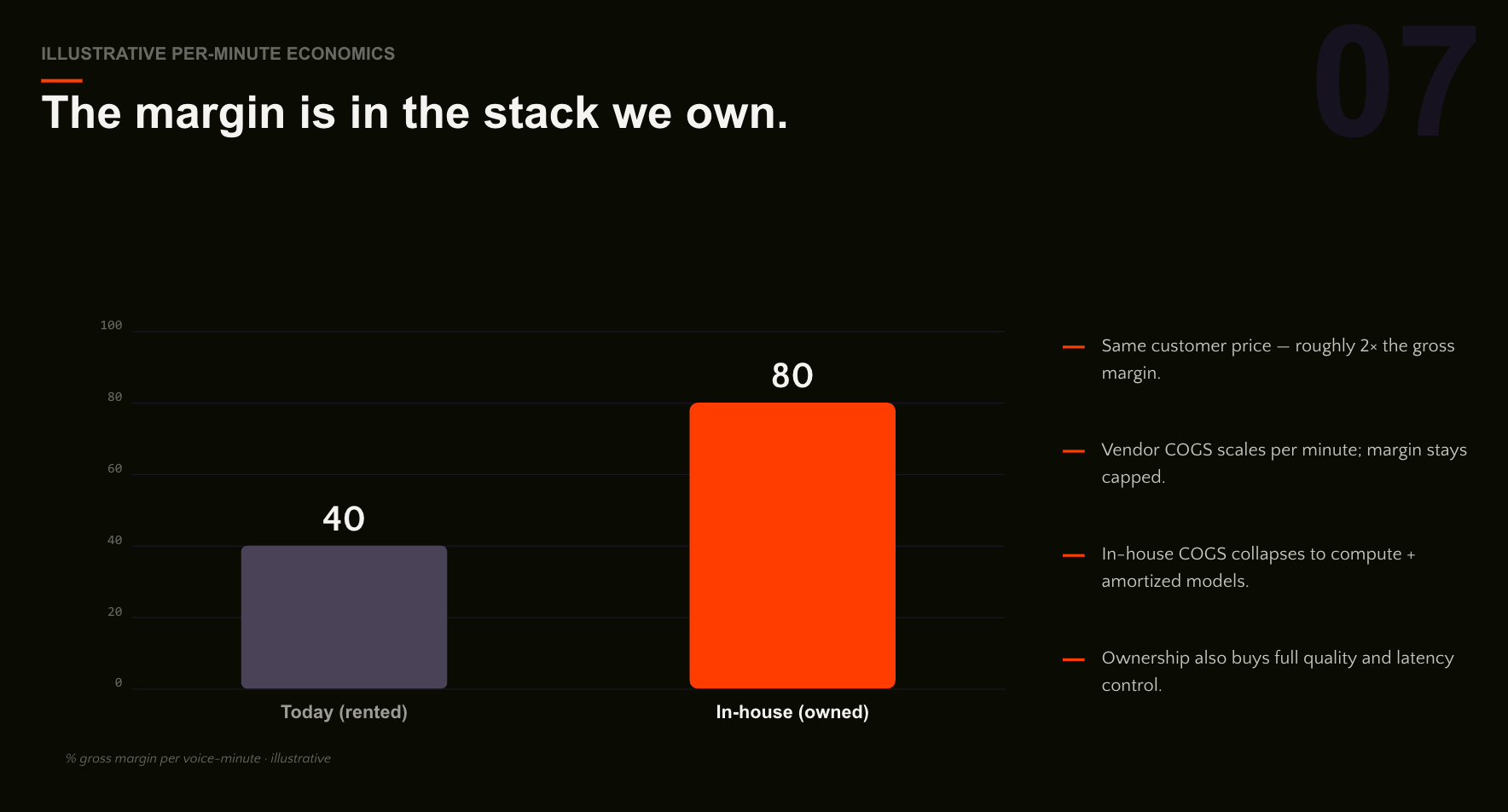
Orvnix plans to charge around ₹4 per minute.
Using outside AI providers, it expects gross margins of about 40%. If it runs more of the system on owned infrastructure, it estimates the cost could fall to roughly ₹0.90 per minute, taking margins closer to 80%.
The catch is volume.
Owned infrastructure is expensive at the beginning. It only becomes cheaper once enough calls are running through the system.
So the margins look attractive, but they are still projections. The commercial proof is not there yet.
GVP Take
The market is starting to move.
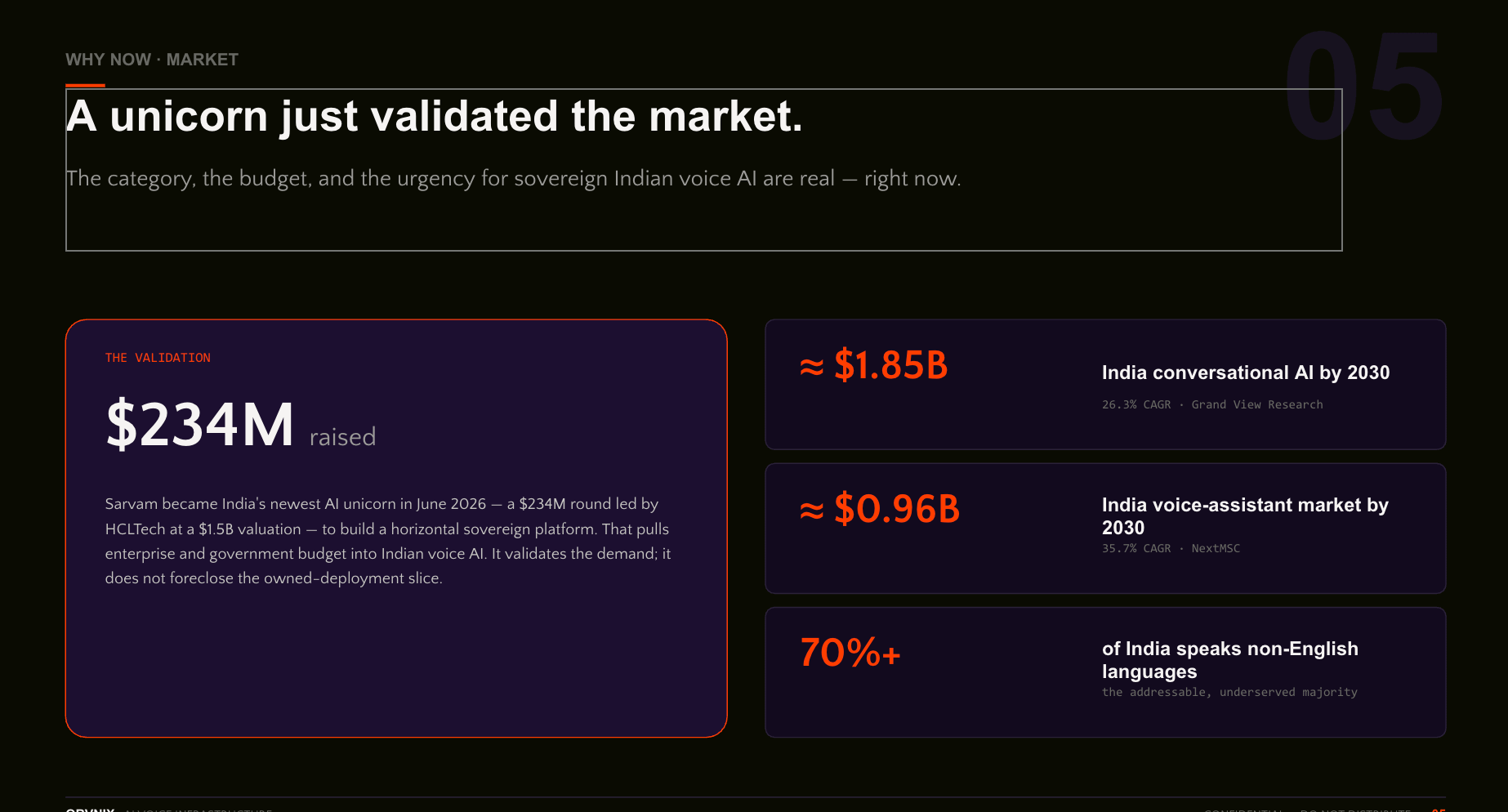
In June 2026, Sarvam raised $234 million at a $1.5 billion valuation to build sovereign AI for Indian enterprises and government. HCLTech alone invested $150 million. Sarvam is also targeting banking, insurance and government use cases—the same buyers Orvnix wants to serve.
That matters because it shows two things:
First, investors are willing to put serious capital behind AI systems built for Indian languages and sensitive data.
Second, banks and public institutions are becoming real buyers, not just a future market. IBM has also partnered with Sarvam to build sovereign AI for government and regulated sectors.
Orvnix is making a much narrower bet.
It is not trying to build India’s largest AI model. It is building the system that lets banks, hospitals and public institutions run multilingual voice agents inside infrastructure they control.
That is interesting because the demand is being validated by much larger players.
Watch this one.
Want an intro to the founders? Just reply to this email.
P.S. One last thing…
GVP has 650 investor subscribers — including partners at Accel, principals at family offices in Singapore and Dubai, and angels across the US, Australia, and Europe.
If you forward this newsletter to 3 investors who subscribe, we’ll make a warm intro for you to any family office or VC in our network you’d like to meet.
See you next week
If you want me to make a warm intro with this startup founder, feel free to reply to this email!
Email: jaylee@globalventureplay.com