

Hi there,
This week we’re covering the following:
Why it takes 14 years and $3 billion to discover a single drug (and why 95% of them still fail)
How an AI platform compresses months of pre-clinical research into a single afternoon
What drug repurposing is, and why the cure for rare diseases might already sit in your pharmacy
How 4 founders with zero pharma connections landed their first pilot in Bangalore
The rare disease data strategy that billion-dollar competitors can’t replicate
What to watch for when evaluating early-stage AI pharma startups
If you're new here, Welcome.
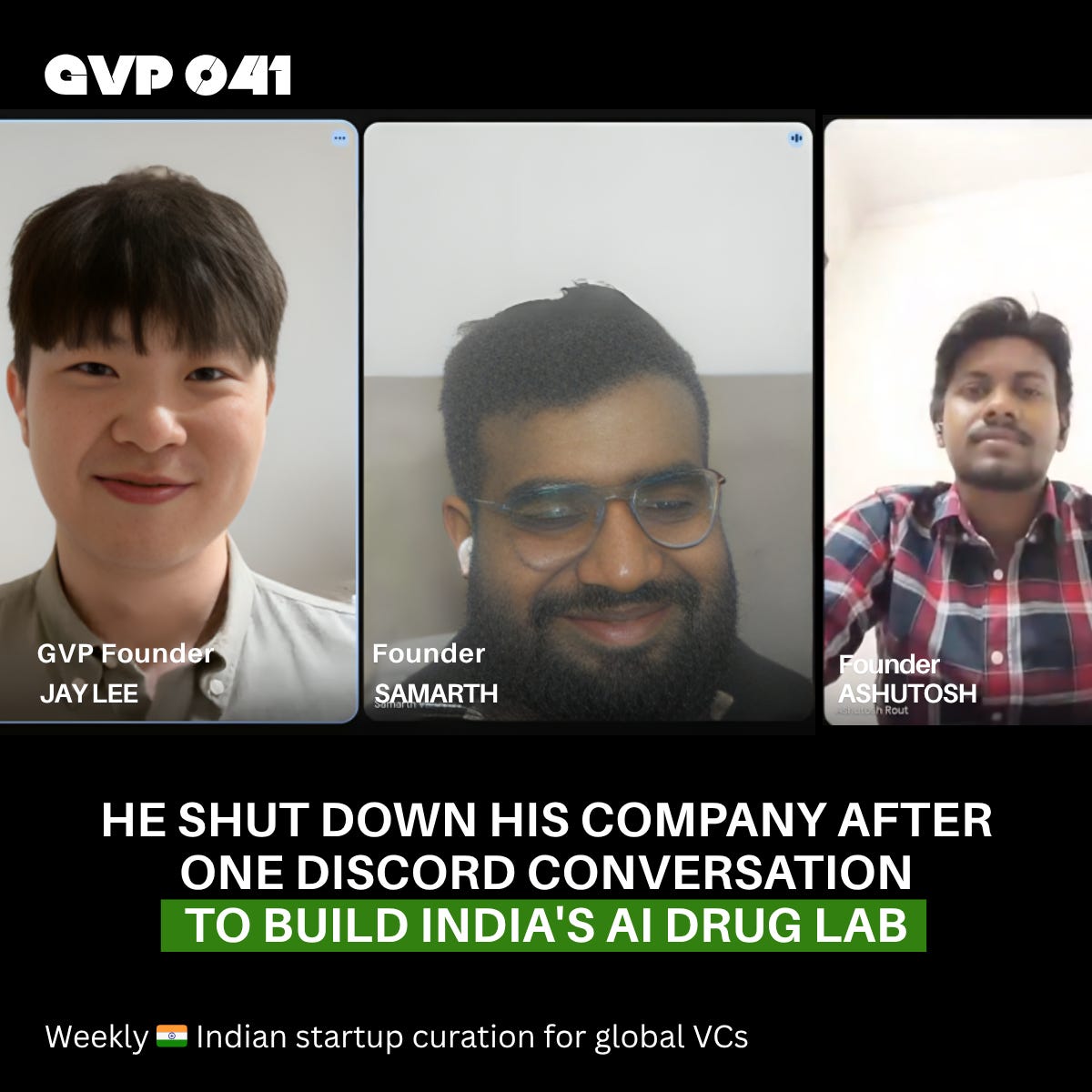
Every week we feature one vetted Indian startup for global investors.
We meet the founders, verify the traction, and write the story so you can make faster investment decisions. 35% of the startups we’ve featured have gone on to get investor meetings.
While the world watches the US, Asia’s best startups are building with real traction at a fraction of the valuation. That’s where we look.
If you find this valuable, subscribing and sharing this with your investor network is the best thing you can do to support us. It helps us keep finding the best founders and deals for you.
Trusted by Accel, Ice.VC and other 500+ global investors
“Someone you love will get sick, and the medicine won’t exist yet.” What will you do then?
Hey there!
Since 1985, the world has faced seven major pandemics. Swine flu. Influenza. COVID-19. Each time, the same question echoed across hospitals, governments, and living rooms: when will the medicine come?
The answer has always been the same.
Years. Sometimes a decade.
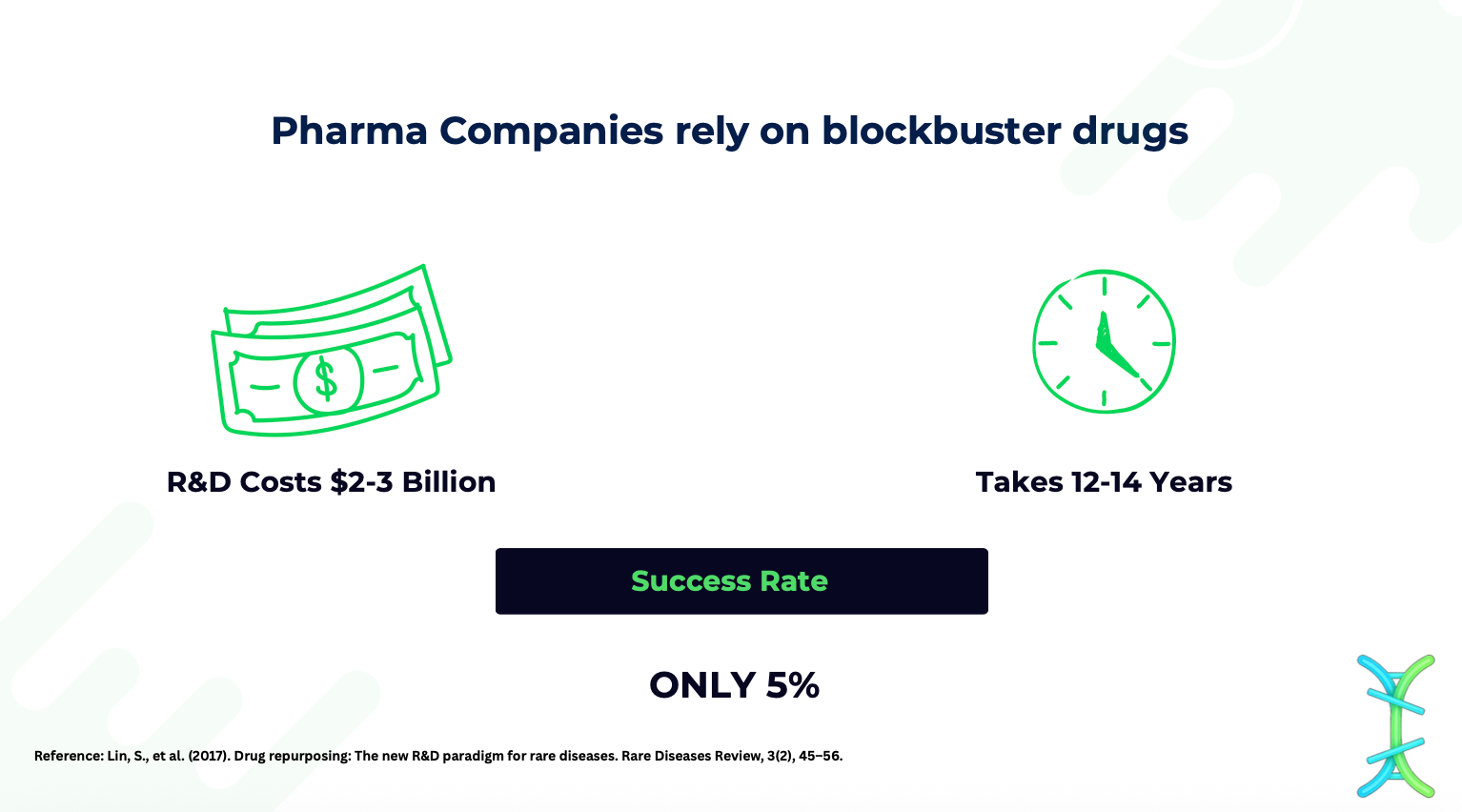
The traditional drug discovery takes 12 to 14 years and costs $2 to $3 billion.
After all that time and money, only 5 out of every 100 drug candidates reach patients. The other 95 fail somewhere in the pipeline.
Four young founders from India believe that timeline is unacceptable.
So they quit their jobs, shut down their companies, and bootstrapped an AI platform that could compress years of pharmaceutical research into 3-5 years.
Their startup is PathoscribeAI.
The $3 billion coin flip that kills 95% of new medicines
To understand why these four founders quit everything, you need to understand how broken drug discovery really is.
Imagine spending $3 billion and 14 years searching for a single key that opens a single lock.
But there are billions of possible keys scattered across the planet. You have to test each one for safety, effectiveness, and side effects. And after all that work, there’s a 95% chance your key doesn’t fit.
That’s pharmaceutical R&D.
But here’s what worsens it. Thousands of drugs already exist in pharmacies. They’ve been approved. We know they’re safe. Some of those existing drugs could treat diseases they were never designed for.
During COVID, researchers scrambled to test whether existing medications could fight the virus. Some worked. But they found them slowly, almost by accident, because no system existed to check all possibilities at once.
This process of finding new uses for existing drugs is called Drug repurposing.
It’s faster and cheaper than building new drugs from scratch. But very few people are doing it systematically at scale.
Samarth put it bluntly during our interview:
“In India, the big pharma companies don’t discover drugs themselves. They just buy the patent and sell. That’s the easy money thing going on.”
The actual research gets delegated to mid-sized companies that most investors have never heard of. Those companies are the ones struggling inside the broken system.
PathoscribeAI compresses months of research into one afternoon.
Here’s how the platform works in plain terms.
A researcher types in a disease name and its symptoms.
Behind the screen, a team of AI agents kicks into action.
One agent pulls molecular data. Another runs toxicity simulations. Another scans patent databases. Another cross-references published research to ground every finding in real science.
Within two to three hours, the platform produces a complete report. Candidate molecules, binding scores, toxicity predictions, tablet formulation details, and IP landscape analysis.
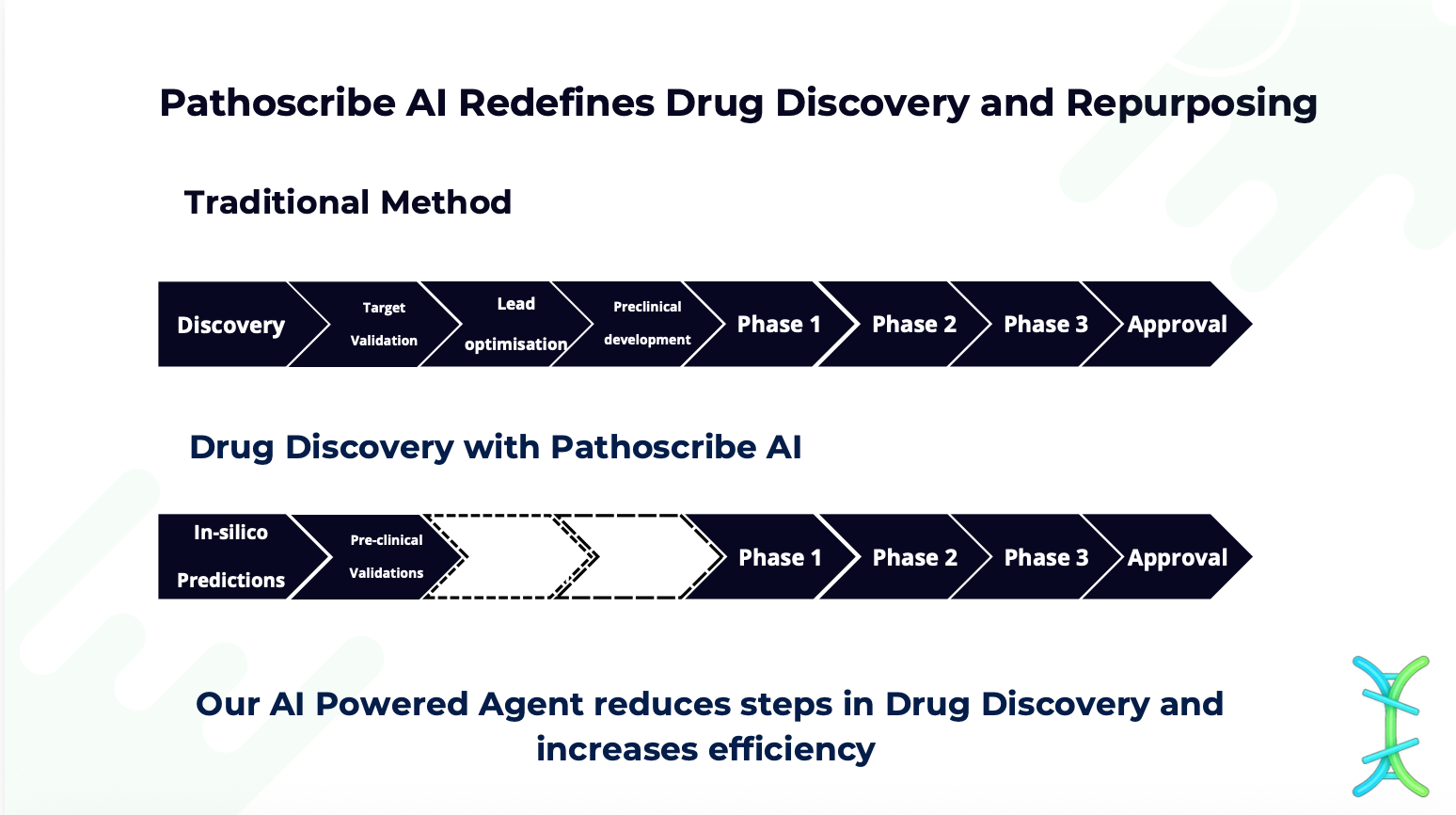
To be clear: this does not replace clinical trials. Drugs still need to pass through Phase 1, 2, and 3 testing with real patients. What PathoscribeAI does is cut the R&D phase that comes before trials.
Ashutosh explained it simply during our meeting: “We basically cut up that R&D part. We give pharma companies the research and documents so they can skip straight to Phase 1.”
His estimate: the full drug development timeline could shrink from 10-15 years to 3-5 years, and costs could drop by roughly 60%.
Most AI drug discovery companies globally focus on either finding new drugs or repurposing old ones.
PathoscribeAI does both and adds tablet formulation on top, so a pharma company receives a complete, actionable package from a single platform.
They landed their first pilot by reaching the people everyone else ignores.
PathoscribeAI didn’t chase big pharma for their first customer. They went after the hidden layer of India’s pharma ecosystem.
Samarth explained the strategy: before starting any pilot outreach, they studied how India’s pharmaceutical industry actually works.
Big pharma companies delegate discovery work to mid-sized and smaller companies. Those smaller firms are the ones drowning in slow, expensive R&D processes.
PathoscribeAI found those companies. They reached out to the researchers directly. Not the executives. Not the procurement teams. The scientists in the labs. They convinced them to try a demo.
That demo became their first pilot partnership with a pharmaceutical company in Bangalore. They’ve also partnered with a research institute connected to the Institute of Life Sciences, one of India’s top government biotech research bodies.
This is the part that caught my attention.
There’s a disease called amyloidosis. It’s so rare that only about 40 people in all of India have it. Forty patients out of 1.4 billion people.
No pharma company will spend $3 billion developing a cure for a market that small. Those 40 patients are invisible to the industry.
But an NGO in India tracks them. Volunteers check on these patients. Record their symptoms. Monitor how they’re doing, day by day.
PathoscribeAI went to that NGO and placed one of their own people inside it. That person collects real clinical data from those 40 patients every day. That data feeds directly into their AI system.
Their AI is now learning from real, living patient data for a disease that doesn’t exist in any commercial database. Not in Recursion’s $100M lab. Not in Insilico Medicine’s pipeline. Nowhere.
If they scale this model to more NGOs tracking more rare diseases, they build a data advantage that billions of dollars can’t replicate. Because the data doesn’t live in a database. It lives with volunteers sitting next to patients in their homes.
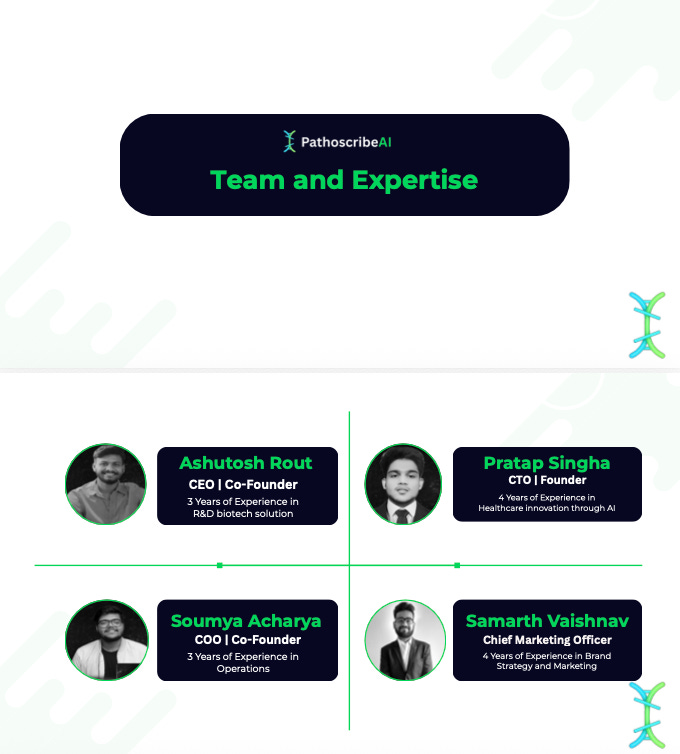
The team behind PathoscribeAI
Pratap Singha (CTO/Founder) is the one the team calls “Captain America.” He pulled all four founders together. Four years of experience building technology for healthcare with AI. He met Ashutosh at a previous startup called Mark 18, met Samarth on Discord, and convinced both of them to leave everything and join.
Ashutosh Rout (CEO/Co-Founder) worked as a research assistant at the Institute of Life Sciences, one of India’s top government biotech research bodies. Three years watching researchers struggle with broken R&D processes from the inside. When Pratap called with the idea, he quit his job and called his college friend to join too.
Soumya Acharya (COO/Co-Founder) had run an agency with Ashutosh during their college years. Three years of operations experience. When Ashutosh called, he came onboard.
Samarth Vaishnav (CMO) studied law. Pivoted to marketing. Built his own agency serving NGOs and small businesses. Met Pratap on Discord. Heard the pitch, shut down his entire company, and joined full-time. Four years in brand strategy and marketing.
Where they stand today?
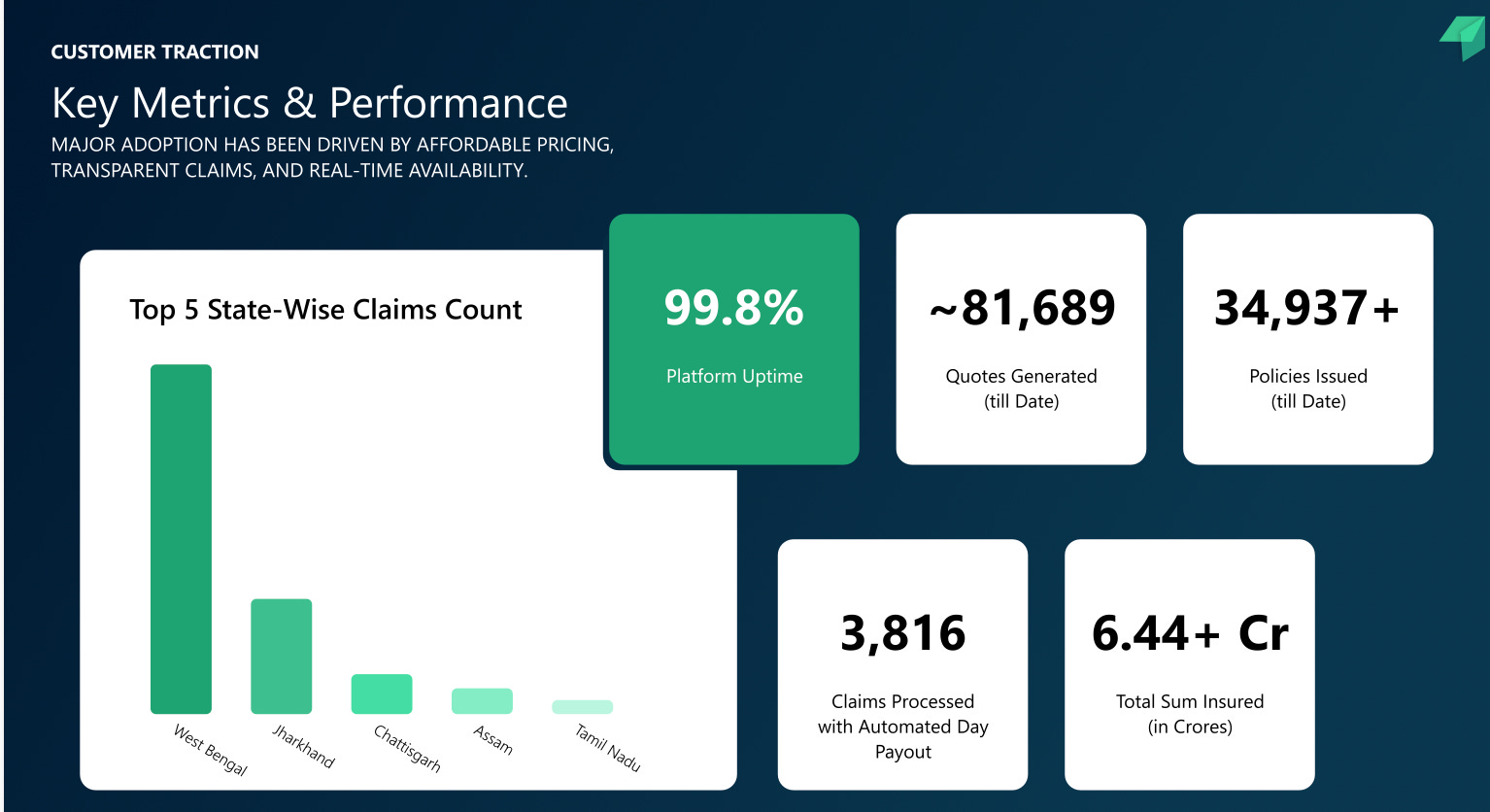
Live with Bajaj General Insurance since Q3 2025. Product branded as Bajaj Allianz ClimateSafe across West Bengal, Jharkhand, Chhattisgarh, Assam, and Tamil Nadu.
34,937+ policies issued
Thousands of claims with automated payout in same day
$120K revenue last financial year
99.8% platform uptime
Gig workers are 59% of policies. Bootstrapped by founders plus ₹1 crore ($120K) from a Sweden-based family office.
Now raising a seed round. In active expansion talks in the UK and Japan.
Where they stand today.
Beta platform live (Pathoscribe-v1, BioPATH model)
First pharma pilot secured in Bangalore
Institute partnership connected to the Institute of Life Sciences
NGO collaborations for rare disease patient data (amyloidosis)
Provisional IP filed on AI orchestration and formulation engine
Bootstrapped, no external funding raised yet
Raising $360K (₹3 crore) at pre-seed for 8% equity
Fund allocation: 35-40% R&D, 20% marketing, remainder operations
GVP’s take.
I wanted to feature PathoscribeAI for a specific reason.
What stands out:
They’re one of the only Indian platforms combining drug discovery, drug repurposing, and tablet formulation in a single AI pipeline. Most global competitors focus on one piece. PathoscribeAI delivers all three in one report.
The NGO rare disease data pipeline is a genuine moat. Real-time patient data from ultra-rare disease populations is something billion-dollar competitors don’t have. If they scale this model to more diseases, that advantage compounds.
They understand India’s pharma structure. Instead of chasing big pharma they can’t reach, they targeted the mid-sized companies that actually do the research. Smart go-to-market for a bootstrapped team.
PathoscribeAI is at the stage where one meaningful pilot can change everything. If you’re in pharma or biotech or connected to a CRO, this team is ready to prove their platform on a real drug pipeline. That pilot could be worth more than any check.
P.S. One last thing…
If this was useful, forwarding it to one person in your network is the single best way to support what we’re building.
500+ investors already read this every week, including firms like Accel, WTFund, and Ice VC, alongside family offices from Dubai, Singapore, and Europe.
Our only promise is this: we will keep finding India’s best founders at the earliest stage, so you never miss a deal worth taking.
See you next week
If you want me to make a warm intro with this startup founder, feel free to reply to this email!
Email: jaylee@globalventureplay.com