

Quick Summary
Sector: HealthTech / Primary Care
Stage: Early Revenue | Expanding via Franchise Model
Traction: 9,000 patients | 20,000 consultations | 1 new clinic every month (post-Diwali launch)
Recognition: Official partner with National Health Authority (ABDM) | Backed by Abbott, Manipal Hospitals, and Toyota’s AISIN
Model: Hybrid “Phygital” Clinics — physical trust + digital backbone
Economics: 400 sq.ft. setup | ₹10–11 lakh investment | Break-even in 8–10 months | 77% margins by Year 2
Opportunity: 200M+ urban workers too “middle” for government care and too “broke” for private hospitals
Welcome to Global Venture Play (GVP)
where we help investors discover undervalued Indian AI startups.
Every week, we feature one high-potential Indian startup, carefully vetted for traction, team strength, and scalability.
So far, we’ve featured 21 Indian AI startups, and 35% of them have secured investor meetings or funding opportunities.
Our subscribers include top venture firms like Accel, WTFund, and Ice VC, alongside 500+ investors across four continents.
The Missing Middle of India’s $1.5T Healthcare Story
India’s healthcare system wasn’t built for the people who are building India.
Every year, 63 million Indians are pushed into poverty because of healthcare expenses
We call ourselves the world’s fastest-growing economy.
The world’s biggest market.
The land of unicorns and 10-minute deliveries.
But 90% of startups here still serve the richest 1%.
Zepto, Blinkit, Zomato – all serve the top 10% of the economy only.
The other 1 billion Indians?
No one’s building for them.
Why?
Because they don’t have the per-capita income that attracts venture money.
India’s Largest Untapped Market: Everyday Healthcare
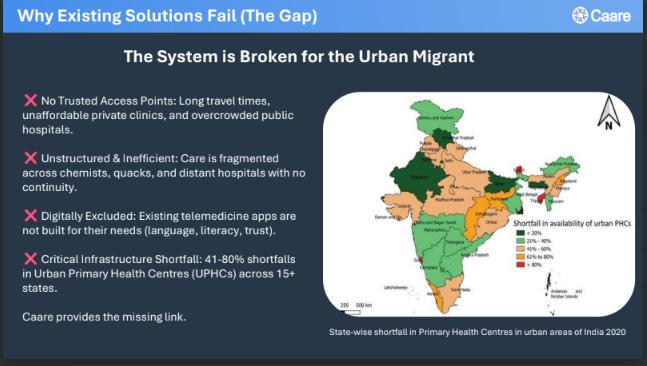
India has over 200 million urban workers, people who are not poor enough for government care, yet not rich enough for private hospitals.
If they go to govt hospital for treatment, even if it’s free it will take lots of time.
If they go private, the medical bills will eat their life savings.
What’s more terrifying is:
India’s doctor–patient ratio stands at 1:1500 (vs WHO’s ideal 1:1000).
That means one doctor for fifteen hundred people and in low-income urban areas, the ratio can be 1:10,000.
To make things worse, 72–75% of Indians pay out-of-pocket for healthcare without any insurance or government cover.
So when a worker falls sick, they don’t just lose a day’s wage, so they risk falling into debt.
In summary, If you see the numbers, they’ll shock you.
Doctor–patient ratio: 1:1500 (in some areas, it’s 1:10,000).
Out-of-pocket spending: 72–75% of all healthcare expenses.
Insurance coverage: less than 15% of Indians have private insurance.
Primary healthcare gap: 80% of Indians rely on unqualified local practitioners.
In plain English?
Most Indians either delay treatment or go to someone who isn’t a doctor at all.

India’s healthcare sector is booming, projected to surpass $1.5 trillion by 2030.
The projection includes everything: hospitals, diagnostics, insurance, pharma, medtech, and wellness.
But that trillion-dollar dream will only materialize when someone builds a solution for the middle 200 million Indians — the people who can’t afford private care and are too “middle-class” for government schemes.
Caare Smart Clinic is solving this massive problem.
What are they building?
Caare Smart Clinic is fixing the gap between crowded government hospitals and expensive private care.
They’re building a network of small, affordable neighborhood clinics that give every Indian access to real doctors, tests, and medicines—at the price of a Netflix plan.
Each Caare clinic is just 400 sq.ft. yet delivers everything a hospital does, at one-tenth the cost.
Here’s how it works:
A real doctor checks patients in person for just ₹150.
A nurse helps with checkups and gives medicines right there in the clinic.
Basic tests and blood samples are done on the spot.
And when specialist care is needed, patients connect instantly to top doctors through teleconsultation.
Everything in the clinic is tracked on a simple digital system, so patients don’t need to carry files or repeat their history each time.
That digital system is build by Caare which is already integrated with India’s national health infrastructure (ABDM).
In short, Caare delivers the trust of a neighborhood clinic, the efficiency of a startup, and the scalability of a retail chain.
Their Business Model
Caare have 2 types of business model.
1. Clinic Model
This is Caare’s core business — the clinics you’ve been writing about.
Each clinic earns money from:
Doctor visits – ₹150 per consultation
Medicines – patients buy directly from the in-house pharmacy
Diagnostics – small tests like blood or ECG done right there
Specialist video consults – a small fee when referred online
Together, these bring in around ₹450–₹500 per visit.
Because setup cost is low (₹10–11 lakh), clinics recover investment within 8–10 months and hit up to 77% margins by the second year.
So how do they keep the setup costs so low?
Each clinic is only 400 sq.ft. — just enough for a doctor’s room, pharmacy, and small test area.
Run by only three people: one doctor, one nurse, and one helper.
No hospital beds, ICUs, or large equipment — only what’s needed for everyday care.
Billing, inventory, and records handled by simple software — no admin staff or paper files.
Medicines and test kits bought in bulk from central partners like Abbott Diagnostics and Subrosza Health, cutting costs further.
That’s why setup costs stay at ₹10–11 lakh (vs ₹40–50 lakh for traditional clinics).
This is the profitable, repeatable engine that keeps Caare running.
2. Franchise + Platform Model (Next)
After proving the model, Caare plans to scale in two ways:
Franchise model:
Doctors or local investors can open their own Caare clinics under the brand. Caare provides software, training, and supply chain and takes a share of revenue or a fixed fee.
Digital platform:
The same tech (health record system, AI tools, and teleconsultation setup) can be licensed to hospitals, NGOs, and state health programs.
That’s how Caare grows fast without owning every clinic.
Like Swiggy connects restaurants, Caare connects clinics and communities.
Here’s a demo video how their digital platform works using AI and telehealth