

If you’re new here, Welcome.
Welcome back to GVP. Every week we meet one Indian founder, verify the traction, and write the story so you can make faster investment decisions. We added 32 new subscribers last week — now at 529 investors reading weekly. If someone forwarded this to you, subscribe here.
This week we’re covering the following:
Why 240 million Indian vehicles still wait 2 to 5 hours when they break down
How one founder got India’s two biggest battery brands to admit what they couldn’t fix in over a decade
What roadside assistance actually means in India today, and why less than 15% of breakdowns get organized help
Why this 43-year-old founder spent 4 years and ₹30 lakhs of his own money before opening a single store
How one customer becomes 4 revenue events spread over 5 years
What to watch for when evaluating early-stage mobility infrastructure startups in India
“"Software is eating the world, but infrastructure is what feeds it." — Marc Andreessen
Uber wiped him out at 40. He started over with ₹30 lakhs.
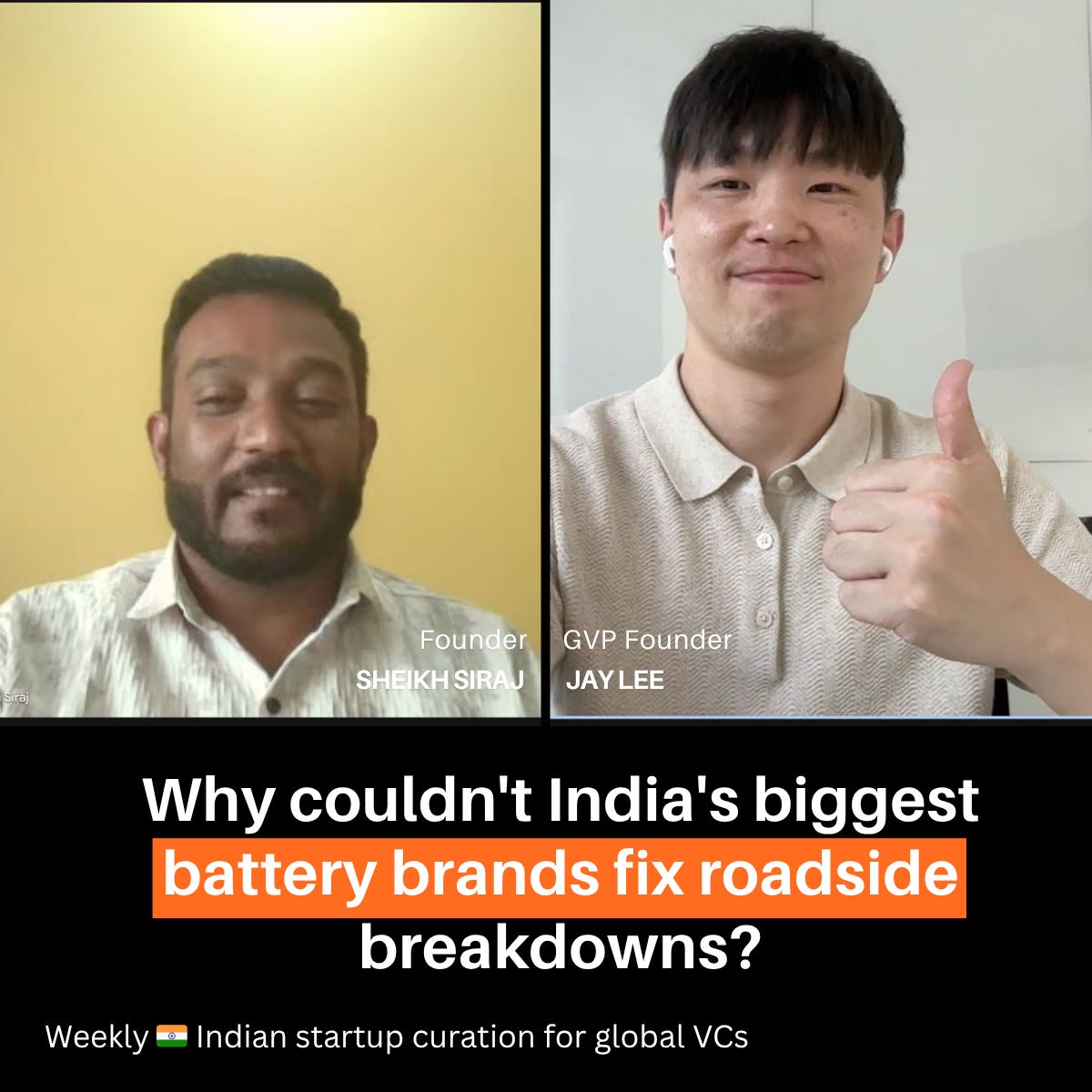
In 2018, Sheikh Siraj had a problem.
For 26 years he had been running cabs and fleet management in Bangalore. Then Ola and Uber entered India. His business couldn’t compete and he had to shut it down.
He was 40 years old, looking for what to do next.
Everyone he spoke to kept telling him the same thing. EVs are the future. Batteries are where the money will go.
So in 2019 he started a battery business. Almost by accident, in his own words. He didn’t know what else to start.
Within six months, he saw something more interesting than batteries.
Six months in, he saw the bigger problem.
Vehicles in India weren’t dying because the batteries were bad. They were dying because nobody could fix them when they did.
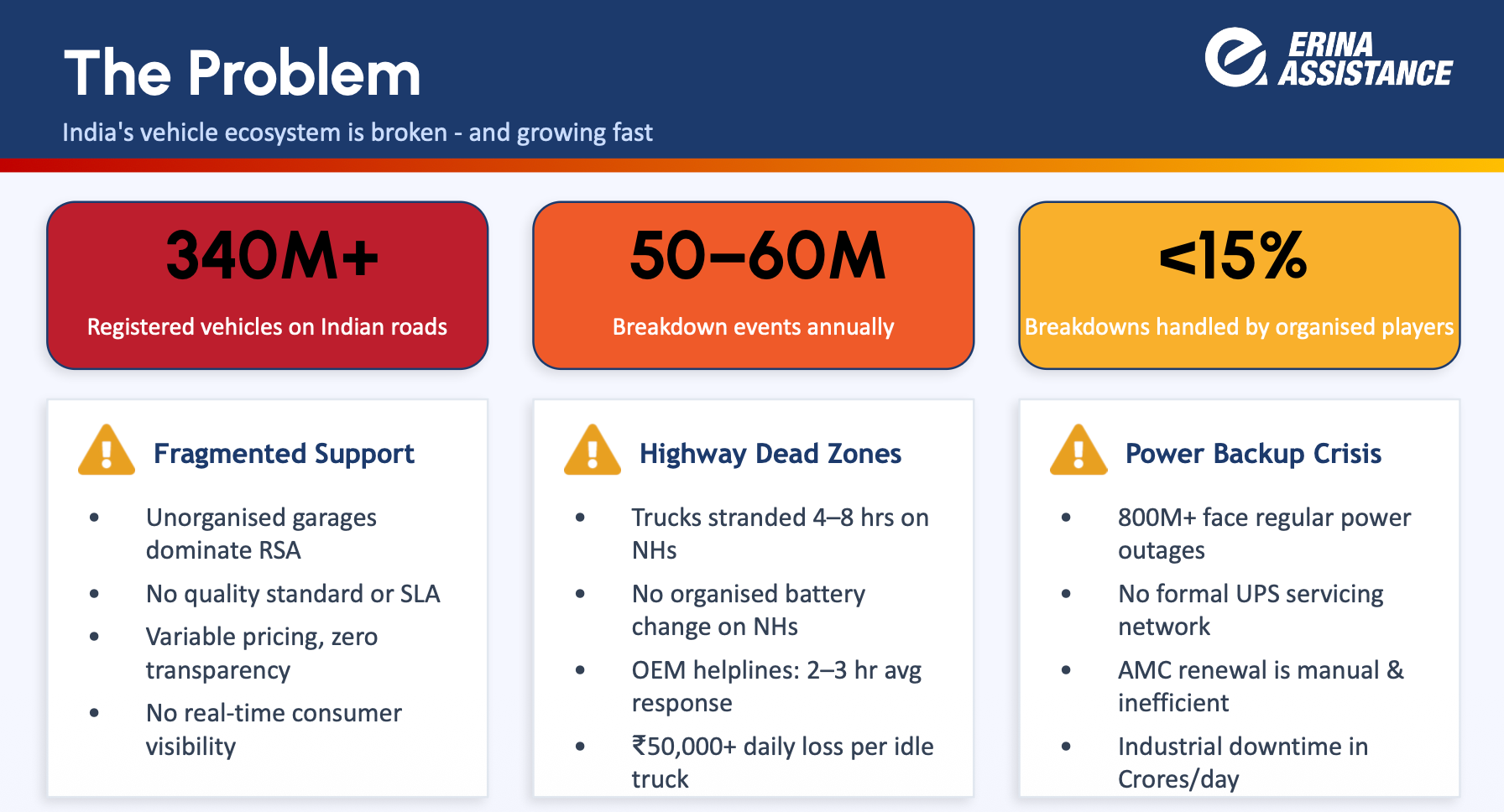
The numbers tell the story.
- There are 240 million vehicles on Indian roads.
- Every year, 50 million of them break down.
- Less than 15% of those breakdowns get help from any organized service.
- When help arrives at all, the wait runs 2 to 5 hours.
That’s a service infrastructure gap, not a battery quality gap.
So Siraj went to the two largest battery makers in India to ask why nobody had fixed it.
The conversation that became a startup.
He met with Exide and Amaron, the two biggest battery brands in India.
He asked them: why has nobody fixed this?
Their answer surprised him. They had been trying for years.
Every dealer in their distribution network operates as an island, and they could not bring them onto one track.
Imagine buying a battery from a dealer in Bangalore.
You drive 50 kilometres out for a weekend, and the battery dies on the highway.
The nearest dealer to you won’t help because you didn’t buy from him. The brand can refer you to him, but he still charges you.
The dealers compete with each other for every customer. None of them have any incentive to share.
Exide and Amaron told Siraj that no centralized service operator existed in India. After years of trying to build one through their dealer network, they had given up.
That answer became his startup.
He spent 4 years quietly building the answer.
His company is called Erina Assistance.
It’s a network of physical service stores across India in four formats:
Metro stores: in cities, serving cars, bikes, and home power systems
Transit stores: on highways, one every 50 km, so no truck is more than 25 km from help
Mini stores: in rural towns, for local battery service and home UPS systems
Franchise stores: where partners put up the capital and Erina runs the operation
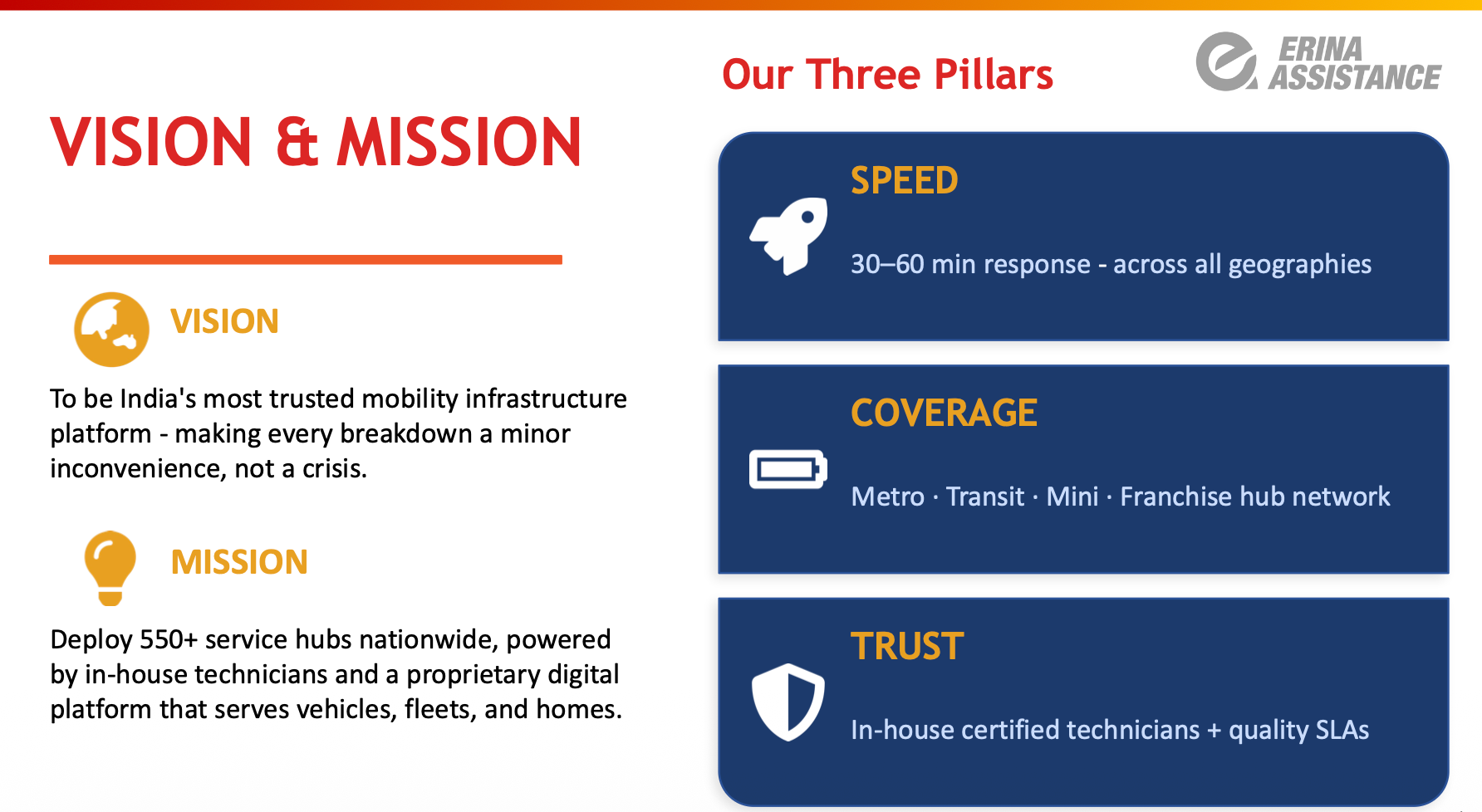
Each store holds inventory and dispatches in-house trained technicians. The customer opens BatterySOS, the consumer app, and a technician arrives in 30 to 45 minutes with the part needed and finishes the job on the spot.
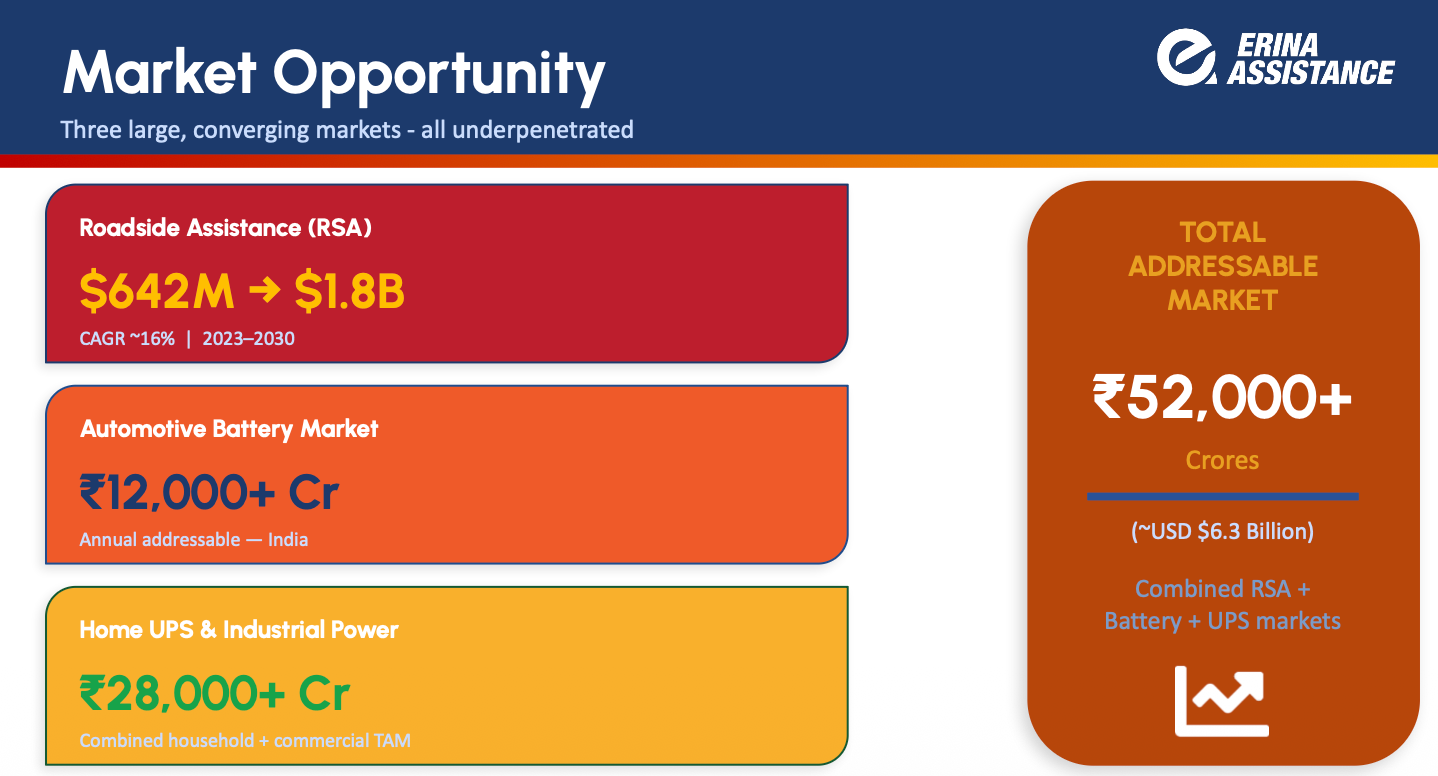
The business runs three revenue streams from one footprint:
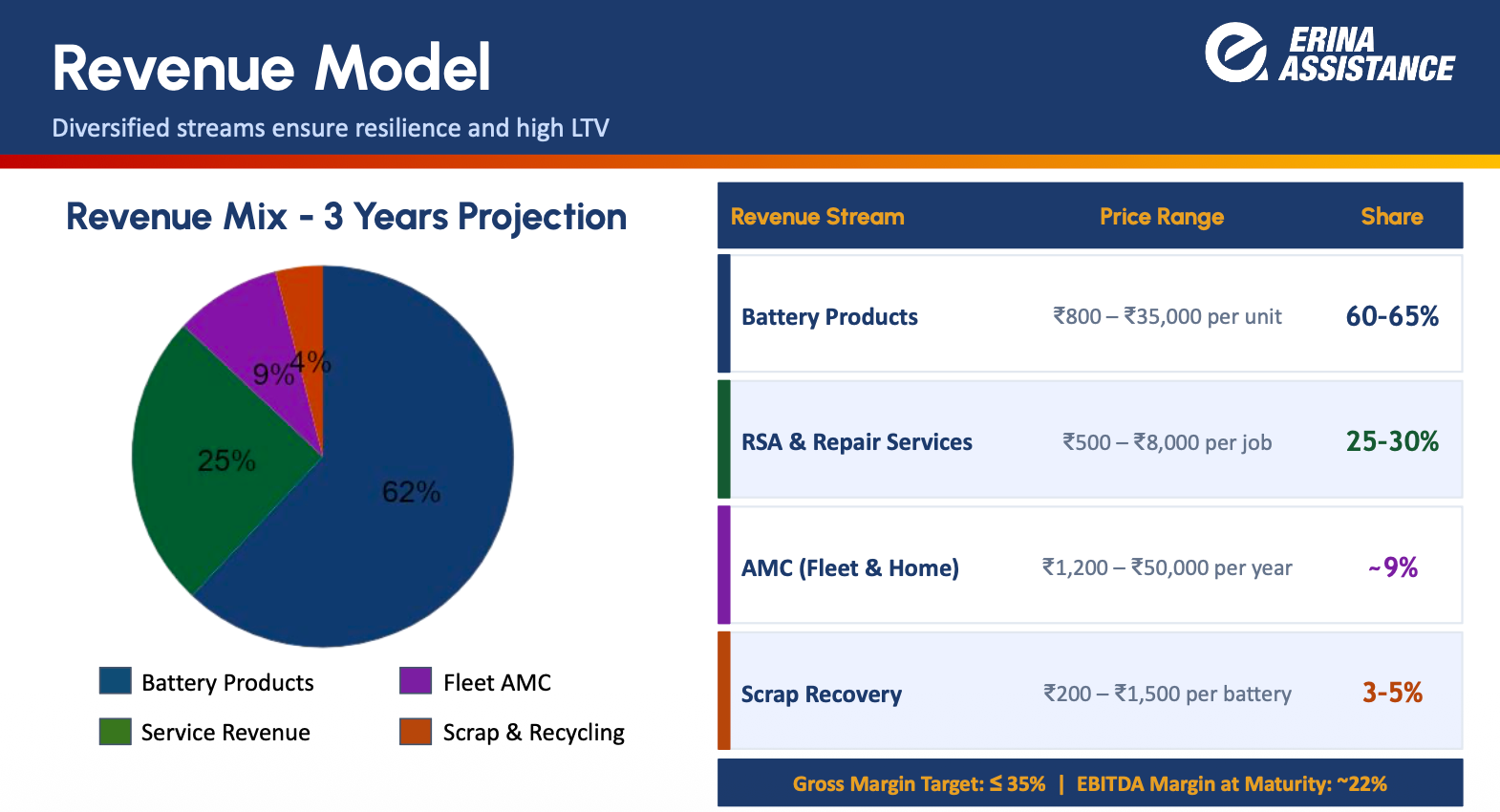
Product sales: 60-65% of revenue (battery sales across automotive, UPS, industrial, solar)
Service revenue: 30-35% (RSA calls, annual maintenance contracts, fleet support)
Scrap recovery: 3-5% (end-of-life batteries collected and resold to recyclers)
The same hubs, technicians, and dispatch system serve all three revenue lines.
One customer becomes four revenue events.
This is what makes the model interesting.
Existing players in India each do one thing. A garage fixes breakdowns, a dealer sells batteries, a scrap collector buys old ones. Nobody owns all three steps.
Erina is built differently. Every customer becomes a multi-touchpoint relationship over 5 years:
Sale: customer buys a battery from Erina
Install: Erina installs it on the spot
Service: AMC visits every 6 months
Replace: new battery sold when the old one dies
Scrap: dead battery collected and resold to recyclers
That’s 4 revenue events from one customer, plus the data captured at every interaction. That data feeds a predictive engine that tells them when to reach out before the next failure.
That data layer is what investors should care about most.
Every breakdown, every service call, every battery health check builds a proprietary dataset that becomes useful to OEMs and insurers over time.
The kind of infrastructure aggregators can’t disrupt.
Most existing competitors fall into one of two camps.
Gig-based RSA apps can dispatch fast but the technician quality is a coin toss. OEM helplines guarantee quality but their dispatch is slow, often 2 to 3 hours.
Erina sits in the gap with three things competitors don’t combine:
In-house certified technicians: not gig workers, trained and salaried
Physical hubs: owned or franchised, holding inventory close to the customer
A technology platform on top: dispatch, predictive engine, channel partner dashboard
The moat compounds with time. Building 500 physical stores takes years, not months. In-house trained technicians can’t be spun up in a weekend. Once Erina owns the lifecycle of a customer, switching costs are real.
This is the kind of physical infrastructure that took FedEx and DHL decades to build. Once it exists, no aggregator can wipe it out the way Uber wiped out Siraj’s first business.
GVP Take
Here’s what stood out to me from our conversation with Siraj.
A 26-year operator who has been disrupted before. He survived the Ola/Uber wipeout, lost his first business to it, and learned the lesson. He’s not a first-time founder learning what India’s transportation sector looks like, since he’s spent his career inside it
.Direct validation from Exide and Amaron. The two largest battery brands in India told him both that the gap exists and that they had failed to fix it after years of trying. That kind of supply-side market signal is rare.
Capital discipline. He’s spent over ₹30 lakhs of his own savings across 4 years and burned no external capital figuring out the business model. By the time he’s raising seed, the platform is already built.
EV transition optionality. The hub network he’s building today for lead-acid batteries is the same network that will service EV batteries and host charging points tomorrow. With India’s EV penetration still under 6%, he’s positioning ahead of that wave.
Capex intensity is the biggest risk. Each company-owned hub costs ₹30 to 50 lakhs to set up. Even franchised hubs need ₹8 to 12 lakhs from Erina for inventory and tech. The model compounds slowly, and investors should expect multiple funding rounds before EBITDA break-even in Year 3.
The first metro store opens days from now. There is no meaningful revenue history yet. The bet here is on the operator, the insight, and the discipline behind the four years of work.
P.S. One last thing…
If this was useful, forwarding it to one person in your network is the single best way to support what we’re building.
500+ investors already read this every week, including firms like Accel, WTFund, and Ice VC, alongside family offices from Dubai, Singapore, and Europe.
Our only promise is this: we will keep finding India’s best founders at the earliest stage, so you never miss a deal worth taking.
See you next week
If you want me to make a warm intro with this startup founder, feel free to reply to this email!
Email: jaylee@globalventureplay.com