

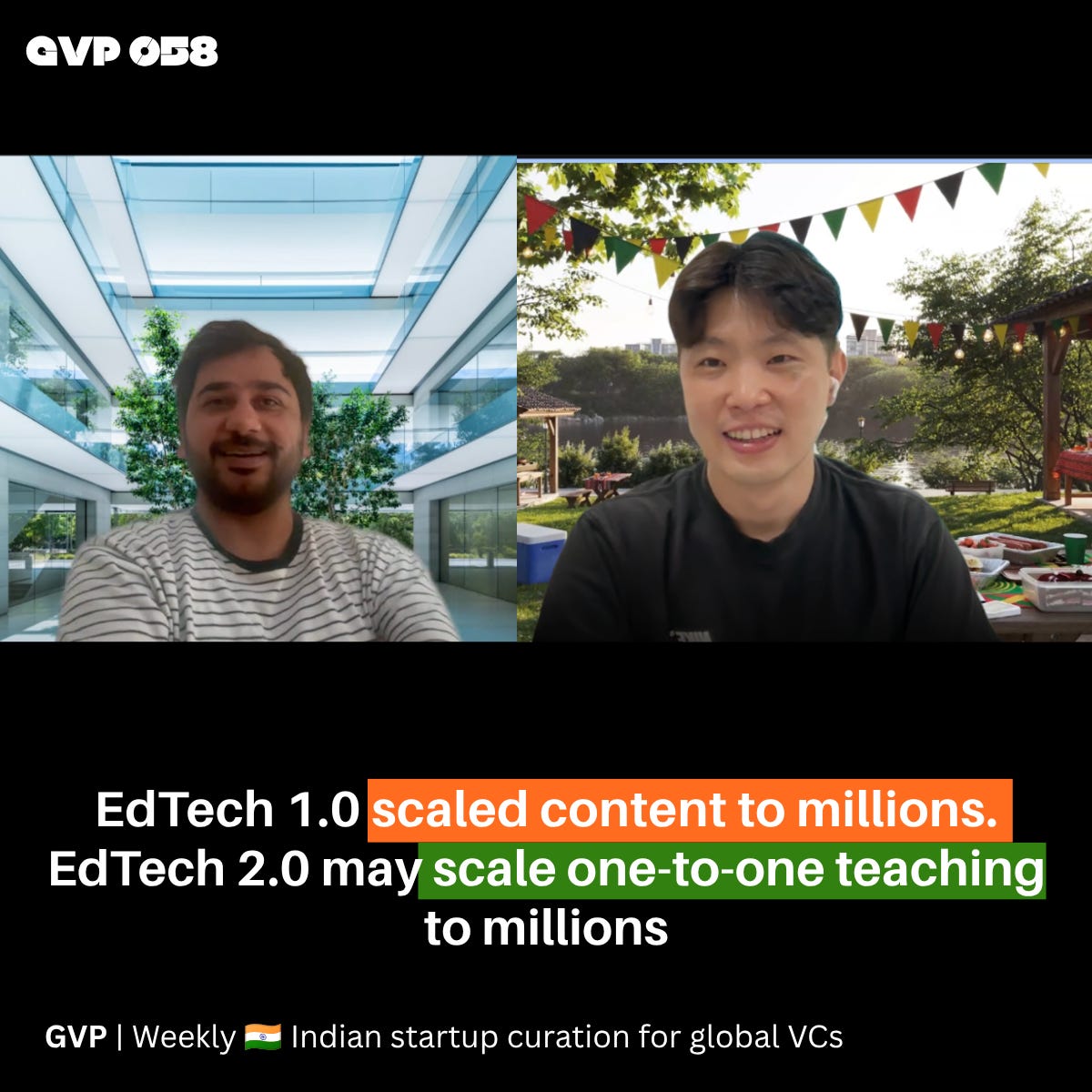
If you’re new here, welcome.
Welcome back to GVP. Every week we meet one Indian founder, verify the traction, and write the story so you can make faster investment decisions. We added 32 new subscribers last week — now at 680 investors reading weekly. If someone forwarded this to you, subscribe here.
Dear fellow investors,
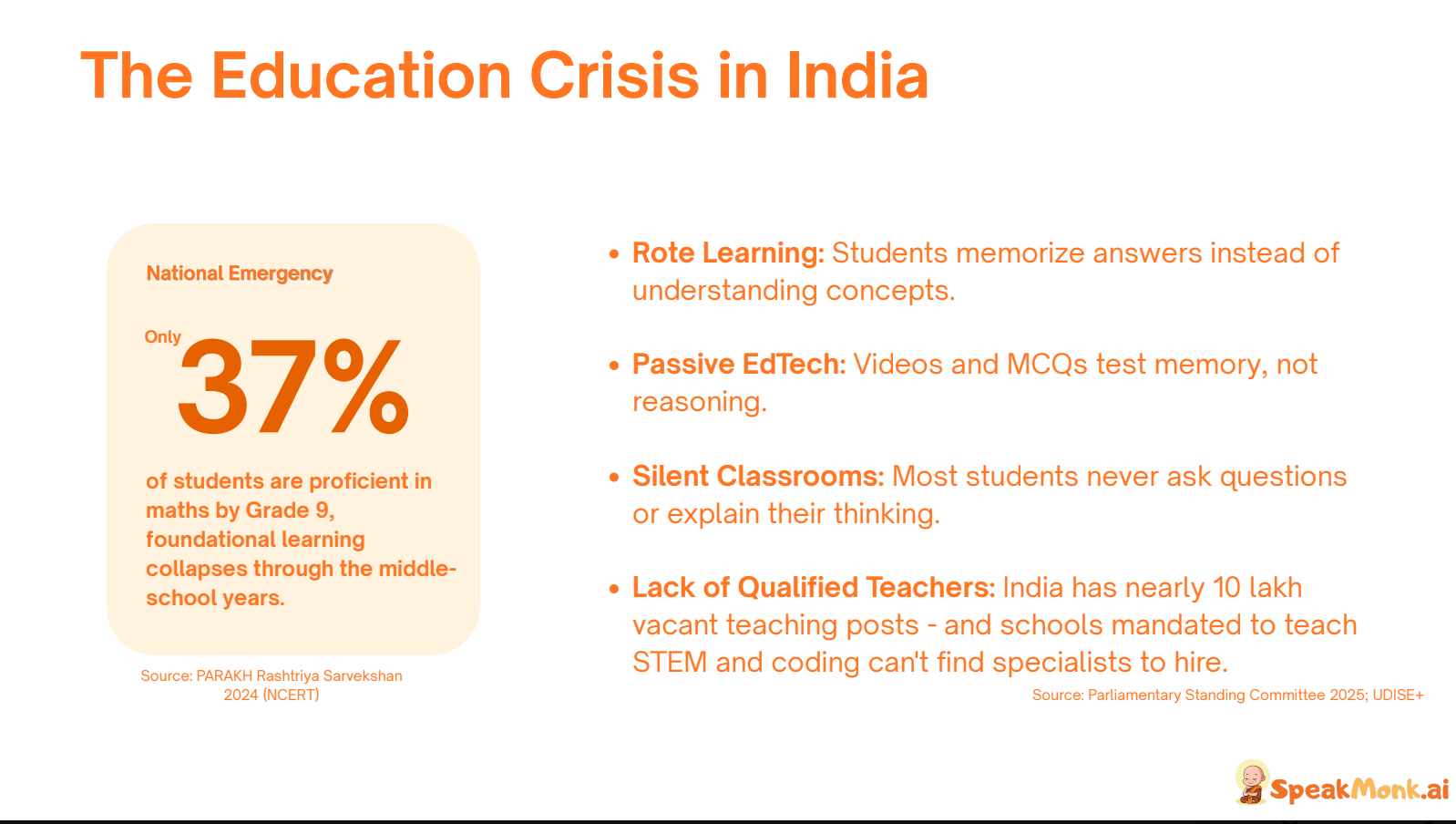
The problem EdTech never really solved
In 1984, education researcher Benjamin Bloom wrote about a problem that still matters today.
Students taught one-to-one could perform far better than students taught in a normal classroom.
But the problem was it’s impossible to deliver at mass scale.
You can give one student a great tutor. You cannot easily give millions of students one.
For the next 20 years, EdTech solved a different problem. It recorded good teachers once and distributed their lessons to millions.
EdTech got very good at distributing lessons.
It never figured out how to give every student individual attention.
AI may be the first real shot at that.
In a 2025 Harvard trial, students using a purpose-built AI tutor learned more in less time than students in an active-learning classroom.
SpeakMonk is trying to bring that model into Indian schools.
Their product changed after watching students stay silent
The company is initially focused on students in Grades 5–9.
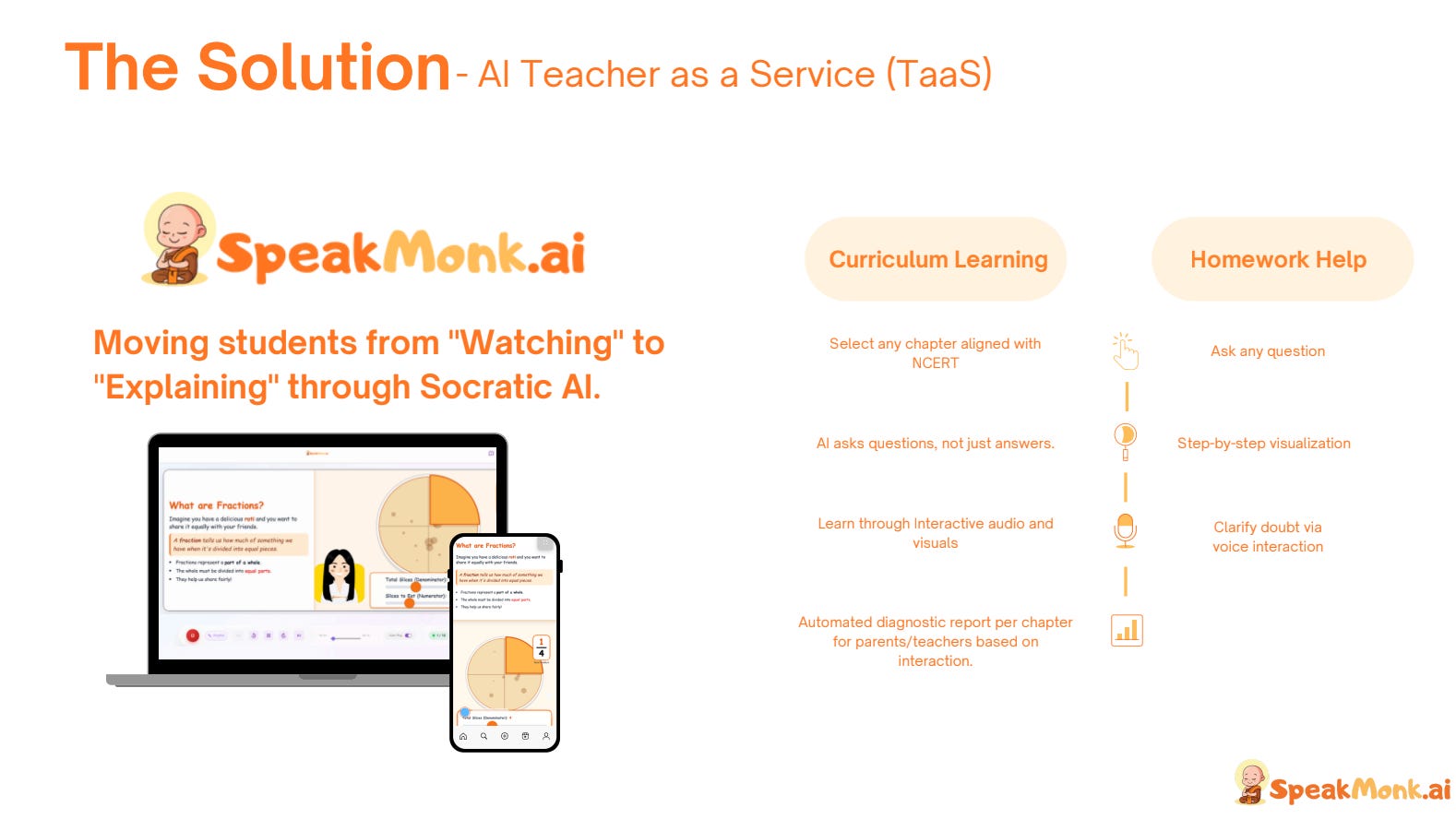
A student selects a curriculum chapter.
SpeakMonk explains the concept using voice and visuals.
Then it does something most EdTech products did not.
It asks the student questions.
If the answer shows a gap in understanding, the AI can follow up instead of simply moving to the next lesson.
SpeakMonk then turns those interactions into a report showing parents and teachers where the student struggled.
That feature came from watching students use the product.
Across more than 120 early interviews and demos, the company says it repeatedly saw students get stuck without speaking up. Himanshu Yadav says their research has since grown to 200 conversations.
So SpeakMonk is not only trying to answer more questions.
It is trying to notice when the student does not ask one.
Schools could change the economics of EdTech
SpeakMonk is not starting by selling subscriptions to individual parents.
It wants schools to distribute the product.
At its current founding-partner pricing, schools pay roughly ₹300 per student per month. SpeakMonk says the marginal serving cost of its text tier is around ₹50, giving it roughly 80% gross margin at that level.
Students can then upgrade for more advanced at-home tutoring.
The timing helps.
CBSE now has a Computational Thinking and Artificial Intelligence curriculum for Classes III–VIII, with dedicated student and teacher resources for the 2026–27 academic year.
SpeakMonk is using STEM and coding as an entry point into schools, then wants to expand into broader curriculum learning.
According to the founder, the company has now worked with three schools, with another seven showing interest for the next academic session.
That is still very early.
A software engineer and a classroom teacher are building it together
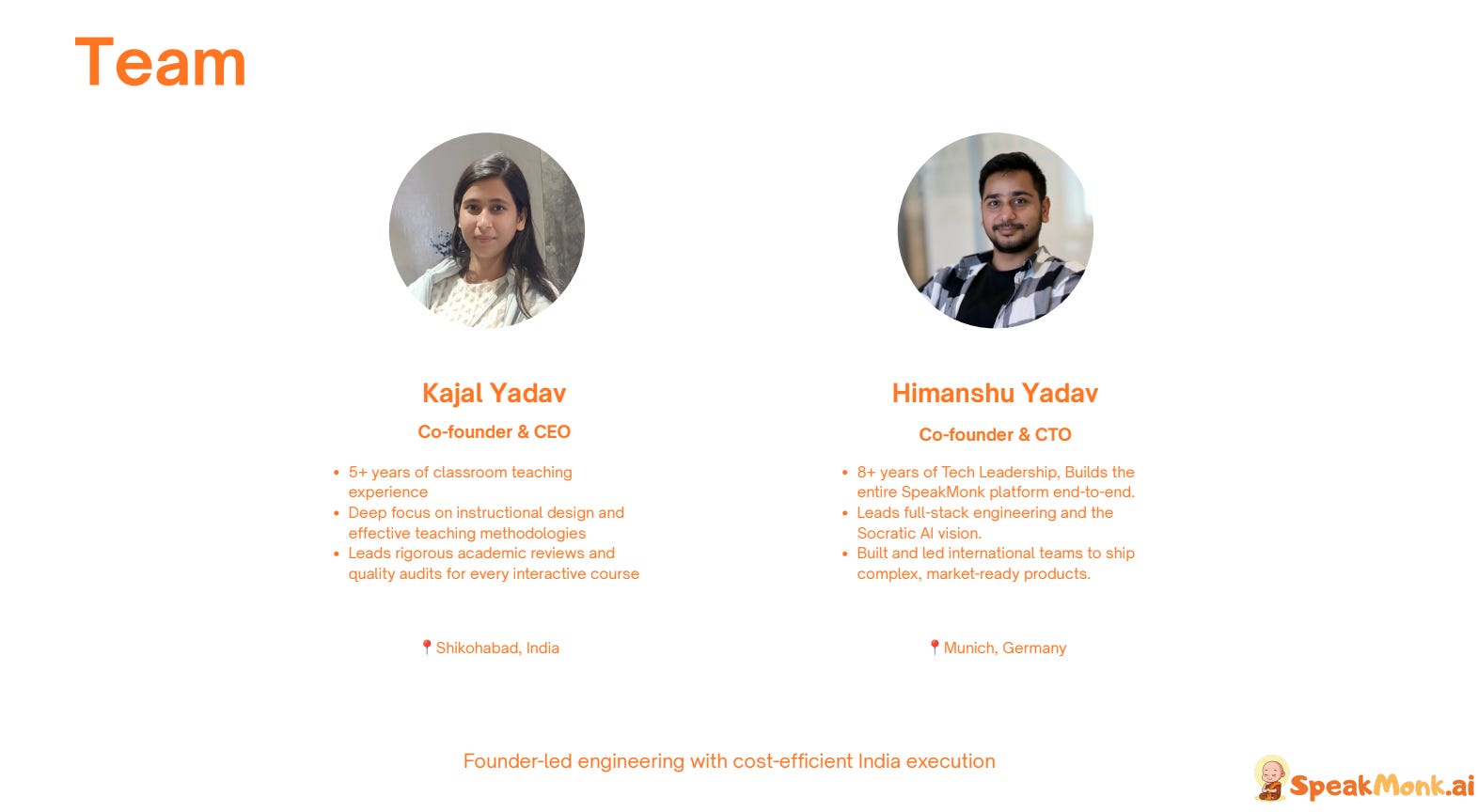
Himanshu Yadav has more than eight years of technology leadership experience and currently lives in Munich.
His co-founder and younger sister, Kajal Yadav, has more than five years of classroom teaching experience and a Bachelor of Education. She leads the academic review and teaching methodology behind the product.
Himanshu’s connection to the problem goes back further.
Around 10 years ago, he visited a government school in his village where a teacher dismissed the children as poor students who did not care about learning.
Himanshu asked all 17 children to come back at 10 AM the next Sunday if they genuinely wanted to study.
All 17 came.
He has been thinking about the teacher problem ever since.
GVP Take
SpeakMonk is still early, but its positioning addresses two of EdTech’s historical weak points:
Massive customer acquisition costs and static video distribution.
The key metrics we will watch next are learning efficacy and B2B2C conversion:
1. Measurable Learning Gains: Can students demonstrate better concept mastery after using SpeakMonk compared to traditional instruction?
2. School Renewals & Parent Upgrades: What percentage of parents upgrade to the live-voice at-home tier once the school adopts the foundational tier?
AI tutoring itself will not be a moat. ChatGPT, Gemini, Khanmigo and others will keep getting better.
SpeakMonk will need to build its advantage in the layers around the model: curriculum grounding, pedagogy, school relationships, local languages and the learning data it collects over time.
EdTech has already proved that one lesson can reach millions of students.
SpeakMonk is betting AI can scale something much harder:
the feeling that the lesson is paying attention to you.
Want an intro to the founders? Just reply to this email.
P.S. One last thing…
GVP has 657 investor subscribers — including partners at Accel, principals at family offices in Singapore and Dubai, and angels across the US, Australia, and Europe.
If you forward this newsletter to 3 investors who subscribe, we’ll make a warm intro for you to any family office or VC in our network you’d like to meet.
See you next week
If you want me to make a warm intro with this startup founder, feel free to reply to this email!
Email: jaylee@globalventureplay.com