

If you’re new here, Welcome.
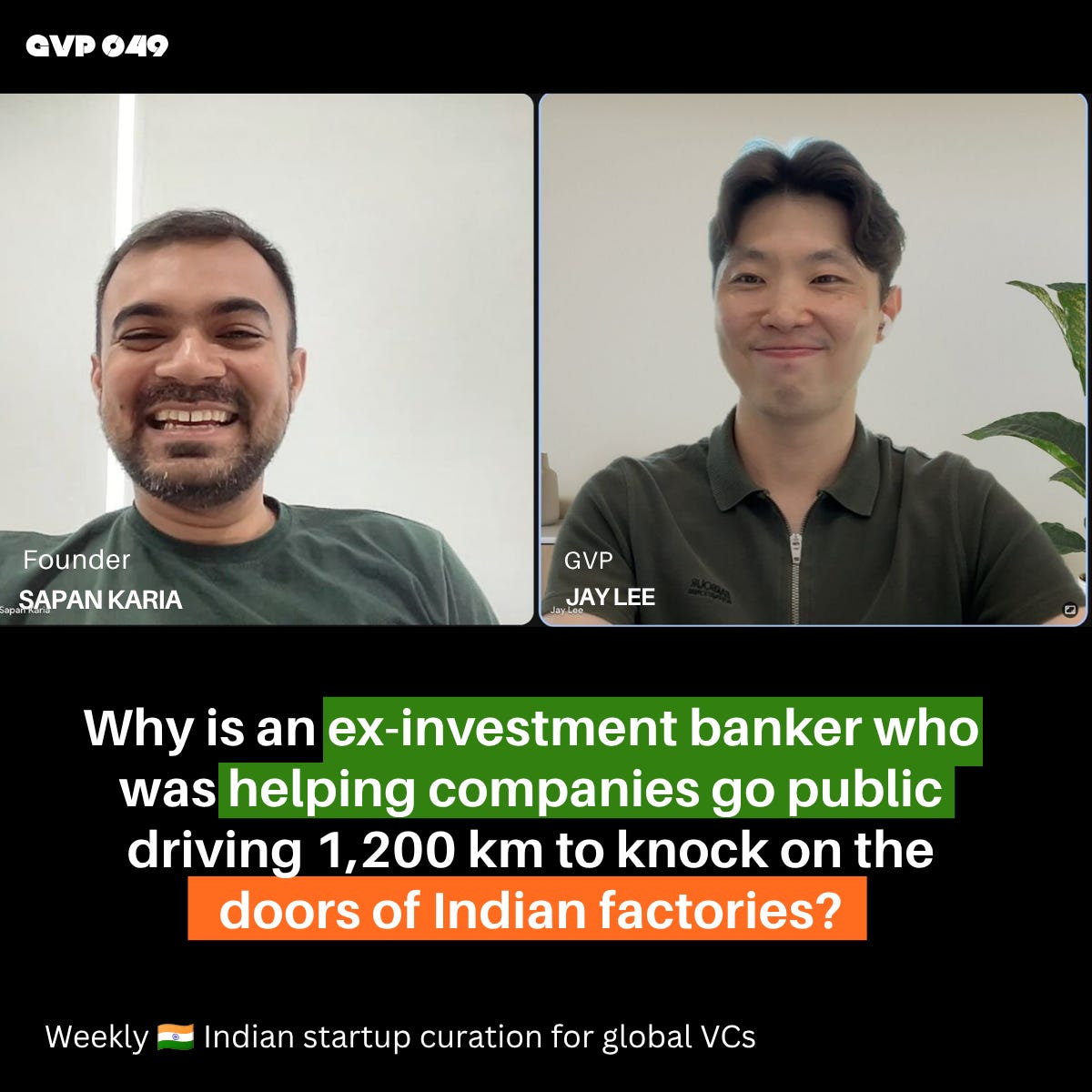
Welcome back to GVP. Every week we meet one Indian founder, verify the traction, and write the story so you can make faster investment decisions. We added 32 new subscribers last week — now at 636 investors reading weekly. If someone forwarded this to you, subscribe here.
This investment banker helped SME / SMB companies raise millions.
Hey there,
Five weeks in a row, Sapan Karia drove into Jamnagar, walked up to a factory he had no appointment with, and knocked on the door.
He’s 30. He didn’t have to do this. He spent his career in investment banking and lending, the kind of work where you sell over the phone in a nice office.
He’d left Bangalore, a comfortable life, and an office five minutes from home to sit across from factory owners in a manufacturing town 1,200 kilometres away.
In his own words, he had to “rewire my brain to be shameless again.”
At 22 he’d done door-to-door sales without thinking twice.
At 30, with a tech co-founder and a real company forming, he made himself go back to knocking, because he’d figured out something about Indian exporters that almost nobody else had noticed.
There’s a leak in how they move money. It’s invisible, it’s been there for decades, and as of January 2025, it finally became legal to fix.
Let me show you what he is building
This wasn’t allowed until one and a half years ago.
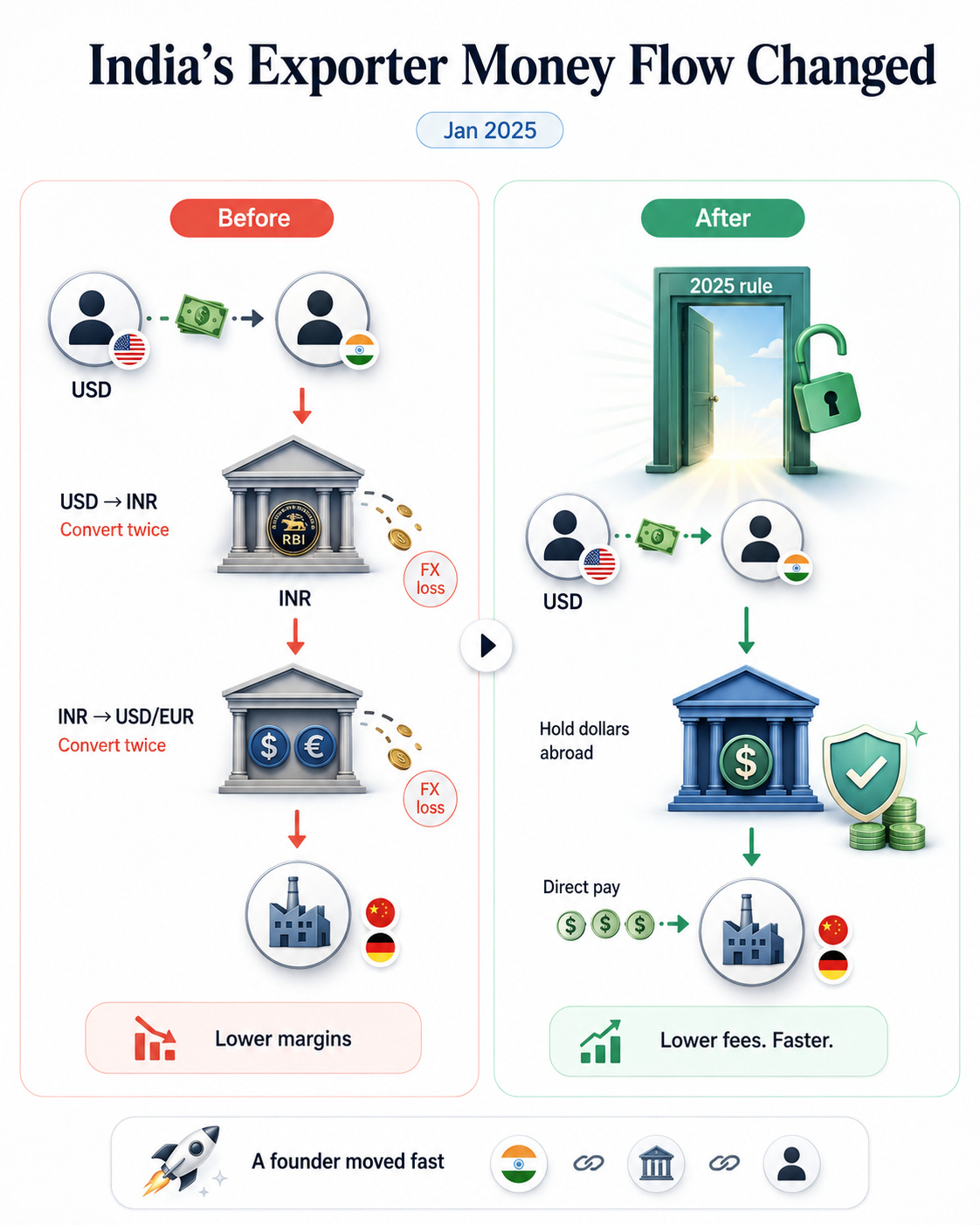
For decades, an Indian exporter legally could not hold dollars abroad. You earned dollars, you brought them home, you converted them. No choice.
In January 2025, that changed. Indian exporters were allowed to open real bank accounts overseas and keep their dollars there.
So now that same textile factory can hold its dollars in the US, and pay its Chinese supplier straight from them. No rupee in the middle. No two conversions. The leak just closes.
Almost nobody moved on this. Sapan did, within months.
He spent his whole career one step away from this problem.
Sapan didn’t stumble into exporters. He’d been circling them for years.
He started in investment banking, doing IPOs for small manufacturers – going factory to factory in Gujarat to pitch them.
Then he moved into lending, then into helping Indian brands set up supply chains abroad.
Every job put him in the same rooms, with the same owners, hearing the same complaint about money lost in conversion.
He comes from Gujarat. He has cousins and friends who run these exact factories. So when the rule changed, he wasn’t reading about a market. He was thinking about people he already knew.
He picked one kind of customer and refused to widen it.
This is the part that surprised me most. Most founders cast as wide a net as possible. Sapan did the opposite.
He’ll only work with a factory that fits all of this:
It both exports and imports, not just one
It’s in textiles, auto components, engineering, pharma, or chemicals
It does $5M to $50M (₹40 crore to ₹400 crore) in revenue a year
It’s a real manufacturer, not a trader
It’s a second-generation family business, run by someone in their 30s or 40s who studied at a good college in India or abroad
And right now, it’s based in one city: Jamnagar - a cluster for brass products manufacturing (sub category of engineering goods)
That last filter is the whole strategy. He isn’t trying to win India.
He’s trying to win one cluster of customers completely, build a playbook that works there, and then carry it to the next one.
By his count there are a dozen-odd clusters like this in Gujarat alone. Win two, he says, and it’s a real company. Win the cluster, and the math gets very large.
He’s closing deals by hand, on purpose.
The product isn’t fully built yet, and that’s deliberate.
Today, Sapan’s team matches companies with financing options manually, running eight mandates through buyer’s credit, factoring, and LC discounting.
Tomorrow, much of that could be handled by AI: evaluating counterparties, comparing financing structures, assessing risk, and recommending the lowest-cost option for a given shipment.
The manual work isn’t separate from the product. It’s generating the knowledge the product will eventually automate.
His team has already turned that instinct into an asset: a trade database covering 5 million companies across 120 countries, pulled from public shipping records, so an exporter can check exactly who they’re dealing with before they ship.
The plan is to own one narrow wedge first, saving exporters their forex costs, then build it into an AI-native services company for cross-border trade.
GVP’s take
Four things made us stop on this one.
He’s an ex-investment banker who sold to these exact factories. He’s not learning the customer, he already knows them.
The problem, market, and customer are unusually clear. Most founders are fuzzy on one. He’s sharp on all three.
He’s finding his first customers the hard way, by hand, in person, before building.
He quietly built a 5-million-company trade database as a byproduct.
If you know a manufacturer in India, in textiles, auto parts, engineering, pharma, or chemicals, who exports and imports? This is worth a five-minute intro. They’re exactly who Sapan helps.
If you know a digital-first bank in Singapore, South Korea, or the US that works with cross-border SMEs?
That’s the other door he’s opening.
P.S. Reply and we’ll make a warm intro to Sapan, whether you’re a factory, a bank, or just know the right person to forward this to.
GVP has 625+ investor subscribers — including partners at Accel, principals at family offices in Singapore and Dubai, and angels across the US, Australia, and Europe.
If you forward this newsletter to 3 investors who subscribe, we’ll make a warm intro for you to any family office or VC in our network you’d like to meet.
See you next week
If you want me to make a warm intro with this startup founder, feel free to reply to this email!
Email: jaylee@globalventureplay.com