


Quick Summary
Sector: AI Infrastructure
Stage: Pre-Seed | Live MVP
Traction: 200+ audits | Paying pilots onboarded
Model: SaaS tool that scores websites for AI agent readiness
Opportunity: 63% of web traffic is AI agents, but 80% of websites can’t handle them
Welcome to Global Venture Play (GVP).
Every week, we feature one early-stage Indian AI founder with real traction and execution speed.
35% of founders we’ve featured have secured investor meetings or funding. Our readers include Accel, WTFund, Ice VC, and 500+ investors globally.
The Designer Founder: A Y Combinator Thesis in Action
Y Combinator (YC) has long advocated for designers to become founders, arguing that the empathy, vision, and focus on user experience are the keys to a successful startup: “Making something people want.” The story of Arunima Valluvakandy, the founder of Bridge AI, perfectly exemplifies this thesis.
She is the designer-founder who saw a massive, emerging problem and, without a team, funding, or a technical co-founder, built a functional AI infrastructure prototype in a single weekend (48 hours) using Replit.
She Built, Shipped, and Validated in 3 Weeks
Arunima Valluvakandy had no team, no funding, and no technical co-founder.
She had a hypothesis: “What if websites aren’t ready for AI agents?”
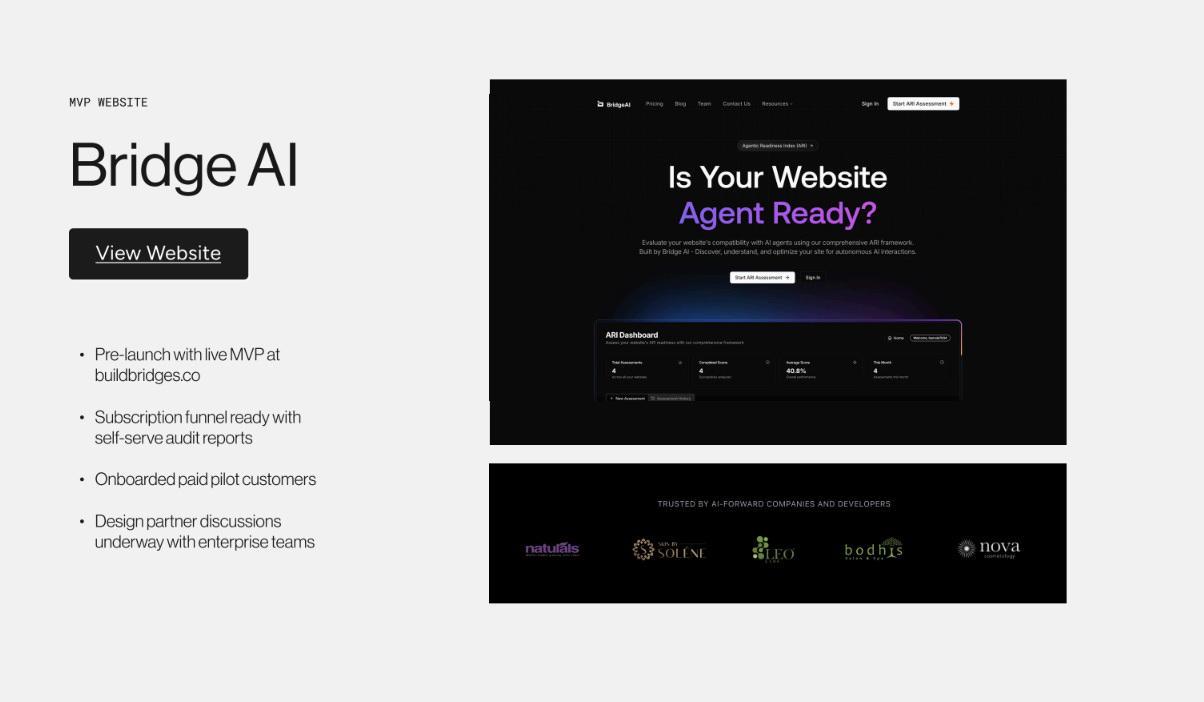
So she spent one weekend using Replit to build a tool that audits websites for AI agent readiness.
Not a polished product. Just a scrappy prototype.
Then she went straight to market.
Within three weeks:
She audited 200+ websites. 95% scored below 4 out of 10.
65% of audited companies came back asking how to fix it.
She converted interest into paying pilot customers.
All before raising a dollar.
The Problem: 63% of Your Traffic Can’t Use Your Website
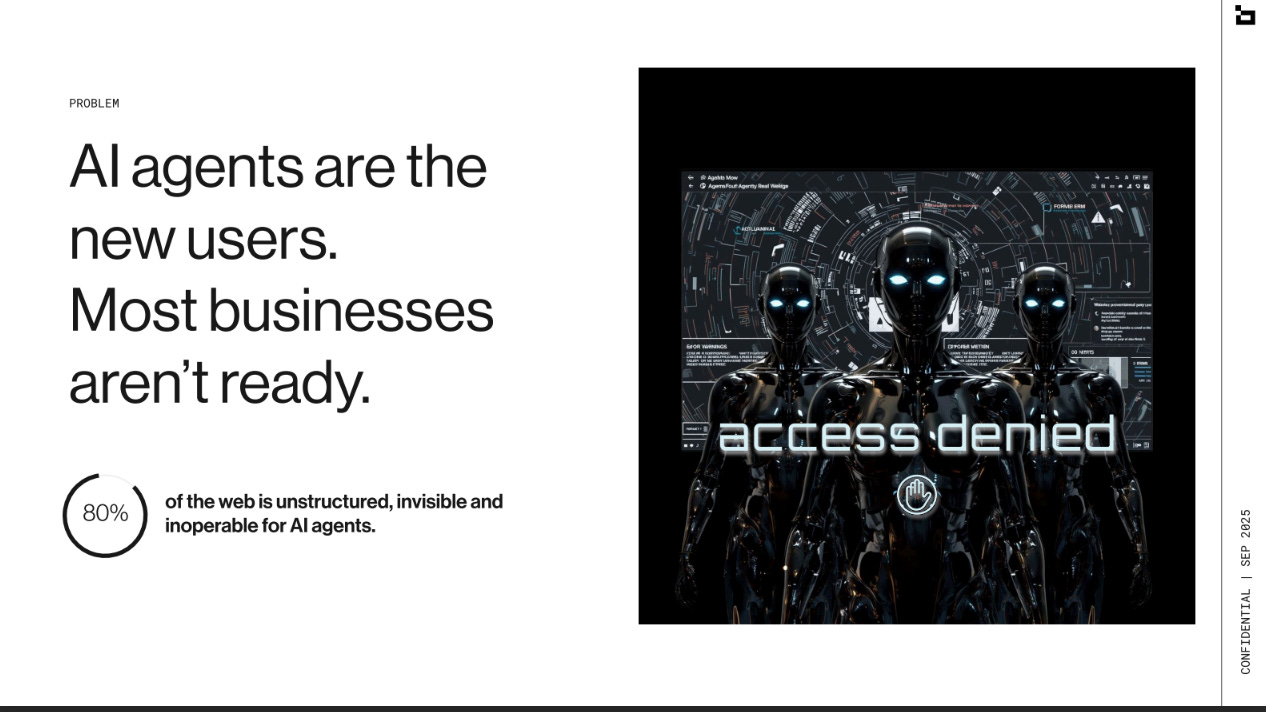
Right now, 63% of web traffic is AI agents (Ahrefs, 2025).
ChatGPT’s browsing tool. Perplexity’s search agent. Autonomous shopping bots.
They’re crawling your site, making decisions, and either buying from you or leaving for competitors.
But 80% of websites can’t handle them.
Why?
Websites are built for human eyes, not machine logic.
CAPTCHAs block agents the same way they block bots. Visual navigation with icons and hover states confuses agents that need structured data. Missing sitemaps turn large catalogs into mazes that waste compute. Vague error pages give agents no path to recover. Unstructured data forces them into expensive retry loops.
What happens when an agent hits a wall?
It doesn’t retry. It doesn’t wait. It leaves and goes to your competitor.
The cost for businesses:
Companies are spending millions deploying AI agents for customer support, shopping assistance, and internal automation.
But when those agents can’t navigate websites, they waste tokens in retry loops, fail tasks, and deliver poor ROI.
Projects that looked promising in demos get scrapped after pilot testing.
Gartner predicts 70% of AI agent projects will fail by 2027. Not because the AI isn’t smart enough, but because websites weren’t built for non-human users.
The Solution: Bridge AI Turns Agent Readiness Into a Score
Most companies have no idea if AI agents can use their website. They’re guessing.
Bridge AI removes the guesswork.
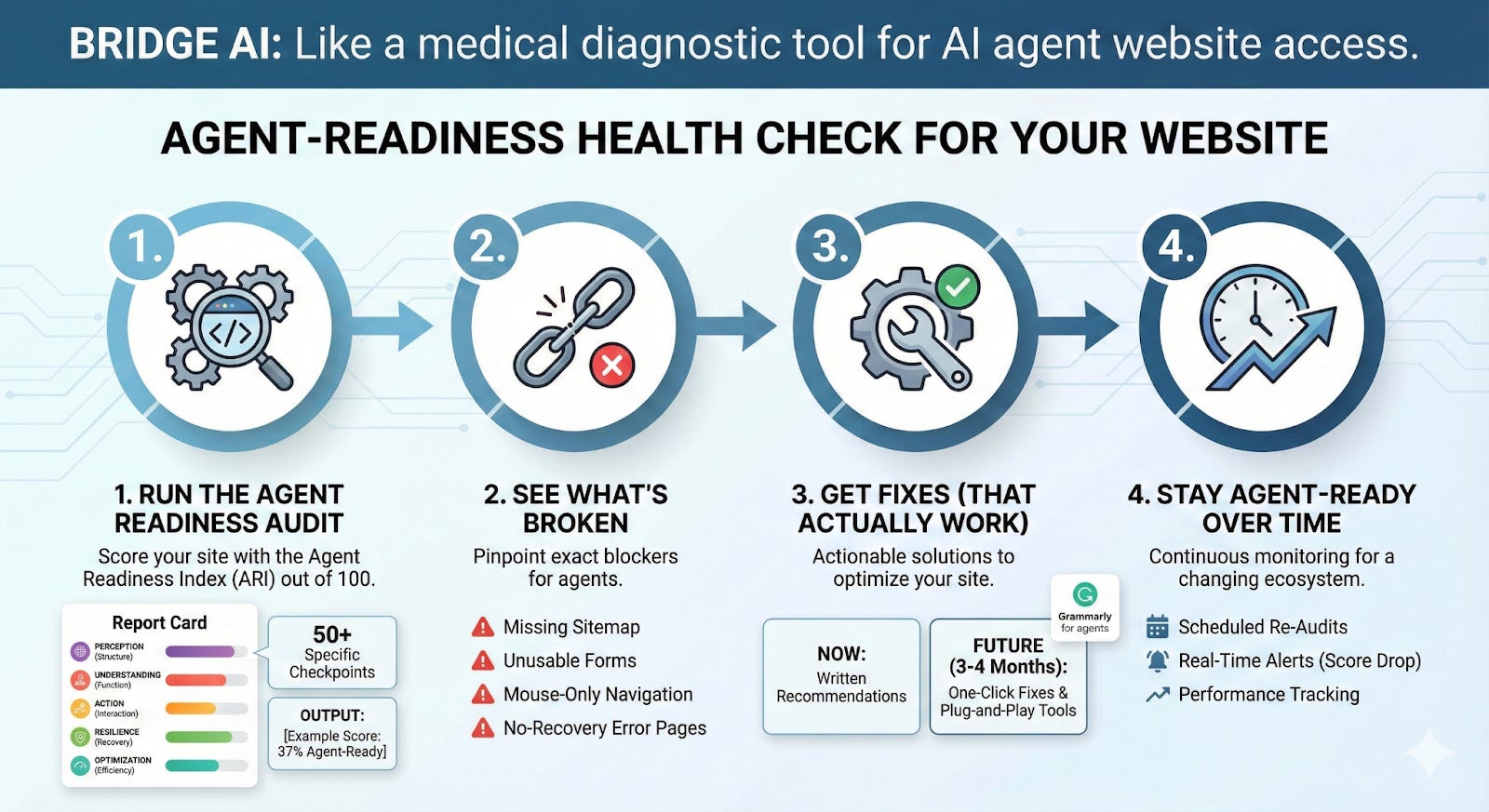
It scores your website out of 100 using something called the Agent Readiness Index. The score tells you if agents can navigate your site, complete tasks, and recover from errors without burning tokens.
Why this scoring matters?
Every audit makes the system smarter.
Fashion sites behave differently than banking sites. Online stores have different agent patterns than software companies.
The more sites Bridge AI audits, the better it gets at spotting what’s broken. That’s the competitive advantage. A growing database of benchmarks that no competitor can replicate overnight.
Their product roadmap:
Right now, Bridge AI gives you a diagnosis and tells you how to fix it.
In a few months, it’ll ship one-click fixes. Plug-and-play tools that optimize sites without needing developers.
By 2026, they’ll offer continuous monitoring, API access, and integration into deployment pipelines so every code push gets checked for agent readiness.
The Market: A $140 Billion Infrastructure Gap
Total market for AI infrastructure: Over $140 billion.
This includes orchestration tools, observability platforms, compliance layers, and agent-readiness tooling.
Serviceable market for Bridge AI: $15 billion to $25 billion.
AI-first software companies, online stores, and ecosystem platforms like Shopify, Vercel, and Supabase already dealing with AI agent traffic.
Realistic target market: $500 million to $1 billion.
Software teams and platforms that need continuous agent-readiness audits, not one-off reports.
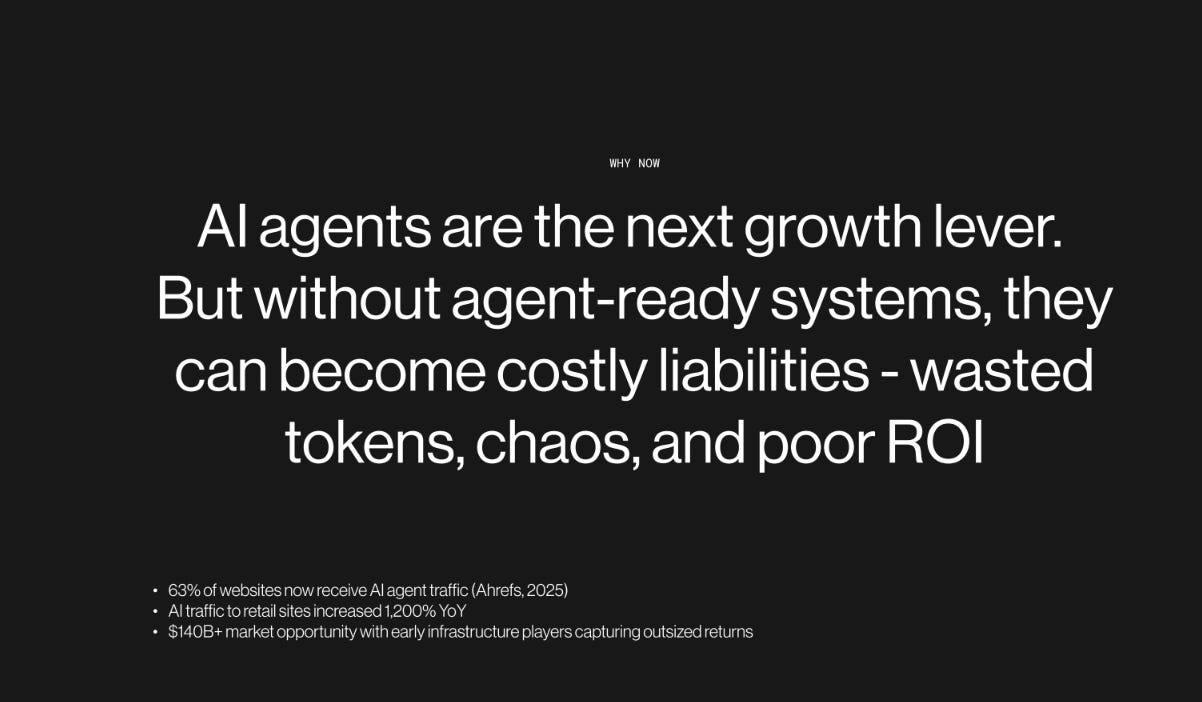
Why now?
AI traffic to retail sites increased 1,200% year-over-year between 2024 and 2025.
63% of websites now receive AI agent traffic.
Companies like OpenAI, Anthropic, and Google are pushing businesses to optimize or get left behind.
Traction & Business Model
After building the tool in one weekend, Arunima proved the market wanted it in three weeks.
The validation:
She audited 200 websites. 95% scored below 4 out of 10.
65% of those companies came back asking how to fix it.