

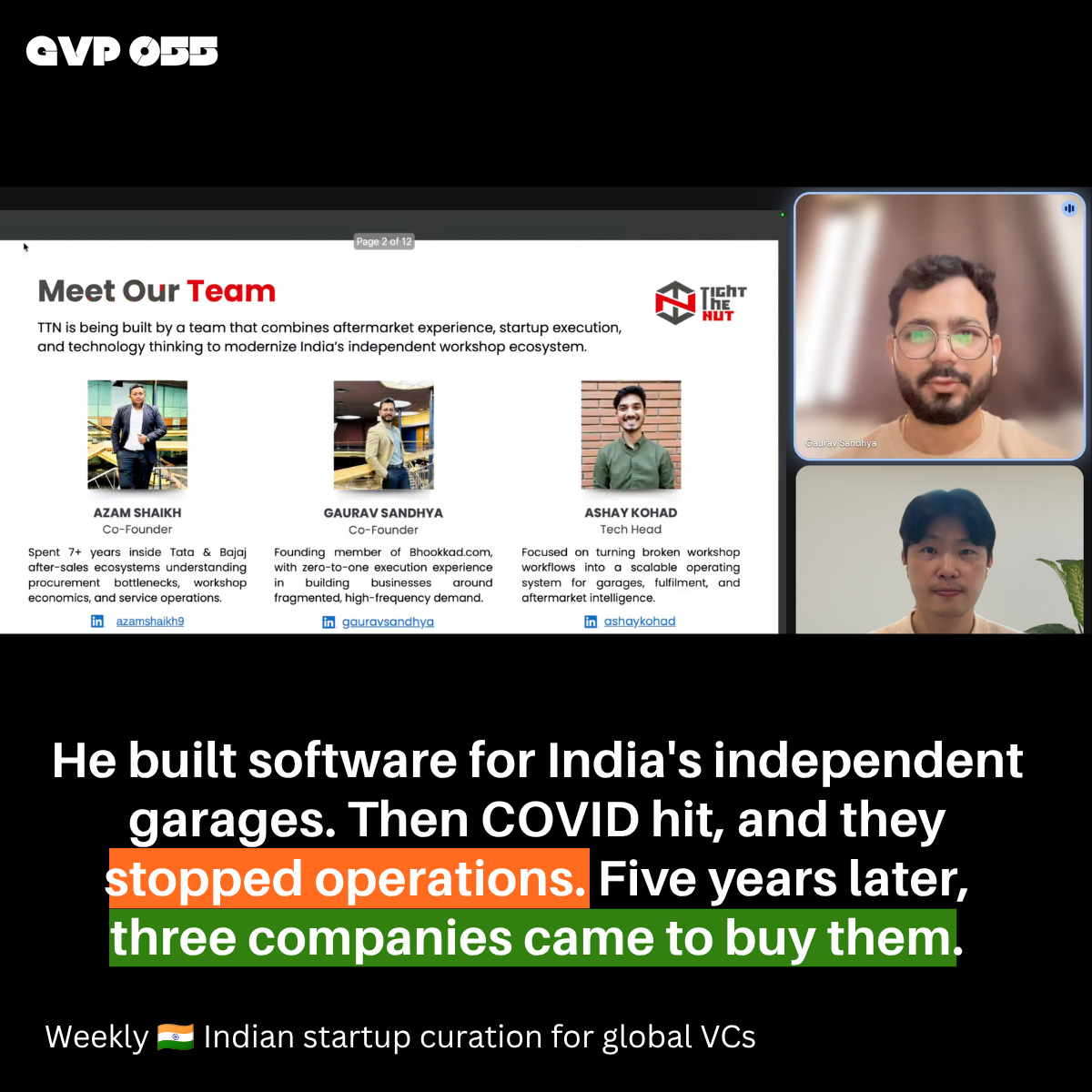
If you’re new here, Welcome.
Welcome back to GVP. Every week we meet one Indian founder, verify the traction, and write the story so you can make faster investment decisions. We added 32 new subscribers last week — now at 650 investors reading weekly. If someone forwarded this to you, subscribe here.
Dear fellow investors,
When Gaurav Sandhya started selling TTN Garage, his workshop management app, in Pune, the biggest objection he heard wasn’t about price.
Mechanics didn’t want to touch a phone screen with greasy hands.
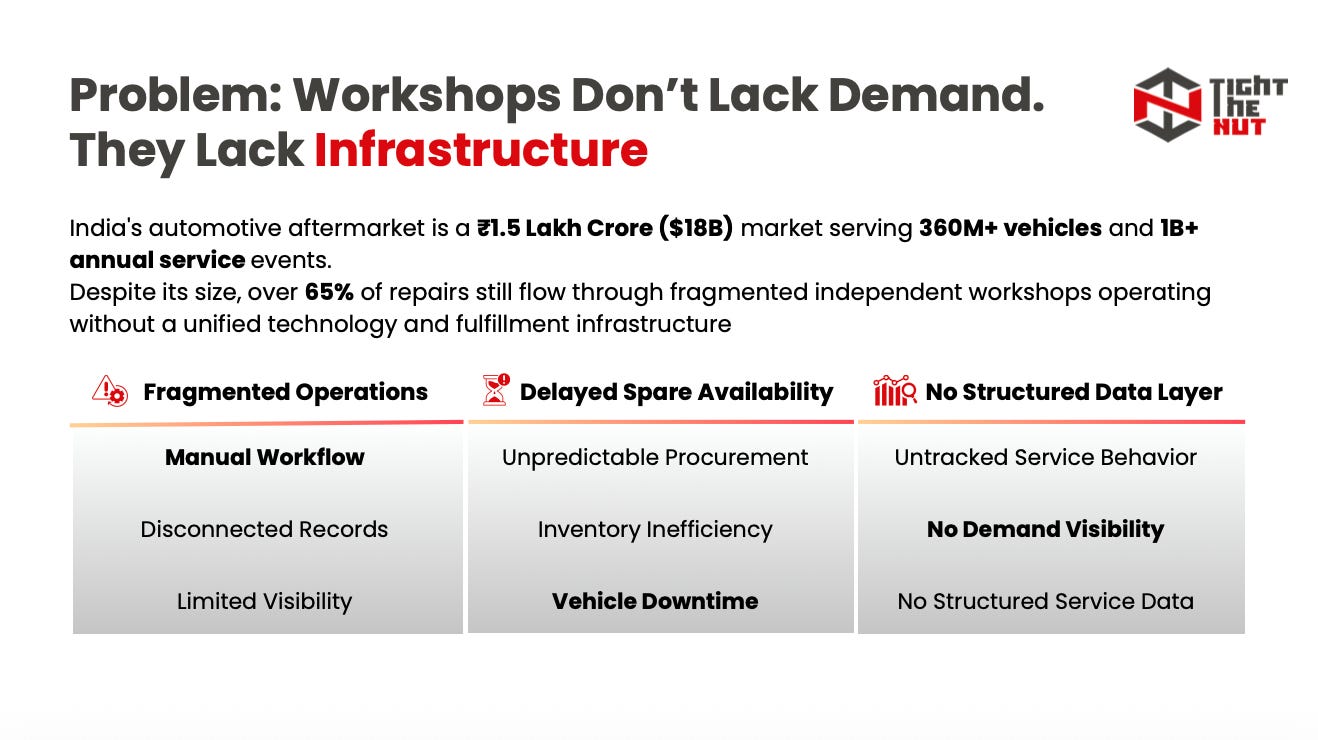
India has more than 400 million registered vehicles, and roughly three-quarters are two-wheelers. After the warranty year ends, most owners leave the authorised service centre for the local garage because it’s cheaper and closer.
India’s independent repair channel was worth $11.9 billion in 2024, larger than the authorised network, and almost all of it still runs on paper.
Software companies have circled this market for years. Reaching the customer means reaching a man who does not read English, has never paid for a subscription, and is holding a spanner.
Tight The Nut launched TTN Garage just before COVID and got nowhere with it. Operations stopped during the pandemic.

What kept garage owners up at night
When the team restarted in 2021, they stopped asking how to get a garage onto a phone and started asking what a garage owner worries about.
The answer was repeat business.
When a customer collects a repaired bike, the work is already hidden. The panels are back on, and the part is inside. There’s no bill listing what was replaced and no way to check the mechanic fitted what he said he fitted.
So the customer tries a different garage next time, and the owner never finds out why.
TTN Garage was rebuilt around that. Job cards, itemised invoices, service histories, and reminders that go out when the next service is due.
A missing spare part created the second business
Running inside the garage showed them a second problem.
A mechanic opens the bike, finds the broken part, and knows exactly what he needs. If it isn’t on the shelf, the repair stops. The bike sits on the ramp, the bay is blocked, the customer waits, and the owner sends someone out to hunt for the part.
TTN tested this with engine oil and found garages didn’t want a month of stock. They wanted the right product for the bike already waiting.
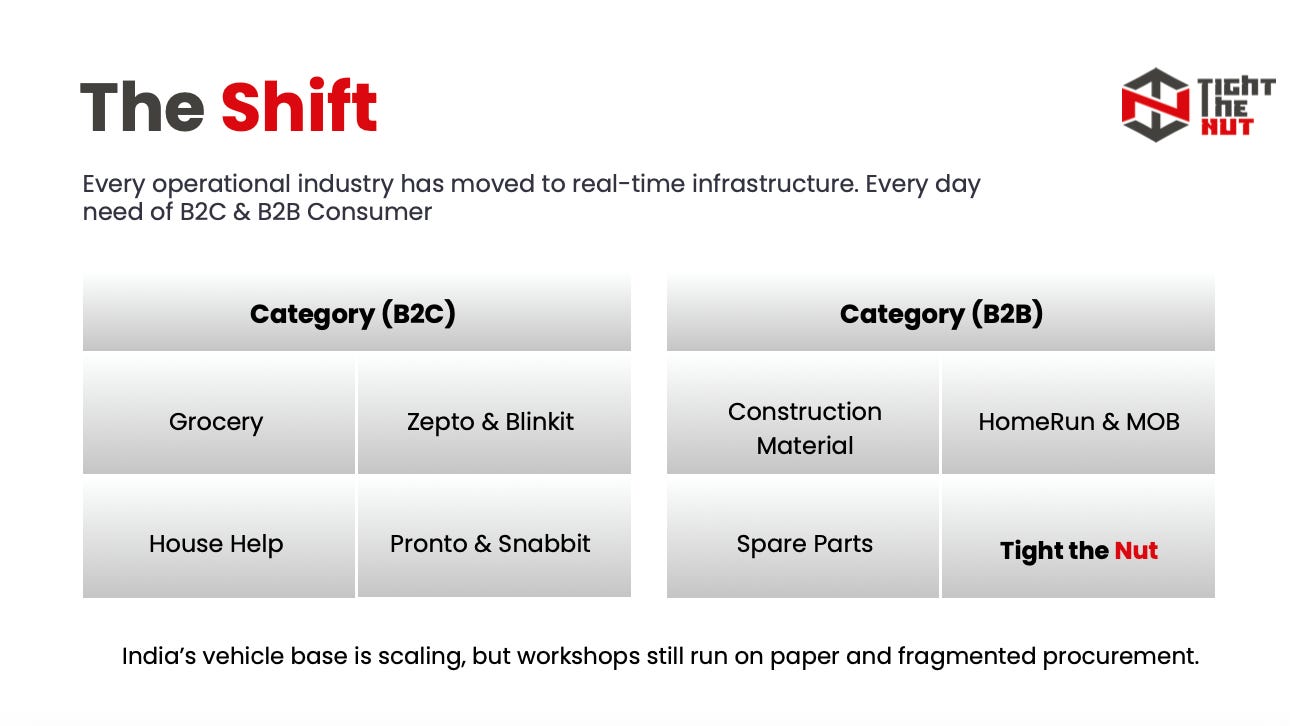
That became TTN Retail, which delivers parts and lubricants to garages within 30 minutes, inside the same app. When a mechanic logs the diagnosis, TTN sees the demand before the order exists.
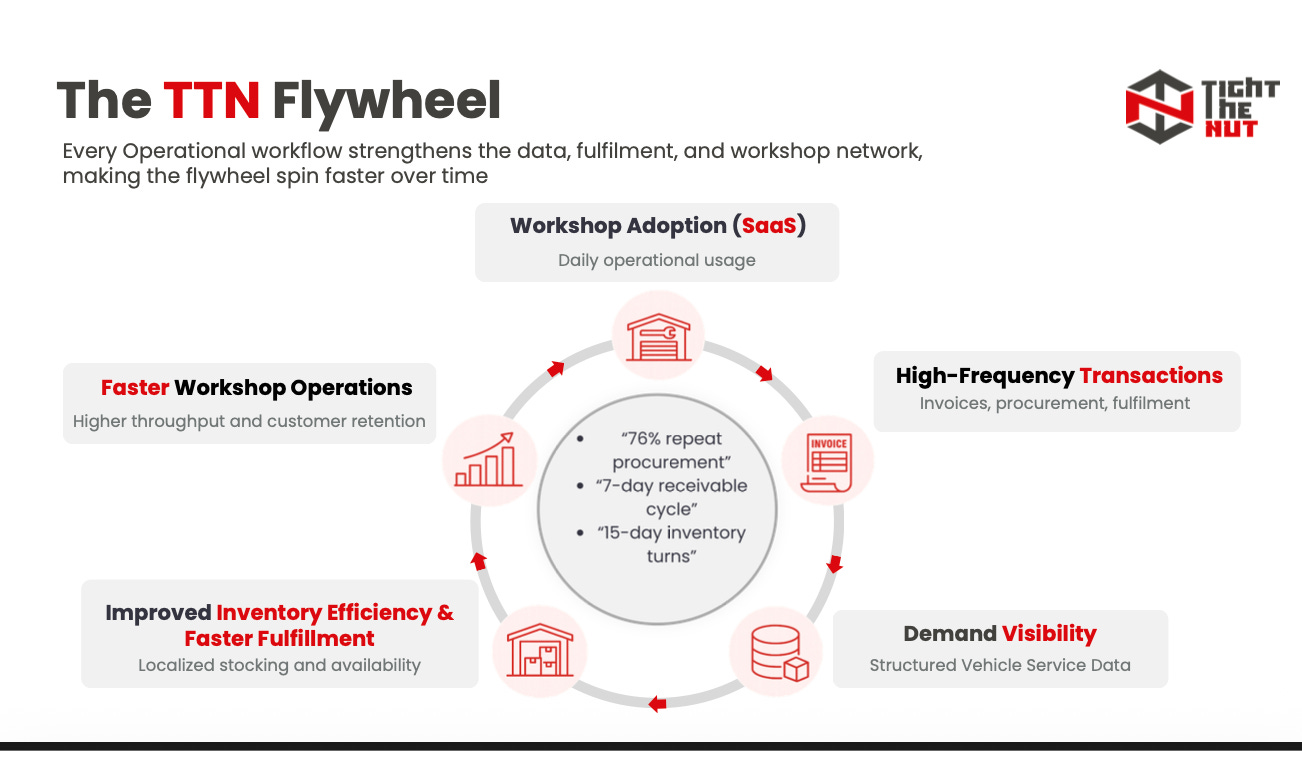
Here’s where an investor should slow down. TTN Retail covers four Pune pincodes at roughly 150 orders a month, with an average order near $250 (₹22,000). 76% of its garage buyers have ordered again.
Tight The Nut is raising $2 million (₹18 Cr) to reach three cities and 12 micro-hubs.
The app had to speak nine languages before anyone used it
Mechanics were not comfortable in English, so TTN Garage runs in nine Indian languages including Marathi, Tamil, Kannada and Malayalam.
The harder call was data entry. Mechanics use local names for parts that don’t map to a standard catalogue, so TTN Garage lets them type whatever they say and standardises it at the backend.
Selling changed too. City-level garage associations made the introductions, and an endorsement from one carried weight no demo could.
Around 22,000 workshops have registered since. That shows reach rather than usage, and the number that matters next is how many still create job cards every week and pay for it.
A leading two-wheeler manufacturer told them the data stops at year three
In 2022, the team worked with one of India’s largest two-wheeler manufacturers, who mentioned they hold about two and a half years of data on any given vehicle. After the warranty ends and the owner moves to a local garage, the bike leaves their view for good.
Sandhya was already collecting what happens next. Every job card on TTN Garage records which part failed, at what mileage, on which model, in which city.
That is why he calls Tight The Nut aftermarket infrastructure rather than a garage app, and why he has turned down three acquisition approaches.
He hasn’t sold any of it yet. The obvious buyer is the manufacturer who lost sight of the bike, and that conversation hasn’t happened.
Meet the team
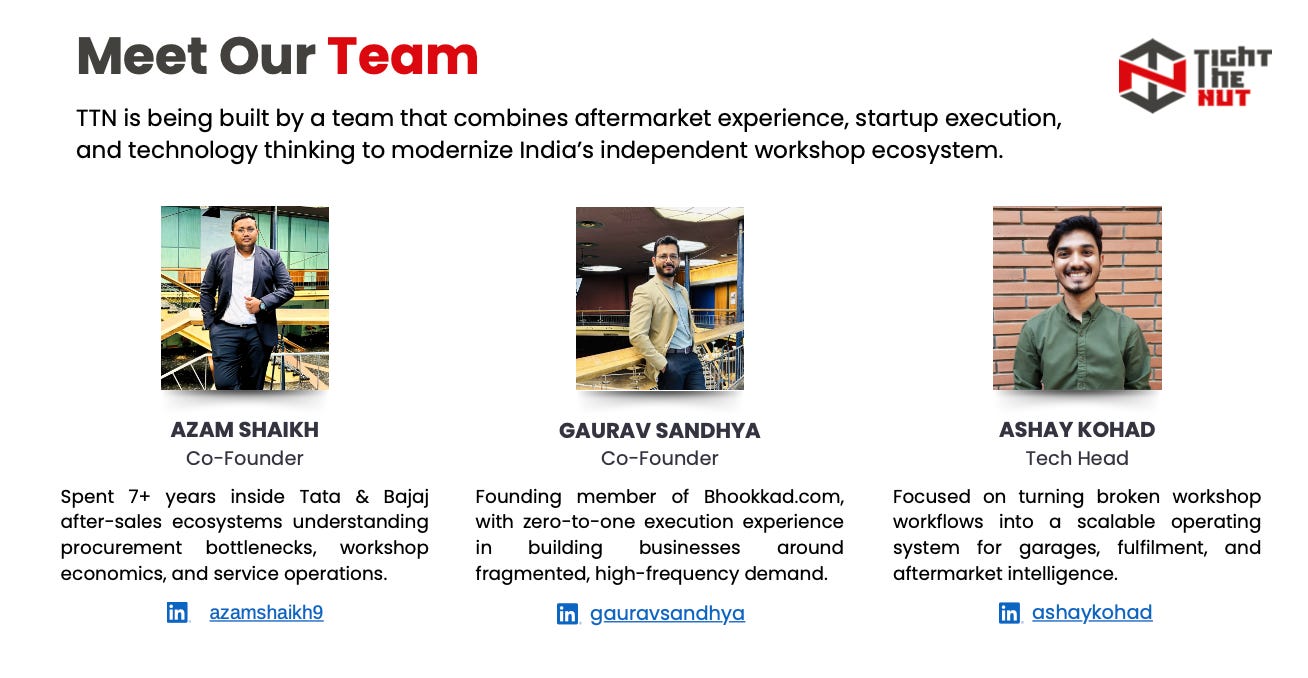
Azam Shaikh, co-founder. Seven years in after-sales at Tata and Bajaj, which is where the understanding of procurement bottlenecks and workshop economics comes from. He is the automotive depth in this company.
Gaurav Sandhya, co-founder. Founding member of Bhookkad.com, a food delivery business. His experience is building in fragmented, high-frequency markets rather than in automotive.
Ashay Kohad, tech head. Runs engineering.
Our take
The repeat rate is the clearest early demand signal. A 76% reorder rate suggests that garages find operational value in TTN Retail. The next test is whether this behaviour continues without excessive discounts or credit and produces a positive contribution margin.
The distribution layer is harder to copy than the software features. Nine-language workflows, garage-association relationships, and five years of operating knowledge give TTN access and context that capital alone cannot recreate quickly. The three acquisition approaches suggest that strategic players also recognize value in this position.
The real thesis is the connection between software and commerce. TTN Garage captures demand when a mechanic diagnoses a vehicle. TTN Retail fulfils that demand while the vehicle is still on the ramp. If active software usage lowers customer-acquisition costs and improves inventory planning, the two businesses can reinforce each other.
The opportunity is national, but the commerce model remains locally proven. TTN Garage has registrations across India, while TTN Retail currently operates across four Pune pincodes. The next phase must demonstrate that hub-level economics, order density, and repeat behaviour can be reproduced across three cities without allowing working capital and fulfilment costs to outrun growth.
The right investor should bring more than capital. Strategic and global investors with automotive, distribution, supply chain, or aftermarket experience could accelerate partnerships and market access. The priority should be investor fit and execution value, not geography alone.
Again, Tight The Nut is attempting something more difficult than building another garage application or spare-parts marketplace.
It is trying to connect the workflow inside an independent garage with the supply chain that serves it.
TTN Garage helps a workshop understand and manage the repair.
TTN Retail brings the required part to the workshop within 30 minutes.
If TTN can prove that this combination produces stronger retention, better inventory efficiency and profitable hub-level economics, it could become something neither a pure software company nor a conventional distributor can easily replicate:
The operating and fulfilment infrastructure for India’s independent automotive garages.
Want an intro to the founders? Just reply to this email.
P.S. One last thing…
GVP has 650 investor subscribers — including partners at Accel, principals at family offices in Singapore and Dubai, and angels across the US, Australia, and Europe.
If you forward this newsletter to 3 investors who subscribe, we’ll make a warm intro for you to any family office or VC in our network you’d like to meet.
See you next week
If you want me to make a warm intro with this startup founder, feel free to reply to this email!
Email: jaylee@globalventureplay.com