

Quick Summary
Sector: Food-tech/Hyperlocal Delivery
Stage: Pre-seed (Raising ₹5 Cr for 10%)
Traction: ₹50L+ GMV, 1,000+ customers, 60% retention
Model: Marketplace connecting customers with local butchers + cold-chain logistics
Opporuntity: $80B Indian meat market is 90% unorganized, but Tier ⅔ cities have zero viable players
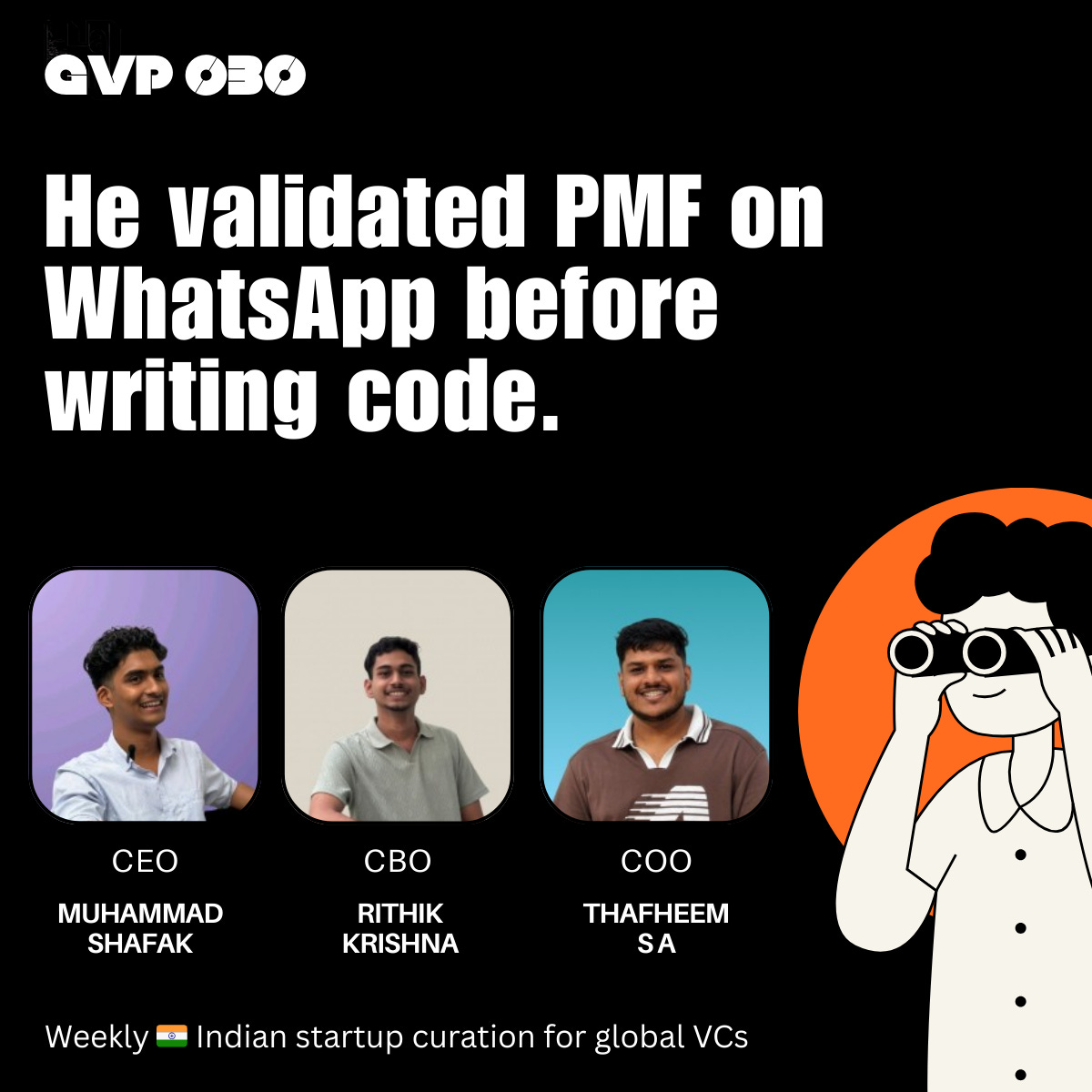
We feature Jugaad founders in GVP
Every week, I personally vet one early-stage founder (screened from 200+) and break down why they’re investable before Sequoia sees the deck.
Our readers include partners at Accel, WTFund, Ice VC, and 500+ investors across four continents who use GVP to spot Jugaad founders building in India’s explosive growth phase.
You’re getting the same dealflow. Just earlier.
“You’re Too Young. Come Back When You Have an App.”
Muhammad Shafak has heard this from every Indian VC he’s pitched.
Last week, I got on a Zoom call with a 21-year-old from Kerala.
Muhammad Shafak runs a meat delivery business. No family connections to VCs. Didn’t go to IIT. Never worked at a startup before.
And his meat delivery business? It runs entirely on WhatsApp. No customer app. No fancy tech stack. Just notebooks, QR codes, and hustle.
MOST VCs look at his deck and say: “this won’t scale.”
But here’s what they’re missing while they pass:
Shafak is doing ₹4 lakh in monthly GMV(Growth Merchandise Value).
Over 1,000 customers.
50+ orders every day.
60% retention rate.
All bootstrapped. All built in 18 months. All running on WhatsApp.
He didn’t wait for a perfect moment to build an app or to get funding.
He tested the market with an MVP build using WhatsApp.
The Kid Who Started With a Notebook
Shafak didn’t set out to build a startup.
He was a second-year college student in Palakkad who noticed something simple:
His neighbors wanted fresh meat delivered. Local butchers had fresh inventory. But there was no way to connect them.
So he became the connector.
He’d call butcher shops in the morning. “What do you have today?”
He’d write it in a notebook. Post it in a WhatsApp group. Take orders from neighbors.
Then he’d coordinate delivery.
No pitch deck. No funding. No permission.
Just: “Can I help you sell more meat?”
The butchers loved it. They were selling more inventory without doing anything different.
The customers loved it. Fresh meat delivered in 30 minutes without leaving their house.
And Shafak? He was making money from day one.
Within weeks, he had 100+ customers ordering regularly.
Within months, he realized he’d stumbled onto something big:
Nobody needs another Licious (one of the biggest player in the market)
But India needs Swiggy for butchers.
The $80 Billion Market Where This 21-year-old Tested PMF With Just Whatsapp
India’s meat market is $80 billion. 90% of it is unorganized. Sold through unhygienic local butcher shops.
So the answer seems obvious: centralize everything.
That’s what Licious did. Raised hundreds of millions. Built massive fulfillment centers. Controlled the entire supply chain.
And it worked — in Mumbai, Bangalore, Delhi. Licious is now worth $2 billion with 40% market share in Tier 1 cities.
But here’s what nobody talks about:
Customers don’t trust centralized players.
They trust their local butcher. The guy they’ve bought from for 20 years. The one who knows exactly how they like their chicken cut.
Licious solved hygiene. But created a trust problem.
And in Tier 2 and Tier 3 cities where 75% of India’s meat consumption happens, that trust gap is bigger than the hygiene gap.
Shafak understood this because he grew up in Palakkad.
He wasn’t trying to replace local butchers. He was trying to help them.
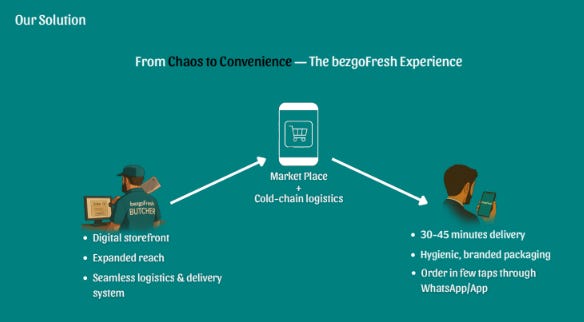
Give them a digital storefront. Handle their logistics. Let customers order from their trusted guy with the convenience of delivery.
Don’t disrupt the butcher. Empower them.
That’s the entire model.
And it’s already working.
The one thing investors kept asking for and why he ignored it
Others might see it as a weakness, but I think he did it brilliantly
When Shafak pitches investors, they always ask the same question:
“Why don’t you have a customer app?”
And Shafak always gives the same answer:
“My job as a founder is to prove I’m solving a real problem — without writing a single line of code.”
So he didn’t build an app waited to spend money on that.
Instead, he tested the market with what he had.
Here’s how it works today:
Customers text orders to a WhatsApp number
Backend team routes orders to butcher shops via custom tablets
Butchers prepare orders using the tablet interface
Delivery boys get assignments through a simple PWA
Payment links sent via QR codes
If customers are willing to order meat through WhatsApp, with no slick UI, no one-click checkout, no gamification, then they’re solving a problem and people are ready to pay for it.
Eventually, he launched the app.
This one decision tells you everything about how this founder thinks
He just hired a CTO who went through YC interviews to build it.
But he refused to build the app first.
Because most funded startups do it backwards:
They raise millions. Build a beautiful app. Then try to find customers who’ll use it.
Shafak did the opposite:
He found 1,000 customers who love the service. Now he’s building the app to make their experience even better.
Licious vs BezgoFresh
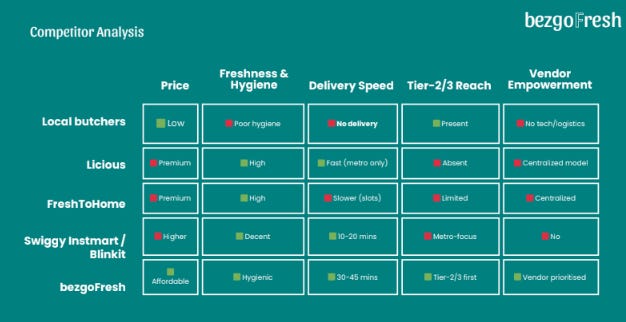
Licious is in Mumbai. Swiggy Instamart is in Bangalore. Zepto, Blinkit, FreshToHome — all fighting for Tier 1.
Market share in metros? Over 20%.
Market share in Tier 3 cities? Less than 3%.
Nobody’s fighting for Palakkad.
And yet:
These cities are urbanizing rapidly
People have disposable income
They want convenience
But they won’t pay Licious’s premium or wait 90-120 minutes
bezgoFresh’s wedge is simple:
Faster than Licious (30-45 minutes vs 90-120 minutes)
Cheaper than Licious (no premium markup)
More trusted than Licious (still your local butcher, just digitized)
While funded startups burn cash fighting for the same customers in Bangalore, Shafak is quietly capturing Tier 3 cities before anyone notices.
