

If you’re new here, Welcome.
Welcome back to GVP. Every week we meet one Indian founder, verify the traction, and write the story so you can make faster investment decisions. We added 32 new subscribers last week — now at 550 investors reading weekly. If someone forwarded this to you, subscribe here.
“Your margin is my opportunity.”
— Jeff Bezos
Hey there!
Tata Starbucks lost $16 million in India last year. Other funded premium cafe chains in the country tell similar stories, with rents climbing faster than revenue.
The standard read on India’s cafe market is that
The bigger you scale, the more you bleed.
This week’s startup is the counter-example.
Seven school friends from a small Kerala town, with no F&B background, have spent eight years building two cafe brands that make money at the outlet level, where every funded premium chain loses money.
Here is their story:
Seven school friends with $8,000 and a food truck.
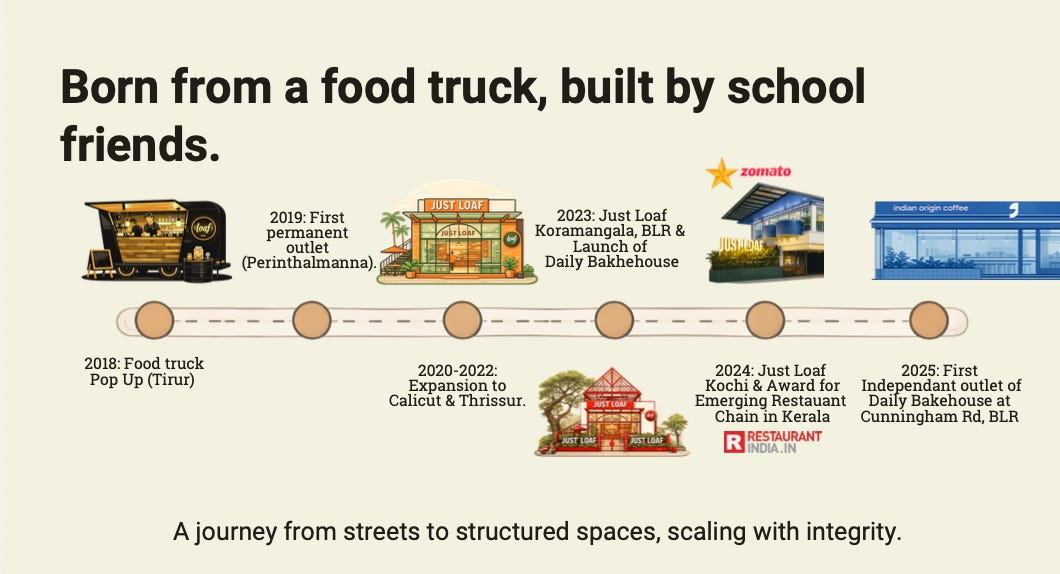
It started in 2018 in Tirur, a small town in Kerala.
Vishnu was studying IT and the others were doing engineering and architecture.
Between them they put in $1,200 each, bought a food truck, and started selling fresh burgers that nobody else in their town was making.
They went to college during the day and ran the truck till 3 AM.
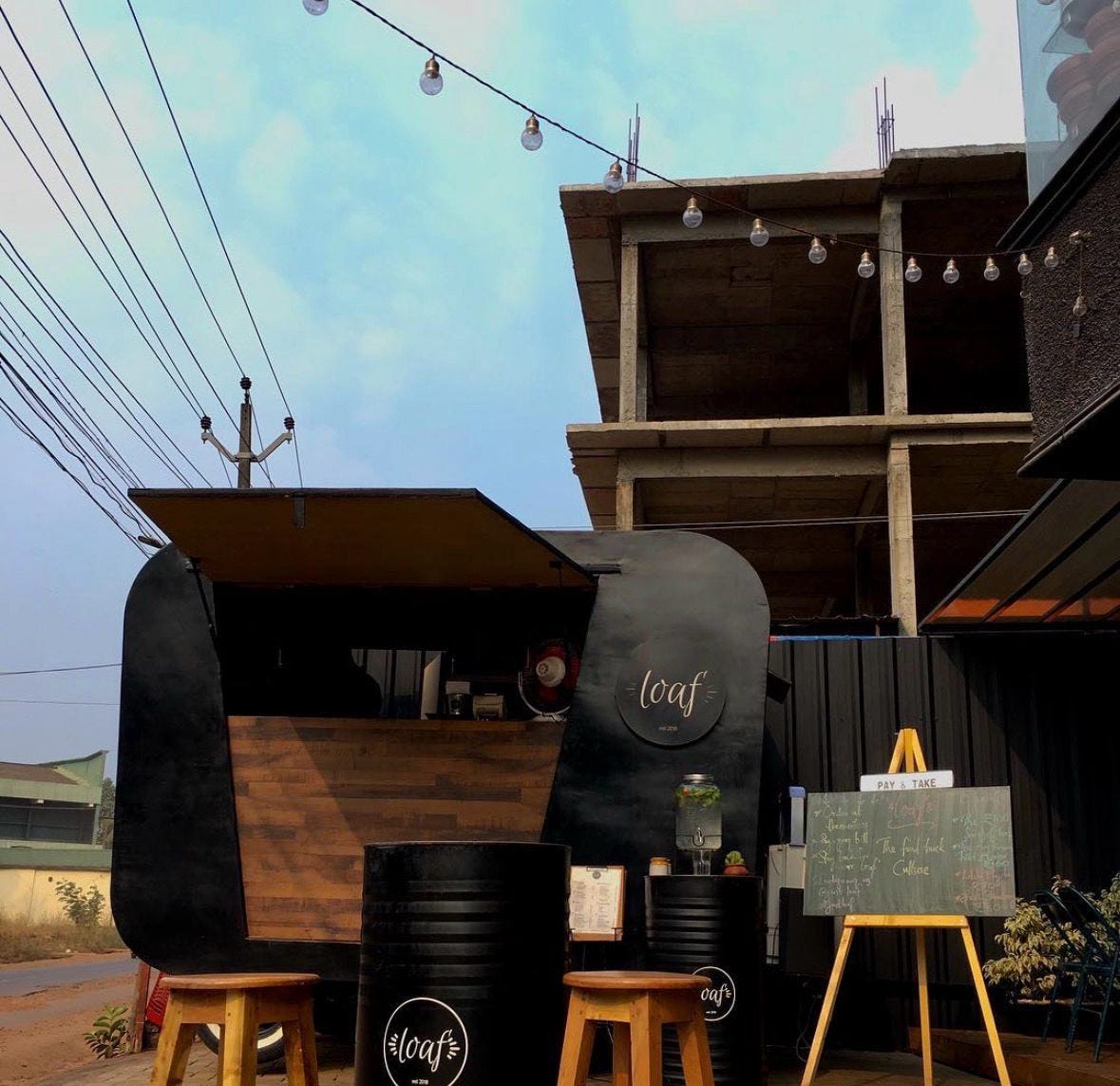
By 2019, they had outgrown the truck format.
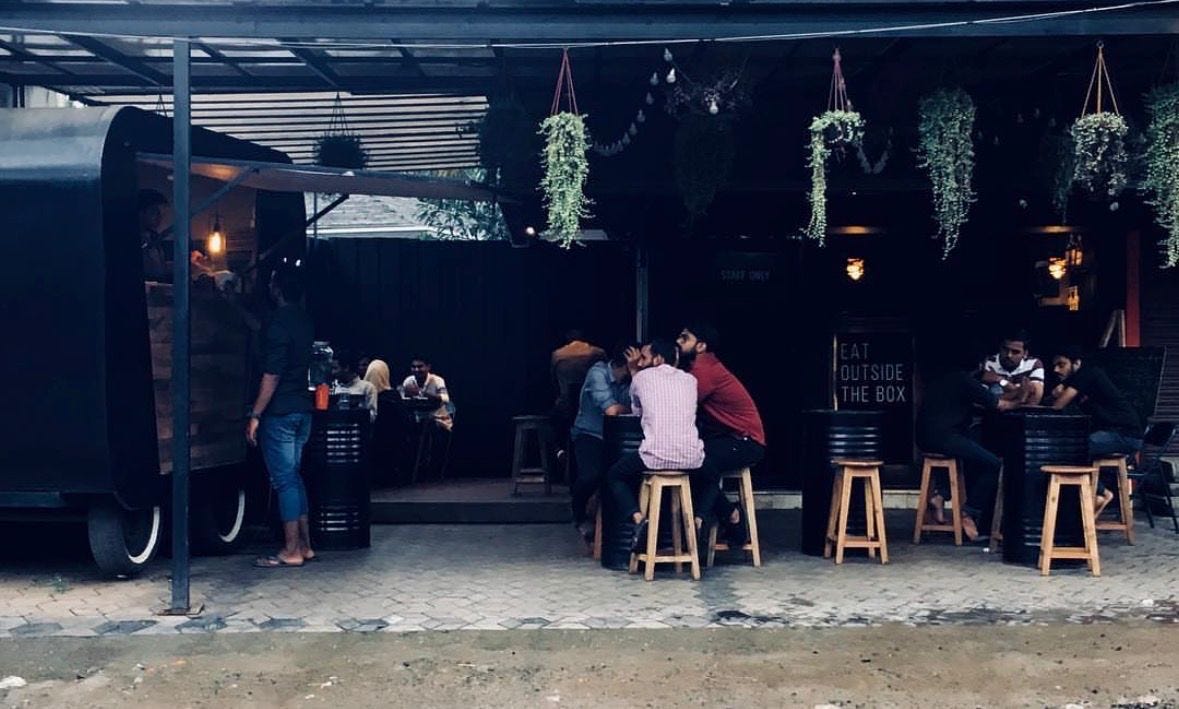
They converted it into a sit-down diner at the same location and called it Just Loaf. That original outlet remains in operation as the first Just Loaf.
Of the original seven, five remain in full-time roles after eight years.
The Indian cafe market has a structural problem.
In India, eating out is treated as an event, not a routine.
The two options for most people are expensive premium chains or roadside vendors where hygiene is a coin toss.
There is no clean middle ground.
The premium chains have tried to fill that gap and hit a wall.
Tata Starbucks has 479 stores and $150 million in revenue, but the FY25 loss widened to $16 million on 5% revenue growth.
Other funded premium cafe chains in India tell similar stories of rising rent and widening losses.
Rent and staff costs eat the margin before the customer walks in.
One back-end, two brands
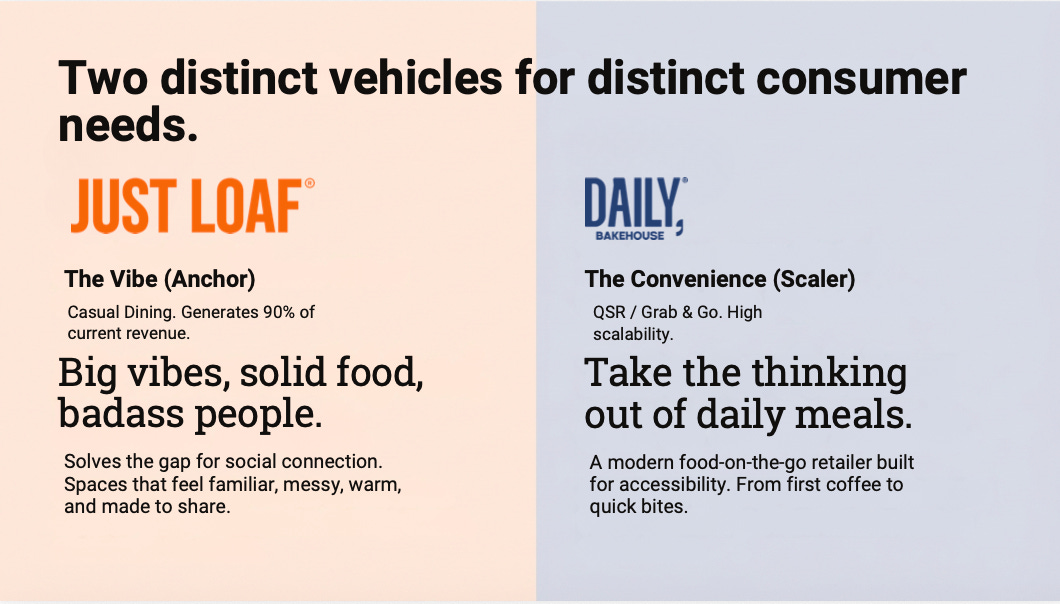
Tableside Pantry’s reframe is that they are not a restaurant company but a food infrastructure company that runs two brands:
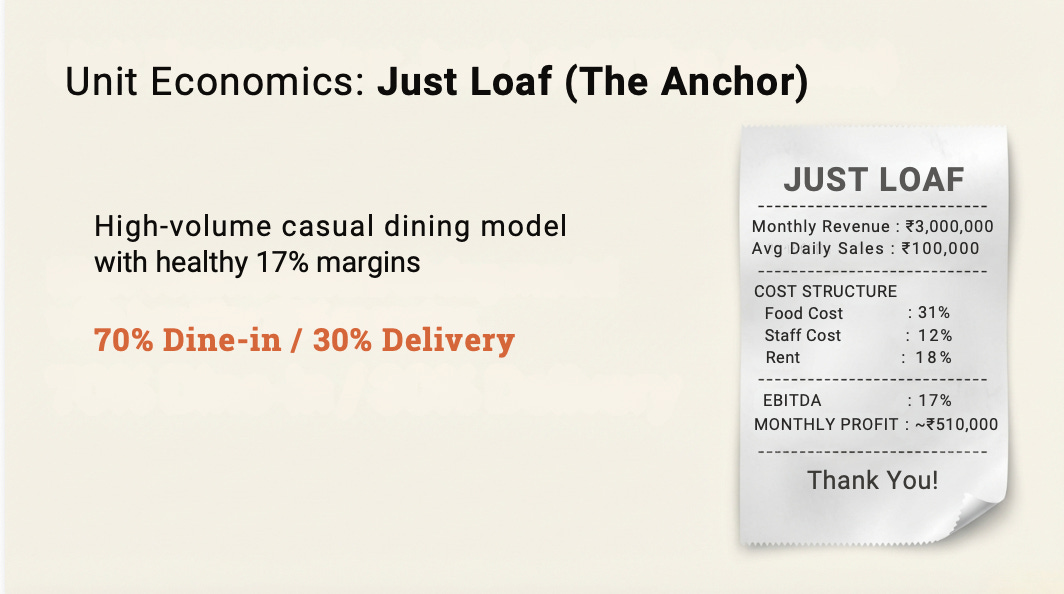
Just Loaf is an 1,800 sq ft neighbourhood diner with 52 seats. The casual sit-down anchor that generates 90% of current revenue.
Daily Bakehouse is a 300 sq ft grab-and-go with six seats and two employees, where everything is pre-made in a central kitchen.
Customers grab hot idli, coffee, or quick lunch, all priced between $0.60 and $2.50.
Think the Indian Pret A Manger, except built around hot Indian food at a price point where one person can eat there three times a day.
Both brands run on the same central kitchen and supply chain.
They built it like engineers, not restaurateurs
The co-founders’ engineering and IT backgrounds shaped how they approached the business. They broke it into solvable systems instead of running on intuition.
Logistics. They centralised the supply chain so multiple outlets share inventory and reduce per-unit cost as they scale.
Recipe. They kept the menu short and standardised, so quality stays consistent and two brands run off one kitchen.
Financials. They built the model around throughput per square foot, not seating density. A 300 sq ft Daily Bakehouse turns the same monthly profit as a 1,800 sq ft Just Loaf.
Meet the team
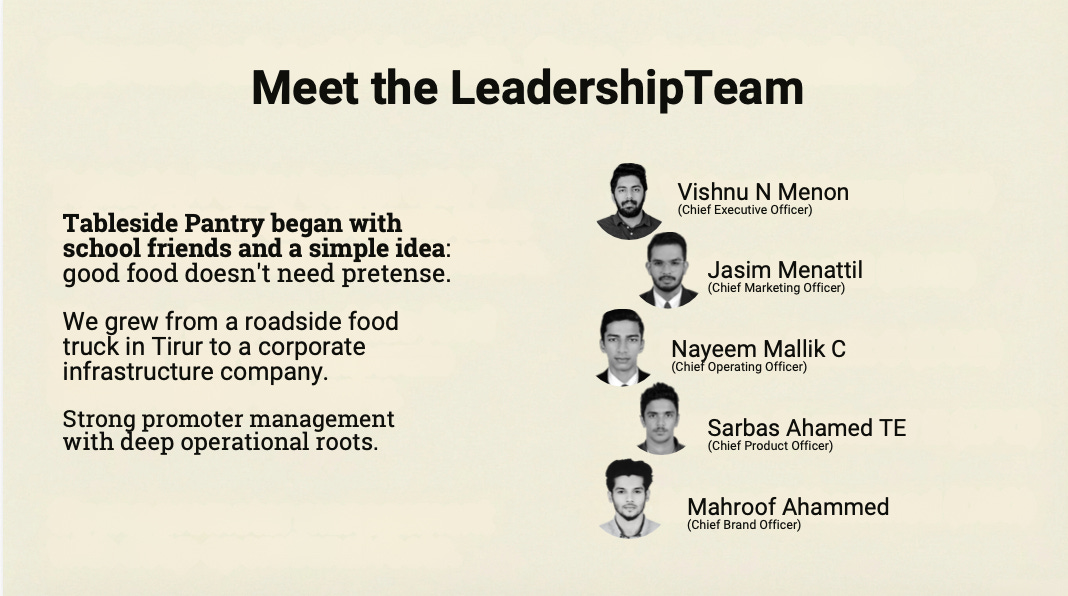
The company is run by five of the seven school friends who started the food truck in 2018:
Vishnu N Menon is the CEO. An IT engineer by training, he led the company’s transition from food truck to multi-brand operator.
Jasim Menattil is the CMO, leading marketing across both brands.
Nayeem Mallik C is the COO, running outlet operations, central kitchen, and supply chain.
Sarbas Ahamed TE is the CPO, owning menu and recipe development.
Mahroof Ahammed is the CBO, shaping brand identity for Just Loaf and Daily Bakehouse.
GVP Take
Tableside Pantry is one of the rare Indian F&B operators where per-outlet economics work without venture capital.
Two reasons we featured them.
Their origin story: Seven college students put $1,200 each into a food truck in 2018, ran it till 3 AM, and let customer demand build the rest of the business.
They had no F&B background and no industry capital, but the food worked, and the customer pull turned the truck into a multi-brand operator.The second is the engineering discipline. The co-founders’ engineering and IT backgrounds shaped every layer of the business: centralised logistics, short standardised recipes, and a financial model built around throughput per square foot instead of seating density.
That is why two formats of different sizes deliver the same monthly profit per outlet.
Eight years of discipline, two profitable formats, and a team that has stayed together since school.
That is why we featured Tableside Pantry this week.
P.S. One last thing…
If Tableside Pantry fits your thesis, reply to this email and we will introduce you to the founders. The intro is on us.
If this issue was useful, share it with one investor in your network. We are pushing for 1,000 subscribers in 60 days.
P.P.S One last thing…
If this was useful, forwarding it to one person in your network is the single best way to support what we’re building.
500+ investors already read this every week, including firms like Accel, WTFund, and Ice VC, alongside family offices from Dubai, Singapore, and Europe.
Our only promise is this: we will keep finding India’s best founders at the earliest stage, so you never miss a deal worth taking.
See you next week
If you want me to make a warm intro with this startup founder, feel free to reply to this email!
Email: jaylee@globalventureplay.com
Great Insights