


Quick Summary
Sector: CleanTech / Waste Management SaaS
Stage: Pre-Revenue | Platform Built & Ready for Launch
Market Size: ₹2.85 lakh crore (2025) → ₹11.2 lakh crore by 2045
Model: B2B Digital Marketplace connecting industrial scrap sellers with verified recyclers
Economics: 3-10% commission + subscription fees (up to ₹50K/month) + participation charges
Opportunity: 62 million tons of annual waste, 300M tons from construction alone, zero centralized platform
Traction: Platform live | Backed by 40+ years of founder expertise in waste management
Welcome to Global Venture Play (GVP)
where we help investors discover undervalued Indian AI startups.
Every week, we feature one high-potential Indian startup, carefully vetted for traction, team strength, and scalability.
So far, we’ve featured 22 Indian AI startups, and 35% of them have secured investor meetings or funding opportunities.
Our subscribers include top venture firms like Accel, WTFund, and Ice VC, alongside 500+ investors across four continents.
They thought Rs.45 Lakhs would be their profit, but it made them a Rs.1.2crore fine.
Hey there!
In 2023, a mid-sized manufacturing company in Mumbai sold 100 tons of plastic scrap to a local trader for ₹45 lakh.
The deal was done over WhatsApp. Payment came in three installments, delayed by weeks. The scrap was picked up by an unmarked truck with no documentation.
Six months later, environmental inspectors traced that same plastic to an illegal dumping site in Maharashtra — and slapped the manufacturing company with a ₹1.2 crore fine for non-compliance under Extended Producer Responsibility (EPR) regulations.
The trader? Vanished. No address. No trace. No accountability.
The company wasn’t trying to break the law. They just had no way to verify where their scrap actually went. No digital records. No compliance tracking. No platform connecting them to legitimate, verified recyclers.
This isn’t an isolated incident. It’s how India’s ₹2.85 lakh crore industrial scrap market operates every single day.
Manufacturers can’t find verified buyers. Recyclers can’t access quality scrap at scale. And ₹50,000+ crore leaks out annually to middlemen, brokers, and illicit operators who pocket 20-30% of every deal while leaving companies exposed to legal and environmental risks.
ScrapEco is solving this massive, invisible problem by building India’s first end-to-end digital infrastructure for industrial scrap management.
Let’s break down why this matters, how big the opportunity really is, and why this could become the Indiamart of industrial recycling.
India runs on UPI and 10-minute delivery — but industrial scrap still operates like it’s 1985.
Here’s the absurdity of India’s waste economy in 2025:
You can order groceries in 10 minutes. Get a loan approved via AI in 30 seconds. Transfer ₹10 lakh instantly through UPI.
But if you’re a factory in Pune trying to sell 10 tons of metal scrap?
You call a guy. Who knows a guy. Who sends another guy to your factory gate. You negotiate over chai. You might get a printed receipt, maybe not. Payment comes in cash or delayed bank transfers. There’s no contract, no digital trail, no compliance documentation.
And here’s the real problem: you have no idea if that buyer is even licensed to handle your scrap legally.
For manufacturers, this creates three existential risks:
Risk #1: Legal liability.
If your scrap ends up in an illegal dump or unauthorized facility, you’re the one who gets fined — even though you sold it in good faith. Under India’s EPR regulations, manufacturers are responsible for the entire lifecycle of their waste. But there’s no system to track it.
Risk #2: Lost revenue.
Without transparent bidding or market benchmarks, manufacturers have no idea if they’re getting fair value. A local trader might offer ₹40 per kg when the real market rate is ₹55. But how would you know? There’s no price discovery mechanism.
Risk #3: Operational chaos.
Every scrap transaction requires phone calls, WhatsApp negotiations, site visits, manual paperwork, and weeks of back-and-forth. There’s no standardized process. No digital workflow. Just chaos.
And for recyclers? The problem flips.
They can’t access consistent, quality scrap at scale because everything is locked up in offline networks controlled by middlemen. They’re stuck chasing leads, competing with fly-by-night operators who undercut them with illegal practices, and watching legitimate business opportunities slip away.
The result? A ₹2.85 lakh crore market that operates almost entirely offline, fragmented, and inefficient, with zero digital infrastructure connecting supply and demand.
ScrapEco is building the missing layer between manufacturers and recyclers.
Here’s what ScrapEco actually does:
It’s a B2B digital marketplace that connects industrial scrap sellers (manufacturing companies) with verified buyers (licensed recyclers and traders) — all on one centralized platform.
But it’s not just a listing site like Indiamart or a niche player like competitors who only handle EPR credits or plastic waste.
ScrapEco provides the full operating system for industrial scrap management:
For Sellers (Manufacturers):
Create online auctions and competitive bidding contracts for scrap lots
Get matched with verified, compliant recyclers instead of random middlemen
Achieve transparent price discovery through live bidding
Track every transaction digitally for compliance audits and EPR reporting
Access accounting tools, invoicing, and payment tracking in one dashboard
For Buyers (Recyclers & Traders):
Discover scrap opportunities across industries, materials, and geographies
Participate in auctions without paying broker commissions
Build credibility through platform verification, ratings, and transaction history
Manage procurement, inventory, and compliance documentation digitally
The Platform’s Real Edge:
ScrapEco isn’t solving just discovery or just compliance or just payments. It solves the entire workflow ( bidding, auctions, daily transactions, accounting, EPR credit trading, and regulatory compliance) – all integrated under one roof.
Think of it this way: if Indiamart is the Yellow Pages for B2B, ScrapEco is the Amazon + Zerodha + Tally for industrial scrap. It’s not just connecting buyers and sellers. It’s digitizing the entire transaction lifecycle in an industry that’s been analog for 40+ years.
Market Opportunity and Moat:
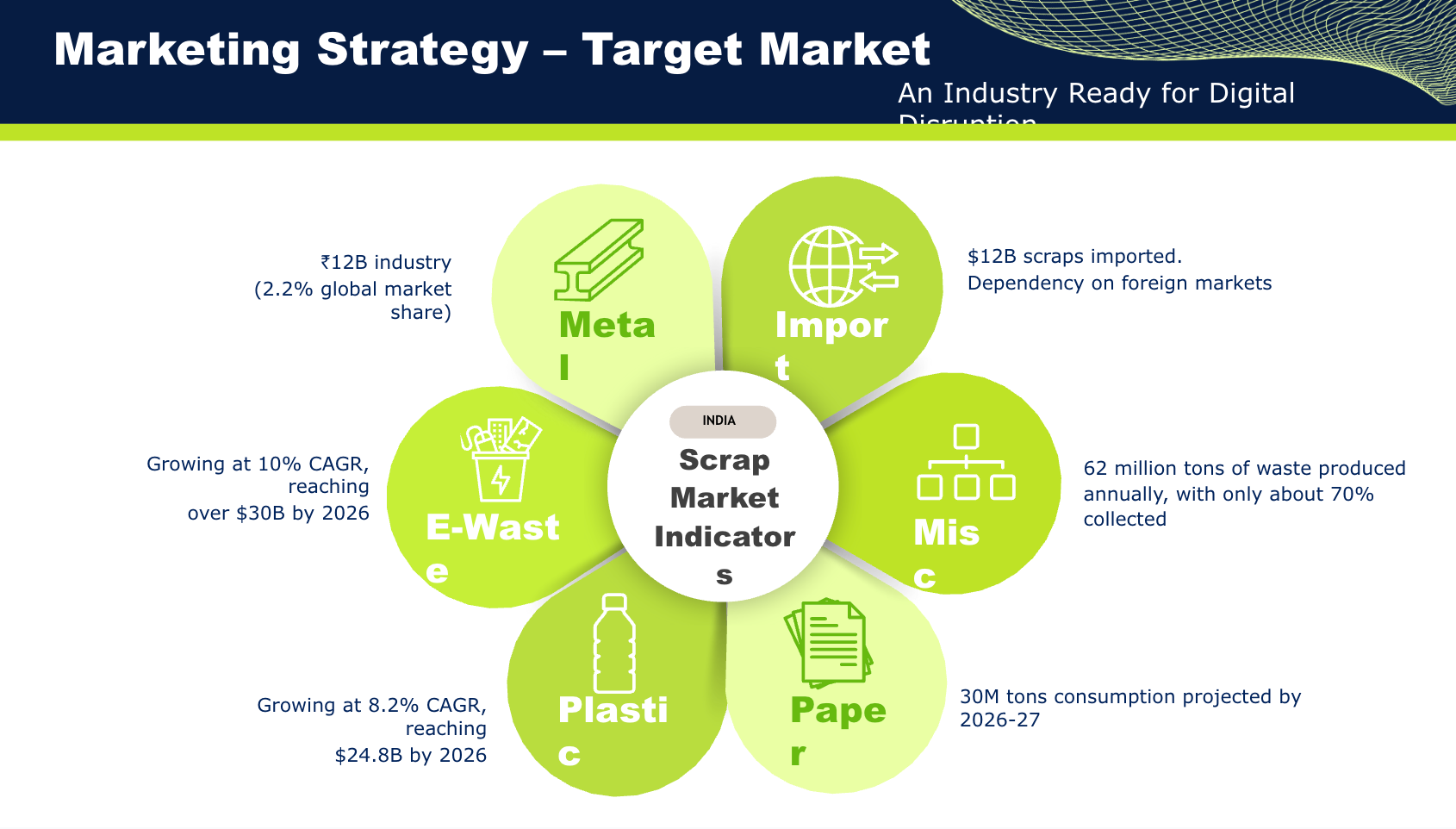
India generates 62 million tons of industrial waste annually and 30% of it never reaches legitimate recyclers.
Let’s talk about the market size, because the opportunity here is staggering.
India’s industrial scrap market is valued at ₹2.85 lakh crore in 2025 and projected to hit ₹11.2 lakh crore by 2045, growing at 8.5% CAGR over two decades.
Here’s what’s driving that explosive growth:
Construction & demolition waste: 300 million tonnes generated annually, the single largest source of industrial scrap
Ferrous metals (steel, iron): ~30 million tonnes, fueled by urbanization and infrastructure buildout
E-waste: ₹1.2–3 lakh per tonne, driven by electronics consumption and IT hardware disposal
Copper scrap: ₹5–7 lakh per tonne, with surging demand from EV manufacturing and telecom infrastructure
Battery waste (lithium, cobalt, nickel): ₹1–1.5 lakh per tonne, exploding due to electric vehicle adoption
Plastic waste: Aggressive regulatory push from government EPR mandates forcing companies to recycle
And here’s the kicker: 70-75% of these transactions still happen offline.
There’s no Swiggy for scrap. No Zerodha for recycling. No digital backbone connecting this massive, fragmented ecosystem.
Even the competitors that exist are playing in narrow, incomplete lanes:
Scrapit: Just a listing portal with no compliance features or transaction support
Zecomy: Focuses broadly on all waste types but lacks depth in industrial scrap workflows
Recykal: Specializes in EPR credit trading, primarily for plastics, but doesn’t handle the full transaction stack
None of them offer what ScrapEco does: a comprehensive, end-to-end platform purpose-built for the industrial scrap ecosystem — from price discovery to payment processing to regulatory compliance.
Meet the Team:
The founder spent 16 years watching manufacturers lose millions to middlemen and decided to fix it.
Behind ScrapEco is Amit Mete(CEO and Founder) and his story is the reason this startup has a real shot at winning.
In 2008, Amit walked into his father’s scrap yard for the first time as a business partner, not just a son. His father had been in industrial waste management since the 1980s, back when “recycling” meant sorting metal scraps by hand in dusty warehouses.
But what Amit saw shocked him.
Manufacturing companies were selling millions of rupees worth of scrap through phone calls and handshake deals. No verification. No contracts. No traceability. Middlemen pocketed 20-30% of every transaction. And companies had zero visibility into whether their scrap was being recycled legally or dumped illegally.
“This is a multi-lakh crore industry,” Amit thought, “and it operates like a street market.”
Over the next 16 years, Amit didn’t just observe this broken system — he built businesses inside it. He launched AM Industries in 2016, winning contracts with major clients like Siemens, Skoda, and Ram Bandhu Masala. He scaled operations in flexible packaging, pallet manufacturing, and industrial recycling.
And every single day, he saw the same pattern repeat: manufacturers couldn’t find verified buyers, recyclers couldn’t access quality scrap, payments were delayed, and compliance was a nightmare.
By 2022, Amit had seen enough. He incorporated ScrapEco — not as an outsider entering cleantech, but as someone who’d spent nearly two decades inside the problem, understanding every broken process, every pain point, every inefficiency.
Alongside him is a team built for execution:
Sumit Ram (Co-founder & COO): Operations expert focused on streamlining processes and scaling efficiently
Aravind Chintalapudi (CTO): Platform architect leading technology strategy, AI integration, and product roadmap
This isn’t a team of consultants or outsiders. This is a team that’s been in the trenches and is now building the digital infrastructure the industry desperately needs.
The business model is simple, scalable, and capital-efficient.
ScrapEco makes money in four complementary ways — each designed to scale without heavy capital requirements:
Revenue Stream #1: Commission from Buyers (3-10% of transaction value).
Every time a buyer wins a bid or completes a transaction on the platform, ScrapEco takes a small percentage. This is the primary revenue driver and scales directly with transaction volume.