


The 27% of online traffic is invisible, and you are losing the revenue.
For the last 20 years, websites were built for people like you and me.
You open your laptop, search "best CRM software for small business," click through 5 comparison sites, read reviews, and eventually fill out a demo form.
But now, people are sending AI agents to do this for them.
They tell ChatGPT: "Research the top 3 CRM platforms, compare pricing, and book demos for next week."
The AI visits dozens of sites, analyzes features, compares costs, and tries to book appointments. All while you're sleeping.
The problem is that Websites don't recognise these agents.
They see them as "weird traffic" that doesn't behave like humans. Agents don't scroll, don't hover over buttons, don't fill out forms the normal way.
So websites serve them the same human-friendly content: flashy hero sections, testimonial carousels, and "Click here to learn more" buttons.
But agents can't click buttons. They need structured data, clean APIs, and machine-readable content.
How does this reflect in Lost Revenue for brands?
This mismatch means money walking out the door.
SonicLinker's live data across 9+ brands reveals the shocking truth:
27% of traffic on B2B sites is already AI agents (not humans)
1% of agent visits go directly to pricing and booking pages (high purchase intent)
Zero visibility in Google Analytics, Mixpanel, or any tracking tool
Analytics tools show these agent visits as "direct traffic" or "unknown source." Brands think they have a measurement problem when they actually have a conversion crisis.
Here's what that looks like in real money:
If your brand gets 100,000 monthly visitors:
6,000 are AI agents (6% average from SonicLinker's data)
2,100 have purchase intent (35% of agents visit pricing/demo pages)
At $90 average order value = $189,000 in monthly revenue opportunity
However, because websites can't communicate effectively with agents, conversion rates drop to near zero.
That's $2.3 million annually that brands are leaving on the table simply because they don't know these visitors aren't human.
Two post-exit IIT founders saw this $200B blind spot and built the solution.
What is Sonic Linker building? Making the Web Agent-Friendly
Right now, websites and AI agents speak different languages.
SonicLinker is the translator that connects them.
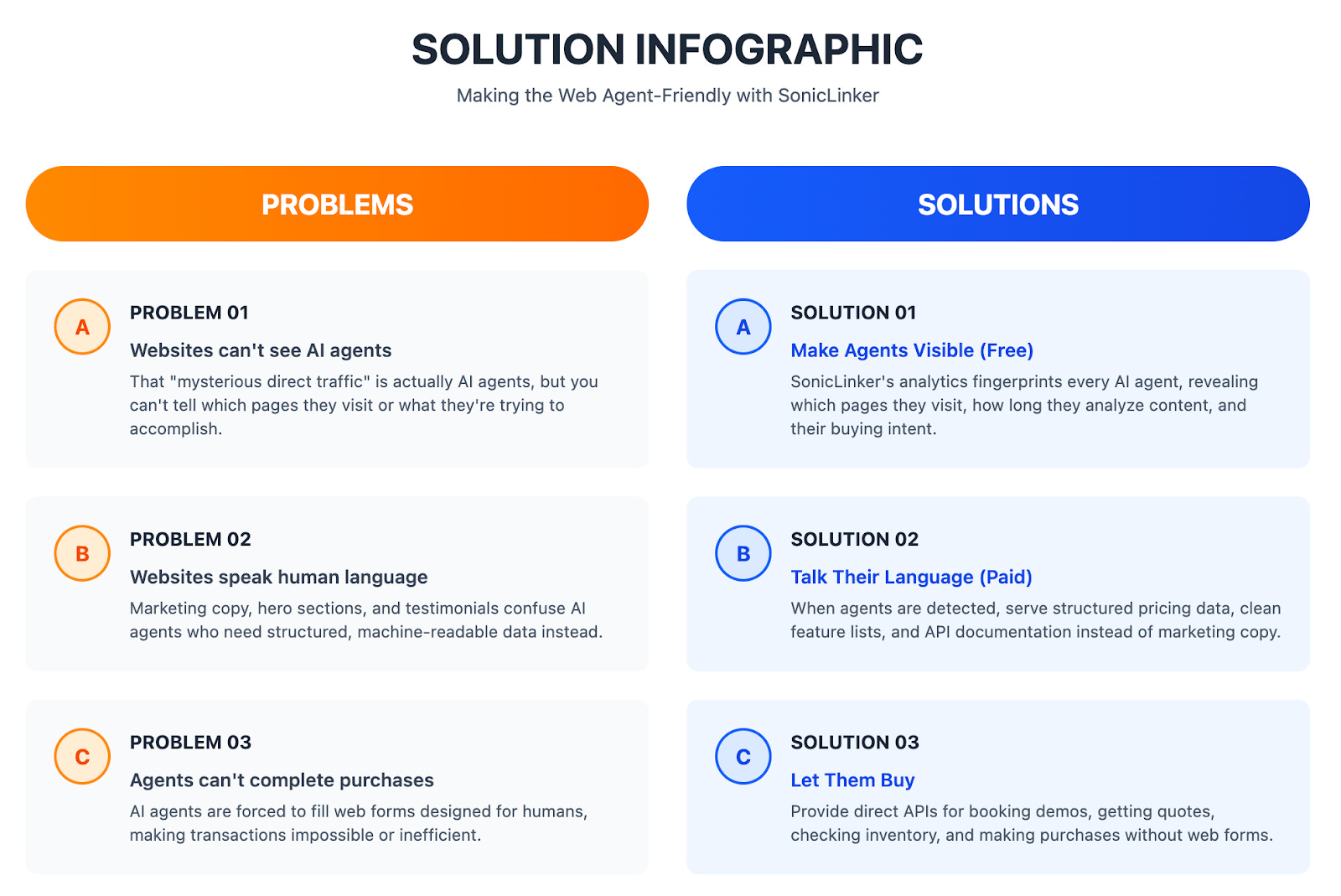
1: Make Agents Visible (Free)
SonicLinker's analytics fingerprints every AI agent visiting your site. Suddenly, that "mysterious direct traffic" becomes clear:
Which pages agents visit most
How long they analyze your content
Which agents have buying intent
What they're trying to accomplish
2. Talk Their Language (Paid)
When SonicLinker detects an agent, it serves machine-readable content instead of human marketing copy:
Agents see: Structured pricing data, clean feature lists, API documentation
Humans see: Your normal website with hero sections and testimonials
3. Let Them Buy
Instead of forcing agents to fill web forms, SonicLinker provides direct APIs for:
Booking demos (/book-demo)
Getting quotes (/get-quote)
Checking inventory (/check-stock)
Making purchases (/checkout)
What are the results for brands?
📌 3x More Agent Conversions
SonicLinker's live data shows immediate impact:
Traffic inclusion: 30% → 60% (agents can now find what they need)
Conversion rate: 6% → 8% (optimized for agent behavior)
Monthly orders: 37.8 → 100.8 (167% increase)
Monthly revenue: $3,402 → $9,072 per brand
The same traffic, but now 3x more agents actually convert because the website speaks their language.

This is not theory, Billion dollar companies are already using it.
The infrastructure is already here:
MasterCard Agent Pay and Visa Intelligent Commerce launched for agent transactions
Amazon "Buy for me" shops across any website
ChatGPT Agent Mode handles bookings and purchases
Google Project Mariner books travel, finds jobs, orders groceries
Brands using SonicLinker will be ready when agent commerce explodes. Those that don't will watch competitors capture revenue they can't even see.
Meet The Founders Who Cracked The Code
Two IIT alumni saw this massive shift and built the infrastructure layer brands desperately need.
Mr.Jain (CEO) is a 3x entrepreneur who built India's first hyperlocal marketplace at Zopper, raised $25M from Tiger Global and Blume, then sold to PhonePe. He later helped scale PhonePe's merchant network to 13M+ businesses.
Mr. Kumar (CTO) holds 4 patents from his time at Microsoft and Amazon AWS. He built Lekh, an AI diagramming app that acquired 100K users as a solo founder.
Their Business Model
Free Plan: Analytics helps brands see agent traffic for the first time (and builds SonicLinker’s dataset).
Pro Plan: $499/month + usage fees
$1.50 per 1K agent requests
$0.50–$2.00 per transaction (or 1% of GMV)
Based on 100K website sessions with 6% agent traffic:
Traffic recognized: 30% → 60%
Conversion rate: 6% → 8%
Monthly orders: 38 → 101
Monthly revenue: $3.4K → $9.1K
Same traffic. Nearly 3x more conversions.
Market Opportunity: Every Website Needs This
The Internet was built for humans. Agents are rewriting the rules.
200M active websites globally need agent optimization
$200B+ commerce will shift to agentic channels
Zero direct competitors solving this infrastructure problem
Legacy players like Shopify or Cloudflare could enter this space, but they're focused on existing business lines. SonicLinker has 18+ months of head start building purpose-built agent infrastructure.
Every extra $1 of ARR here can add $15 of enterprise value.
GVP Take
Every major platform shift creates a new layer of infrastructure. Mobile apps needed Stripe for payments. SaaS needed Twilio for communications.
Agent commerce needs SonicLinker.
Category creation doesn’t happen often. When it does, it’s almost always led by founders who’ve done it before.
Both SonicLinker and the founder’s previous company, Zopper, share a core strength: high gross margins and strong customer retention. This combination makes their SaaS economics especially attractive.
If SonicLinker were to scale to $10M ARR, its margin strength (75%) and retention-led economics (LTV/CAC ~4x) imply a theoretical enterprise valuation of $150M. That’s the kind of upside that comes from sticky SaaS infrastructure plays — every incremental $1 of ARR can create $15 of enterprise value.
And a first-mover advantage in a category that doesn’t exist yet.
Crucially, they’re not trying to build the agents. They’re building the infrastructure layer that makes agent commerce possible for every website on the internet.
When up to 27% of your traffic is already agentic and you can’t see it, measure it, or convert it. That’s not a small optimization problem. It’s an existential threat.
The brands that solve this first will dominate the agent-driven era. The ones that don’t will become footnotes in the history of human-only marketing.
Unit economy, traction records & full pitch deck download(Pro Zone)
