

If you’re new here, Welcome.
Welcome back to GVP. Every week we meet one Indian founder, verify the traction, and write the story so you can make faster investment decisions. We added 32 new subscribers last week — now at 565 investors reading weekly. If someone forwarded this to you, subscribe here.
The metal everyone owns and nobody can clean
My dear fellow investors,
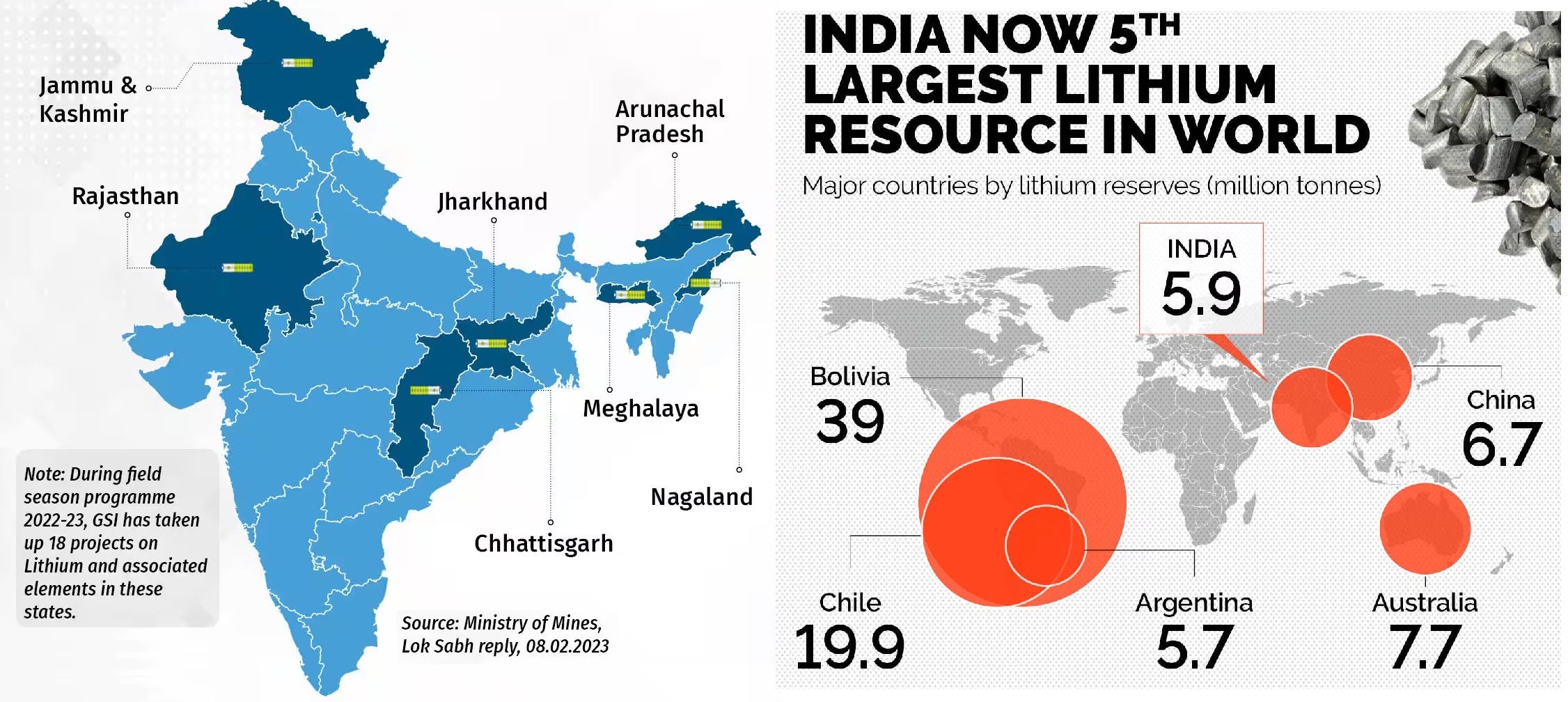
In February 2023, India announced it had found 5.9 million tonnes of lithium in Jammu and Kashmir. The headlines went wild. India is a lithium giant now.
Two years later, India still lacks meaningful domestic refining capacity, and depends on foreign processors for nearly all of it. The reserve just sits there. The government tried to auction that block twice. Both times, not one serious buyer showed up.
Here’s the part nobody told you. Owning lithium rock means almost nothing on its own. It comes out of the ground dirty, and before any of it can go into a battery, someone has to clean it.
That step is called refining, and refining is where the power sits.
China figured this out twenty years ago. It owns only about 8% of the world’s lithium, but controls roughly 70% of global refining capacity. It barely owns the rock. It owns the cleaning. That’s how it sets the price for everyone.
So when people ask if India will be the Saudi Arabia of lithium, they’re asking the wrong question. The crown was never the rock. It was the refinery. Every gram India uses still gets shipped out, cleaned abroad, and shipped back.
That’s the gap Daratha Technologies is going after. India’s need for its own battery-ready lithium by 2030 sits between 12 and 15 billion dollars. What India makes today is almost nothing
The market hiding under the mines
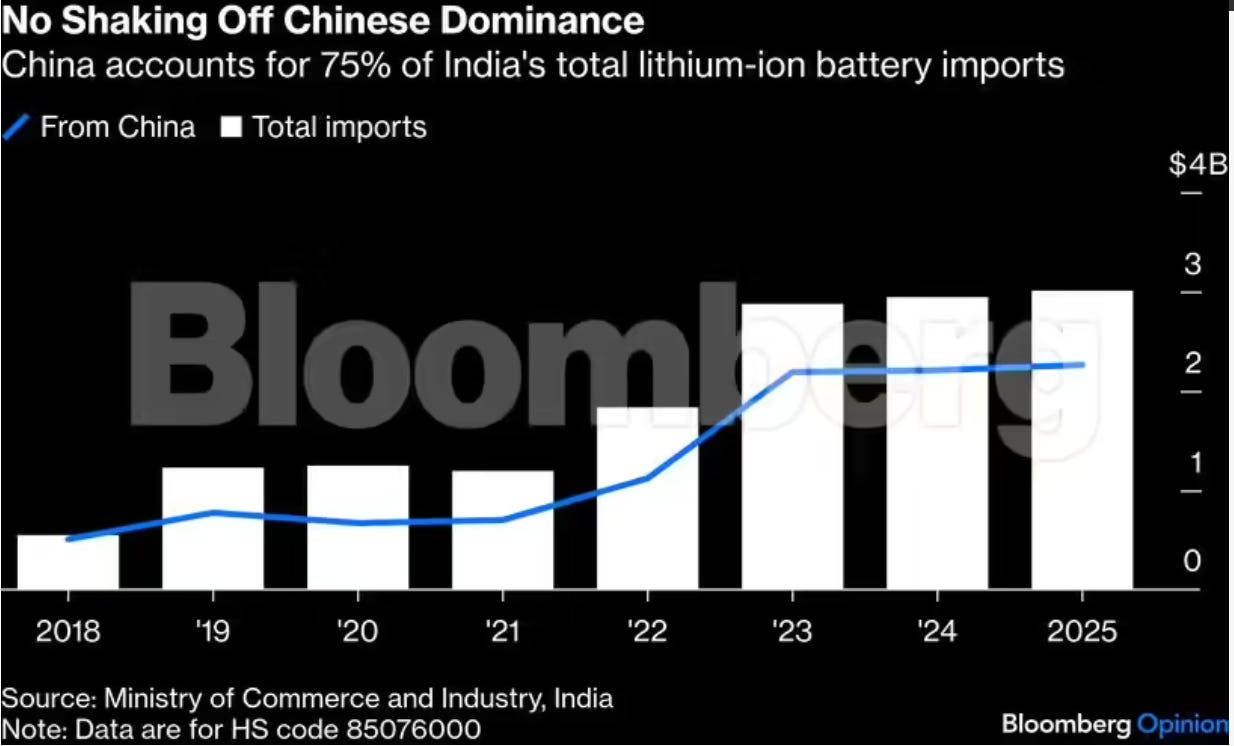
In 2025, India brought in 18,200 tonnes of cleaned lithium worth 1.2 billion dollars.
Most of it, 68%, came from China. Every bit of lithium India uses gets shipped out, cleaned in someone else’s factory, and shipped back.
Think about what that means.
India is building electric scooters, solar batteries, defense gear. Every one of them runs on lithium that passed through a foreign factory first. If that supply ever gets cut, India has no backup.
None….
That’s not a small problem. It’s a hole in the country’s energy independence, and it’s been sitting in plain sight while everyone talked about the rock.
A couple of Indian companies have started building refineries in the last year, so the space isn’t totally empty anymore.
But it’s close. India’s need for its own cleaned, battery-ready lithium by 2030 is somewhere between 12 and 15 billion dollars. What India makes today is almost nothing.
That’s the gap. Not the digging. The cleaning.
How a fintech founder got into this industry
Gaurav Kaushik is a mechanical engineer.
Before this, he built and ran a fintech company called Pay4You. It put banking into rural India, in villages where the nearest bank was ten kilometres away. It worked. It still runs today, doing over 4 crore in transactions every month.
And he walked away from it.
Someone else runs it now. When I asked him why he’d leave a working business behind, his answer was simple.
“The impact felt too small. Deep tech is what pulls at him, and this lithium problem felt like something India needed, not just a nice opportunity.”
There’s one detail he almost let slip after our call, once the serious questions were done. He grew up in a small village.
“The first fridge his family ever owned was made by a foreign company, not an Indian one. He said it like small talk. But it’s really the whole reason he’s doing this. He wants to build something Indian that the rest of the world depends on.”
Why can no nation break the monopoly of China in this market?
Two reasons a 12-billion-dollar gap is still sitting empty.
Cleaning lithium is a money-losing trap, on purpose.
China didn’t just build factories. It built so many that it flooded the world with cheap, clean lithium and crushed the price.
Prices have fallen more than 80%.
So when a rich country like Australia does the math, the answer is don’t bother.
Huge cost to start, nasty waste, slow permits, and then you’re selling into a market where China can drop the price below your cost any time it wants and wipe you out.
So Australia just digs up its rock and ships it to China to clean. The dirty, low-profit step turned out to be the throne, and the West handed it over without a fight.
The old way of cleaning is filthy and costly.
The traditional method dumps in mountains of harsh chemicals and spits out piles of toxic waste while using huge amounts of water.
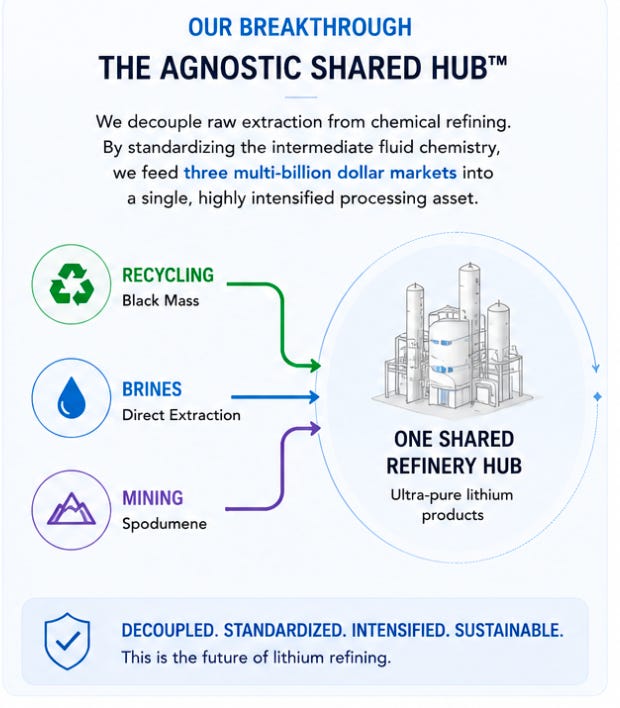
And because rock, salty water, and dead-battery scrap are all so different, you normally need a separate factory for each one. Three factories, three times the cost. The few who try it stay too dirty and too expensive to matter.
What Daratha is actually building
Why hasn’t someone already done this?
Lithium refining is one of the most technically challenging separation processes in the critical minerals industry.
One factory for any source.
Dirty lithium shows up in three forms: hard rock, salty water, and the black gunk left over from recycling dead batteries. Daratha’s plan is to do a little prep on each one so they all come out looking like the same liquid.
Once they match, one factory can finish all three. Build it once, feed it anything. One times the cost instead of three.
Electricity instead of chemicals. Instead of dumping in harsh chemicals, the final cleaning uses special filters and an electric current to pull the lithium out. Way less toxic waste. Over 90% of the water gets reused. Zero of the nasty leftover salt.
A real shot at a low price. Lower startup cost, plus reusing the heat the process already makes, means a price that could survive even when China leans on the market. That’s the whole bet. Not bigger than China. Cheaper and cleaner, at small scale, made in India.
Their long-term vision: India’s first feedstock-agnostic refining platform, processing hard-rock lithium, brines, and battery black mass through one shared system.
The team
Gaurav Kaushik, Founder and CEO. Mechanical engineer. Former CEO of Pay4You, the rural fintech he built and left, still running at 4 crore in monthly transactions. Started Daratha in April 2026.
That’s the team. One person. He’s in talks with CSIR for the filter tech and with IITs for lab access to build the first test version. No co-founders, no chemists, no operations people yet. I’m telling you exactly what’s there, because at this stage that honesty is the whole point.
My take
The timing is rare. Lithium was on India’s restricted list until 2023. The legal door to private refining is barely a year old, backed by a 1.88 billion dollar critical mineral budget. This market is young by law, not by luck.
His honesty is a feature. He isn’t claiming he’ll beat China. He’s building a backup so India isn’t stuck if it gets cut off. He told me his own ceiling before I had to dig for it.
The risk is just as real. His exact way of chaining all four steps is unproven and unbuilt. A solo founder, one month in, against a problem twenty-year-old global firms still wrestle with. Back this today and you’re backing an idea and a person, not a product.
What makes it worth your time is the size of the hole. A country handed a treasure it can’t use, a gap worth billions, and almost nobody building toward it. Whether Gaurav fills it, I don’t know. That the gap is real, I’m sure of.
Most weeks I’d point you toward a funding conversation. Not this one. Daratha is too early for that, and Gaurav would be the first to tell you so.
What he actually needs right now isn’t a check. It’s a lab and a shot.
So here’s my ask. A lot of you have deep networks. Some of you have ties to chemistry labs, research institutes, universities, or battery and EV companies running pilot projects.
If you know a lab that could give him bench space, or a company that could hand him a small pilot to prove his process, that single intro is worth more to him today than money he can’t use yet.
GVP has 600+ investor subscribers — including partners at Accel, principals at family offices in Singapore and Dubai, and angels across the US, Australia, and Europe.
If you forward this newsletter to 3 investors who subscribe, we'll make a warm intro for you to any family office or VC in our network you'd like to meet.
See you next week
If you want me to make a warm intro with this startup founder, feel free to reply to this email!
Email: jaylee@globalventureplay.com