

Quick Summary
Sector: PropTech / InteriorTech / AI Design
Stage: Early Revenue | Rapid Growth
Traction: ₹2.45Cr revenue | 300+ designers | 3x YoY growth
Product: Browser-based 3D AI + AR/VR Interior Design Platform
Business Model: SaaS + Execution Margin (15%) + Paid BOQ Tools
Tech: Built on modified Unity engine (runs in browser, 4G friendly)
Backed by: Govt. of India Seed Fund (AIC-Sikkim Manipal) | Shriram Subramanian (MD, InGovern) | Mr. Chandrahas Panigrahi, Co-founder & CEO of Let’s Game Now and ex- founder of Edukemy.
Opportunity: $32B Indian interior design market, 80% unorganized, growing 12.5% CAGR
Welcome to Global Venture Play (GVP)
where we help investors discover undervalued Indian AI startups.
Every week, we feature one high-potential Indian startup, carefully vetted for traction, team strength, and scalability.
So far, we’ve featured 22 Indian AI startups, and 35% of them have secured investor meetings or funding opportunities.
Our subscribers include top venture firms like Accel, WTFund, and Ice VC, alongside 500+ investors across four continents.
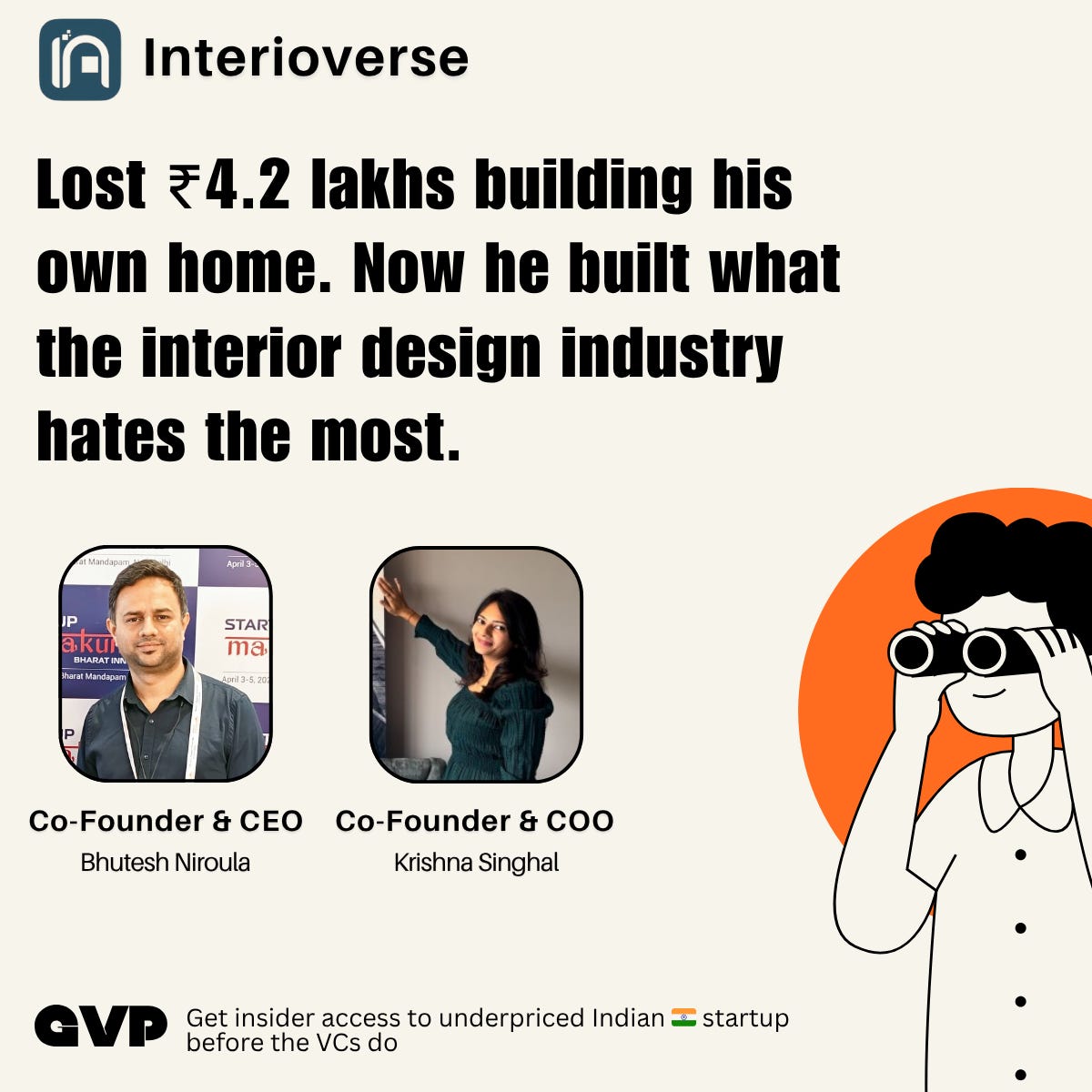
The Founder Who Lost ₹4.2 Lakhs Building His Own Home
Hey there!
In 2017, Bhutesh Niroula had just graduated with an MBA from one of India’s top business schools.
His father had passed away the year before. He was drowning in ₹15 lakhs of debt. His sister’s marriage was pending. And his family had no proper house.
So he took a personal loan and started building a home in his village in Sikkim, coordinating with workers over phone calls from his job in Delhi.
Six months later, he had lost ₹4.2 lakhs.
Materials ordered wrong. Work done poorly. Money vanished into thin air.
For someone who grew up in a remote village without electricity, where getting 50% marks was a celebration for the entire village, losing ₹4.2 lakhs felt like the end of the world.
He sat down and cried.
But then he realized something:
If this happened to him, an MBA graduate coordinating from Delhi, what happens to the millions of Indians building homes with zero guidance?
That question became Interioverse.
Today, Bhutesh is solving India’s $32 billion interior design problem
From Village Without Electricity to Solving India’s Interior Crisis
Bhutesh’s journey to this moment started in a remote village in Sikkim where there was no electricity during his childhood.
He studied in government schools until class 12. His family raised cows and goats. No one in his village even knew what IITs were.
Then a teacher from Bihar told him: “You’re talented. Go to IIT.”
Bhutesh said, “Sir, we’re a BPL family (below poverty line). We don’t have money.”
The teacher replied, “You don’t need money. Just pass the exam.”
That conversation changed everything.
Bhutesh moved to Delhi in 2008, the first person from his village to leave for education. He didn’t make it to IIT, but he got into NIT, a top engineering college.
After graduation, he worked as a customer care executive to support his family.
Then did his MBA. Then I took a job in infrastructure consulting.
But when he lost ₹4.2 lakhs building his family home, he knew he had to solve this problem.
He moved to Bangalore and joined an interior design startup as a co-founder. Over the next three years, he personally called over 6,000 customers and closed ₹12 crore in sales.
And every single call taught him the same lesson:
India’s interior industry is completely broken.
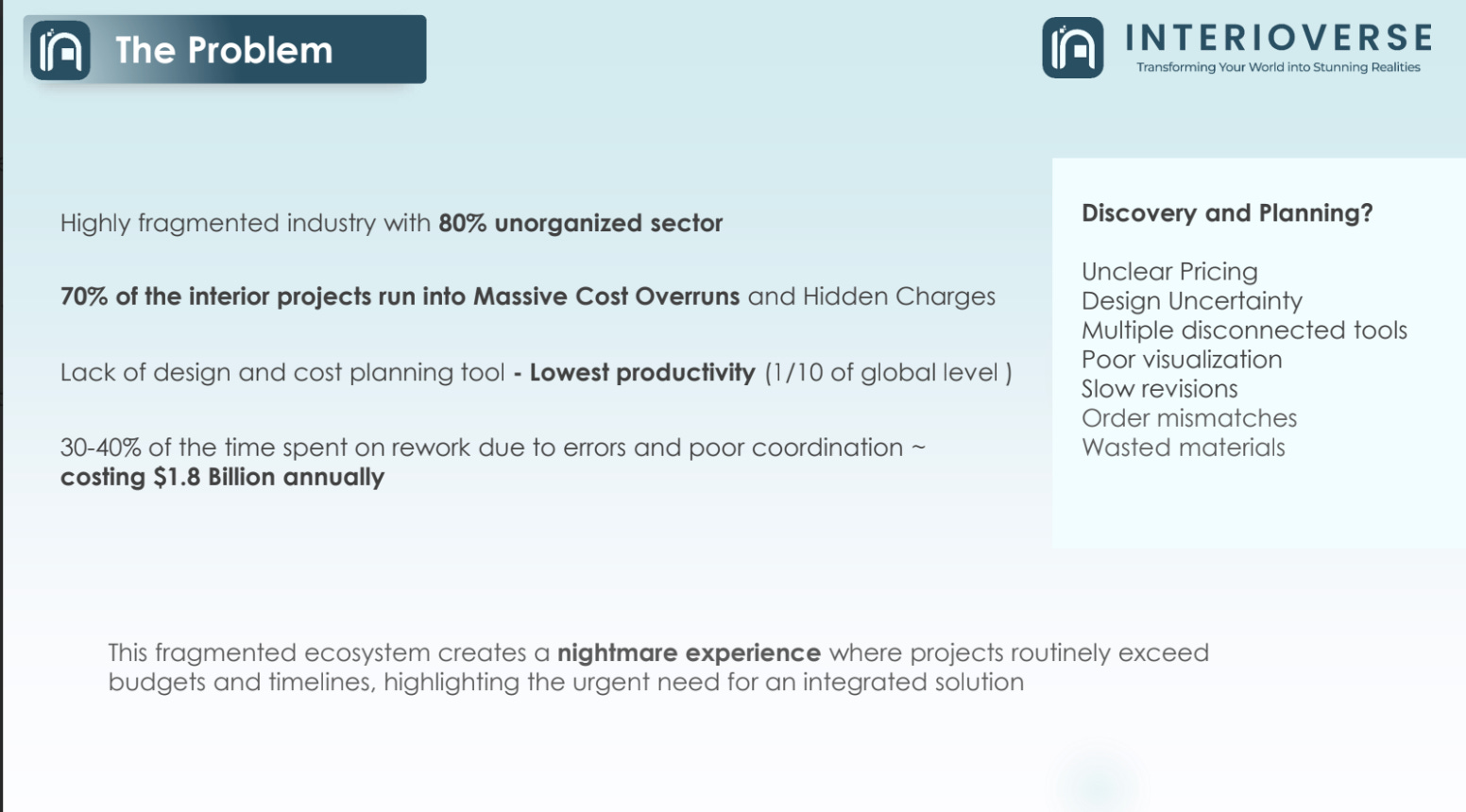
80% of the market is unorganized. There are no standardized tools for design planning, cost estimation, or execution. Everything runs on WhatsApp chats, Excel sheets, and gut instinct.
The result?
30-40% of project time is spent on rework due to errors and poor coordination — costing the industry $1.8 billion annually.
70% of projects run into massive cost overruns and hidden charges.
Design takes 30 days. Execution takes 45 days. And most of it is avoidable chaos.
This isn’t just an operational problem. It’s a ₹48,000 crore market operating at 1/10th of global productivity levels.
So today, I’m going to show you how Bhutesh is fixing this by turning interior design into a browser-based, AI-powered, real-time 3D experience.
Let’s dive in.
The nightmare of designing a home in India.
Most Indians think interior design is expensive because of materials or labor.
But the real cost? Chaos.
Here’s what a typical interior project looks like today:
Discovery Phase:
You browse through Pinterest, Instagram, and Google Images trying to imagine what your home could look like. But images don’t help you understand dimensions, feasibility, or cost.
Planning Phase:
You hire a designer. They sketch a few 2D layouts. You try to visualize it in your head. You nod along, but you’re not really sure what it’ll look like in real life.
Design Phase:
The designer creates a 3D render. But it takes 7-10 days. And when you finally see it, you realize you don’t like the wardrobe color. Or the bed placement. Or the lighting.
So you ask for changes. Another 7-10 days. Another round of back-and-forth.
Quotation Phase:
You finally approve the design. Now comes the quote. But it’s vague. “Approximately ₹6 lakhs.” No breakdown. No material costs. No alternate options.
You sign anyway because you’re exhausted.
Execution Phase:
The contractor starts work. Midway, they tell you the wood you chose isn’t available. Or the measurements were slightly off. Or there’s a “small” additional cost for electrical work.
Your ₹6 lakh project becomes ₹8.5 lakhs. Your 45-day timeline becomes 90 days.
And you have no recourse because everything was done on trust, WhatsApp messages, and verbal agreements.
This is the reality for 8 lakh Indian families every single year.
The problem isn’t that Indians don’t want good interiors. The problem is the tools don’t exist to plan, visualize, and execute interiors efficiently.
Until now.
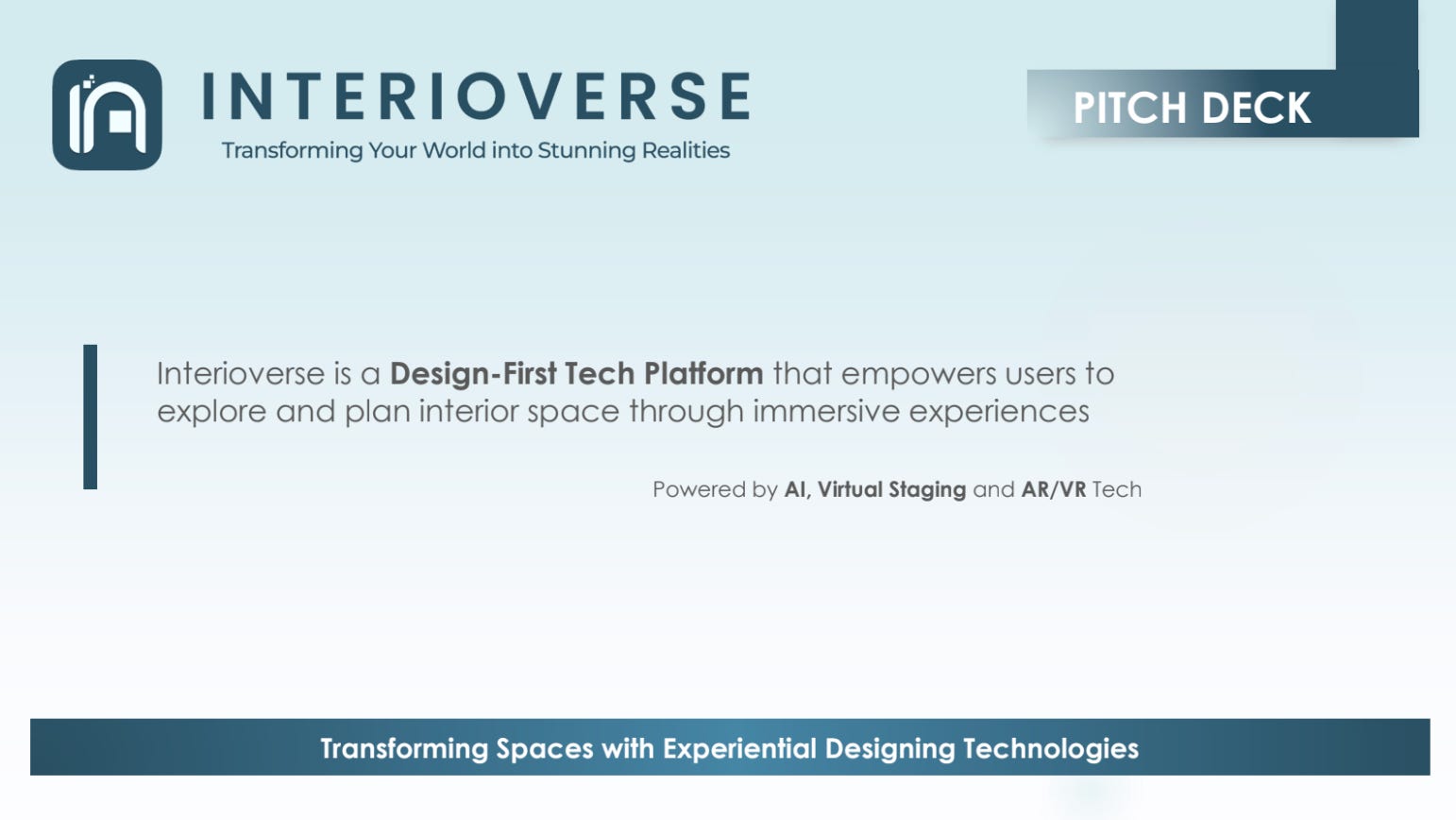
Interioverse: The AI-powered design discovery, planning and 3D designing platform for India’s interior chaos.
Interioverse is a web-based, AI-enabled platform that lets you explore, design, and execute your interior project – all in a real-time 3D environment.
No more waiting for renders. No more unclear pricing. No more budget overruns.
Here’s how it works 5 Simple steps:
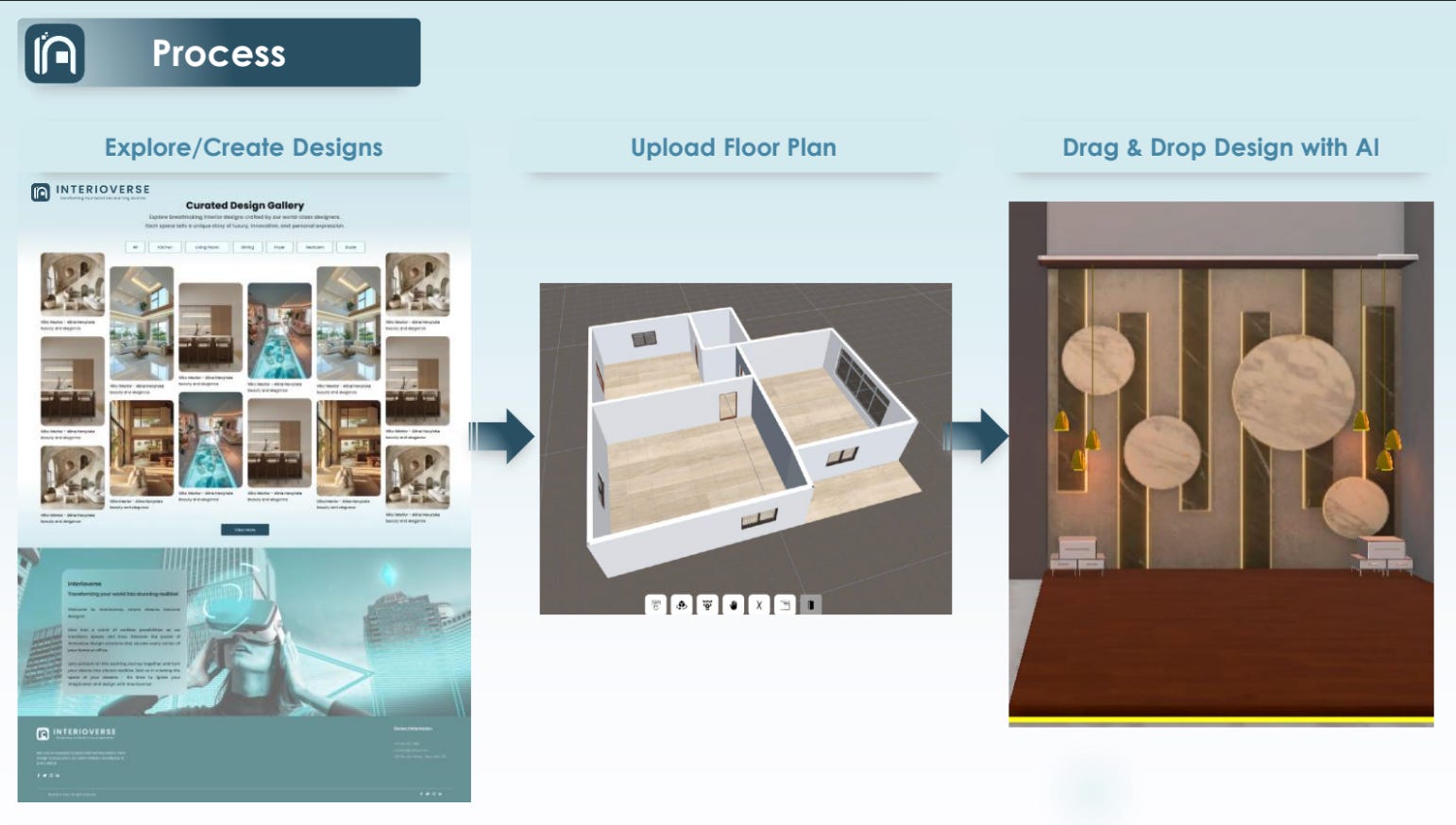
1. Upload Your Floor Plan
You start by uploading your home’s floor plan. Interioverse instantly converts it into a 3D walkable environment right inside your browser. No app download. No fancy hardware.
2. Explore & Design in Real-Time
Now comes the magic. You can drag-and-drop furniture, materials, lighting, and finishes into your 3D space.
Interioverse has a library of millions of 3D design ideas you can browse and customize.
And if you’re not sure where to start, their AI design assistant can generate layout suggestions based on your room dimensions and style preferences.
3. Get Instant Pricing
Here’s where Interioverse becomes a game-changer. The moment you finalize a design, the platform instantly generates a quotation with a complete Bill of Quantity (BoQ), material breakdown, and cutting layout.
No more “approximately ₹6 lakhs.”
You see exactly what you’re paying for. Down to the square foot of plywood and the meters of edging tape.
And if your budget is tight?
Interioverse suggests alternate materials that can save you ₹60,000–₹90,000 per project.
4. Collaborate in Real-Time
Interioverse isn’t just for homeowners. Designers, contractors, and real estate agents can all collaborate inside the same 3D environment with live avatar walkthroughs and immersive virtual meetings.
5. Execute with Transparency
Once the design is locked, Interioverse connects you with vetted execution partners, skilled contractors who work off the same 3D model and BoQ.
No miscommunication. No scope creep. No hidden charges.
The result?
Design time: 30 days → 2 hours
Execution time: 45 days → 21 days
Cost savings: ₹60,000–₹90,000 per project
The business model: A platform for India’s fragmented interior market.
Interioverse makes money in four ways:
1. Platform Partnerships/Commission
When a homeowner finalizes a design and chooses an execution partner through Interioverse, the platform takes a commission on the project value.
2. B2B Subscriptions
Interior designers and real estate agents pay a subscription fee to access Interioverse’s full suite of tools (3D libraries, AI design assistant, BoQ generation, and client collaboration features.)
3. Pay-Per-Use Advanced Features
Users can unlock premium features like advanced AI prompts, material optimization algorithms, and automated 2D drawing generation on a pay-per-use basis.
4. Brand Endorsements
Material brands (furniture, tiles, lighting, etc.) pay to feature their products inside Interioverse’s 3D library, giving them direct access to purchase-ready homeowners and designers.
The beauty of this model?
Interioverse doesn’t execute projects themselves. They’re a platform connecting homeowners, designers, and contractors – which means they can scale without carrying execution risk.
Their MOAT: India’s interior market is ripe for disruption.
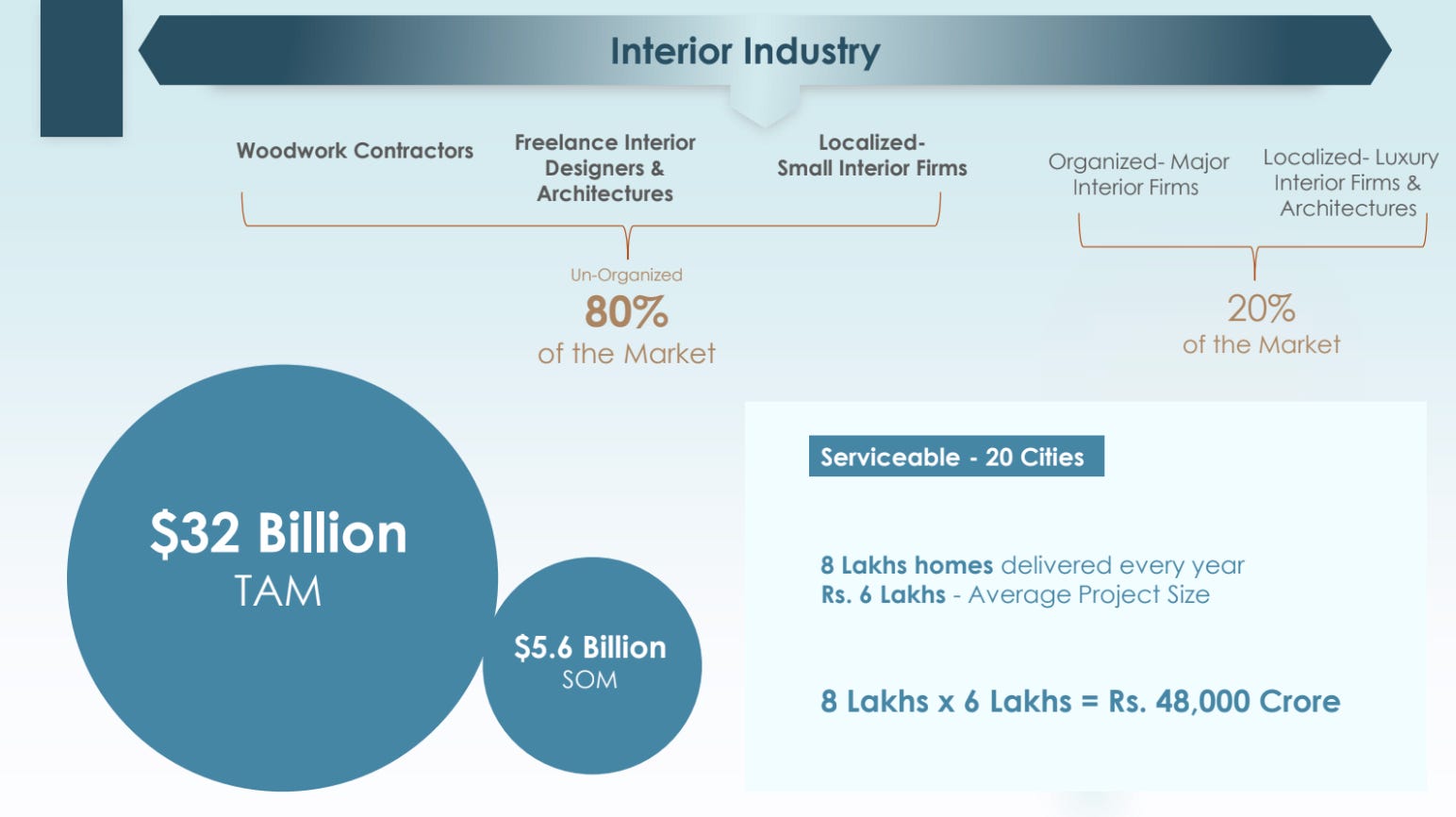
India’s interior design industry is a $32 billion market.
But 80% of it is unorganized.
It is run by local contractors, freelance designers, and small firms with zero tech infrastructure.
The organized players? Livspace, HomeLane, and a handful of others.
But they’re expensive, slow, and focused only on the top 20% of the market.
Interioverse is targeting the other 80%.
Here’s their wedge:
For Homeowners:
Interioverse gives them design autonomy. They can explore, customize, and finalize designs without paying upfront design fees or waiting weeks for renders.
For Interior Designers:
Interioverse makes them 10x faster. What used to take 30 days of back-and-forth now takes 2 hours. Designers can serve more clients, deliver better visualizations, and win more projects.
For Real Estate Agents:
Interioverse helps them close deals faster. Instead of showing buyers an empty flat and asking them to “imagine” the interiors, agents can walk them through a fully designed 3D model on the spot.
For Contractors:
Interioverse eliminates execution chaos. With a detailed BoQ, cutting layout, and 3D model, contractors know exactly what materials to order, how to cut them, and how to execute, reducing rework and material wastage.
And the numbers prove it’s working.
