

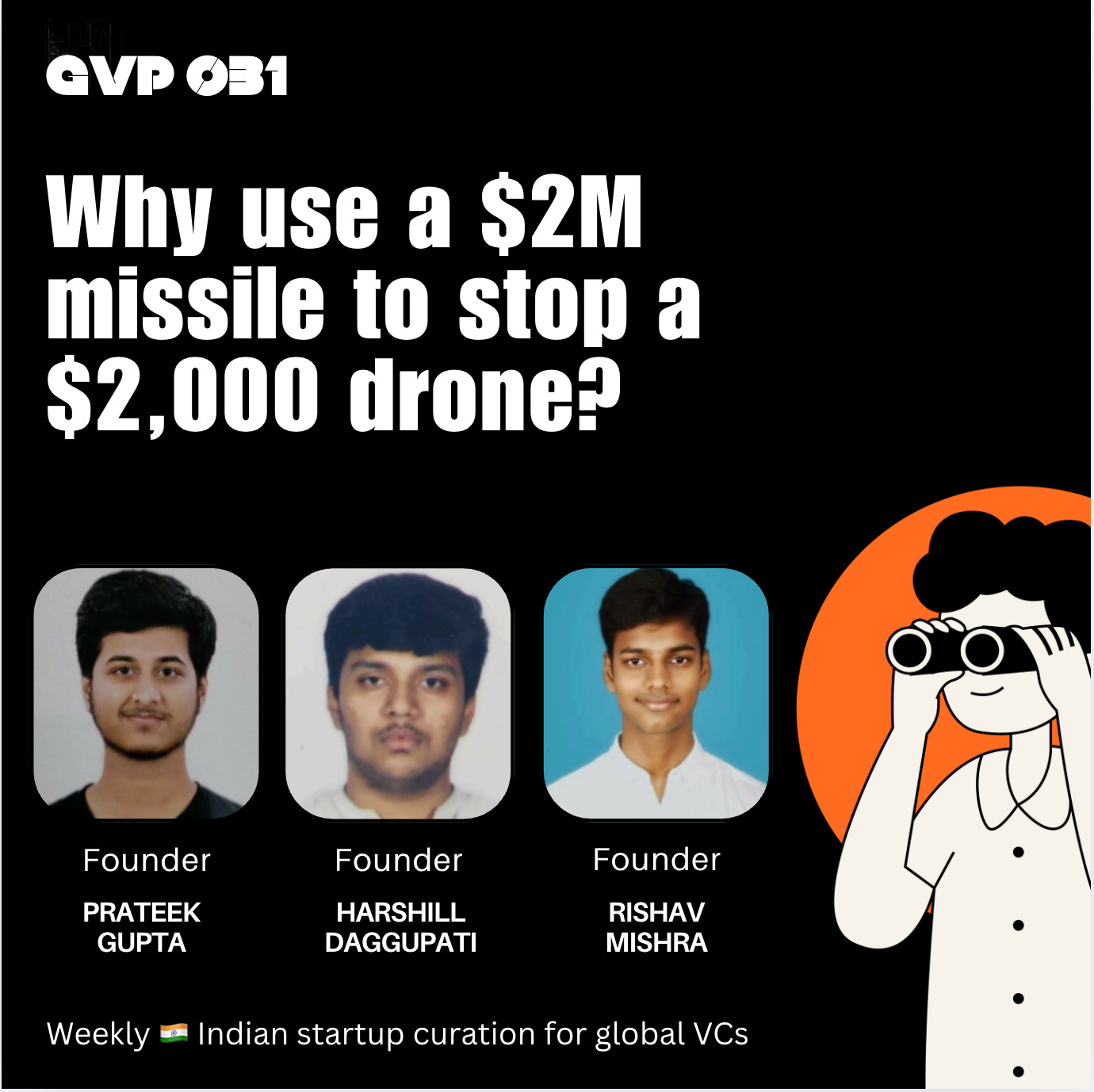
Quick Summary
Sector: Defense Robotics / Autonomous Counter-Drone
Stage: Pre-seed, targeting first military contracts Dec 2025
Product: Autonomous interceptor drones that cost ₹2 lakhs vs ₹3-5 crores missiles (98% cheaper)
Traction: Government demo May 2025, Military trials June 2025
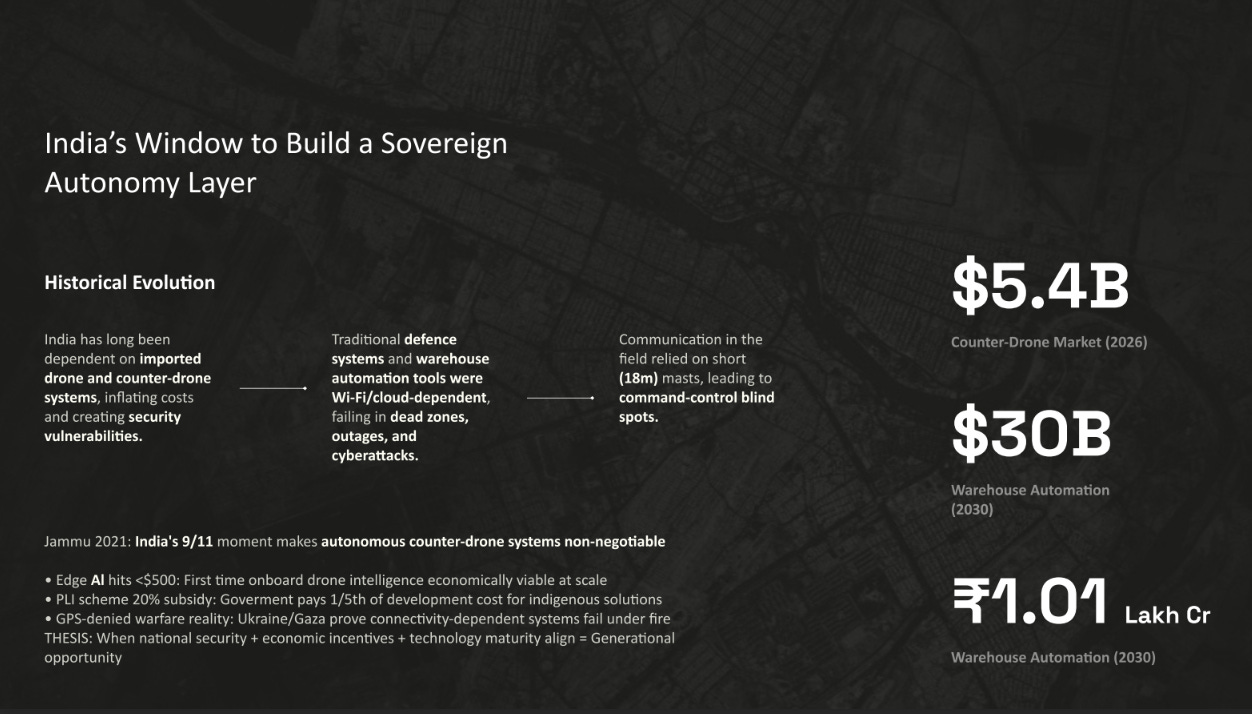
Market: $1.6B India counter-drone market
Team: Military veteran + Autonomy architect + Ex-Goldman strategist
Opportunity: Solving the $2M missile vs $2K drone economics problem
Jugaad Before Firepower
Building a defense technology company is supposed to be slow, expensive, and capital-intensive.
Defense primes burn lakhs and crores on R&D long before a product reaches the field. That cost structure is treated as unavoidable.
Kshatra Labs questioned that assumption.
Instead of building a large in-house research team, they asked a simpler question:
Where does India already have deep technical capability that defense startups rarely access?
The answer was hiding in plain sight.
India’s top engineering universities—IITs, BITS Pilani, NITs, VIT—produce advanced research in autonomy and robotics every year. Most of it never leaves academic papers.
Kshatra built its R&D inside this ecosystem.
PhD researchers work on real battlefield autonomy problems as part of their academic work. Students gain publications and deployment exposure.
Kshatra gains cutting-edge R&D at a fraction of traditional cost.
What usually costs crores now runs on tens of lakhs.
This isn’t cost-cutting.
It’s structural leverage—and in defense, leverage matters.
Why Defense Economics Decide Wars
Wars aren’t won by the most advanced weapons.
They’re won by the side that can afford to fight longer.
History repeats this lesson.
During World War II, Britain realized it cost far more to shoot down German bombers than it cost Germany to build them.
Britain needed radar, pilots, fuel, and coordination. Germany needed to manufacture once and send.
Germany didn’t need better technology.
They only needed to make defense too expensive to sustain.
Decades later, the same pattern reappeared.
In Iraq and Afghanistan, IEDs costing hundreds destroyed vehicles worth millions and forced massive defensive spending.
Attackers paid little.
Defenders paid endlessly.
The imbalance always favored the cheaper weapon.
The Pattern Today
The cheapest weapons now fly.
Small drones costing a few thousand dollars are used to attack:
Military bases
Airfields
Power plants
Civilian infrastructure
To stop them, defenders fire missiles costing crores.
Drones don’t arrive alone.
They arrive in groups and swarms.
Even when defense works, the defender loses economically every time—and no country can sustain that.
The Gap Kshatra Labs Is Building For
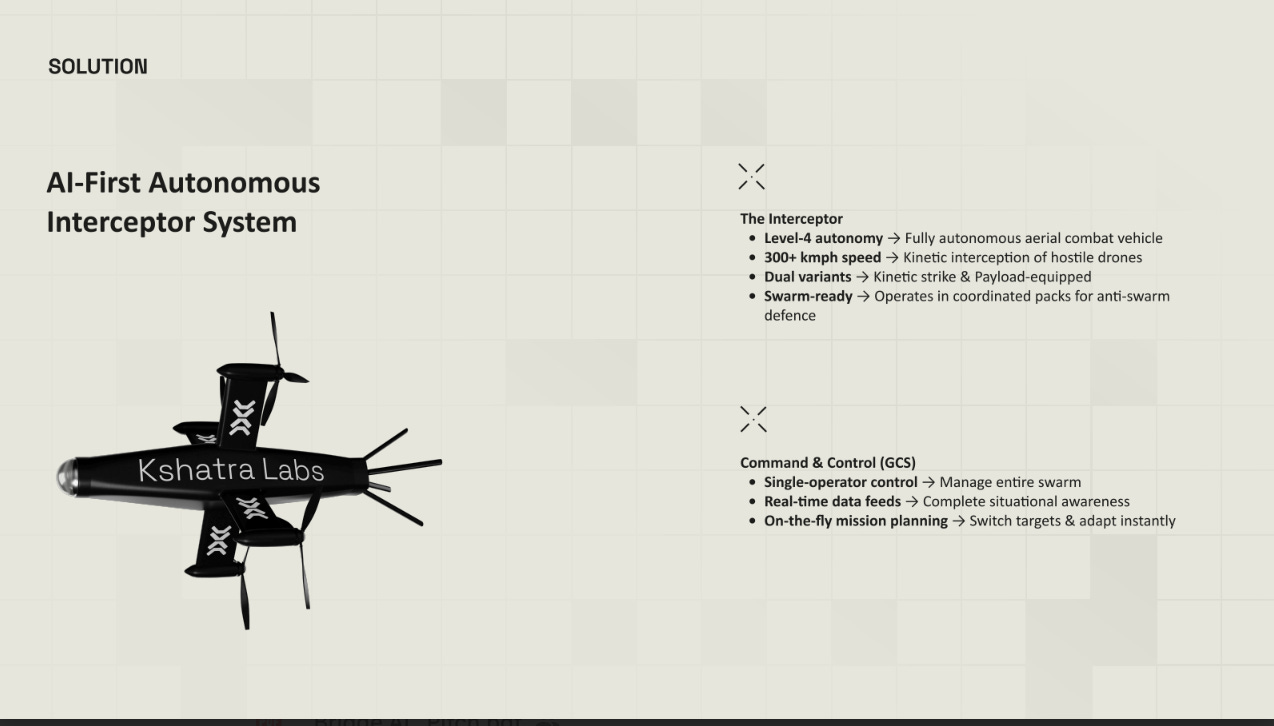
Kshatra Labs is building autonomous interceptor drones to stop drones without burning missiles.
Their system:
Launches within seconds
Autonomously intercepts hostile drones
Destroys them mid-air
Returns to base for reuse
The logic is simple:
If attackers use cheap, repeatable weapons, defense must be cheap, fast, and repeatable too.
Instead of relying on billion-dollar air defense systems, Kshatra adds a new defensive layer—fighting drones with drones.
This shifts air-defense economics.
Why This Works Now
GVP pro zone: To see more, subscribe to our pro plan!
Three changes made this possible.
